Ancient art of the Americas
We buy pre-Columbian art.
Ceramics, stone, shell and metalwork made in Mexico, Central America and the Andes before European contact. One piece or a whole collection: send us photographs and what you know, and you hear back within two working days.
Tell us what you haveWhat we buy
Or write straight to info@precolumbian.com
Pieces from our own collection, each with a documented history. About the pieces
Collections kept whole
We would rather buy a collection whole than pick through it. If a few pieces are not for us, we tell you which, and why, before you decide anything.
An offer in writing
Every offer comes in writing with the reasoning behind it. You are free to compare it with any other.
No fee, no obligation
Looking costs you nothing, and neither does saying no. Nothing moves until you have agreed.
Read by a person
Every message is read and answered by a person who knows this art. Your photographs and details stay with us.
From our collection
Pieces with a history
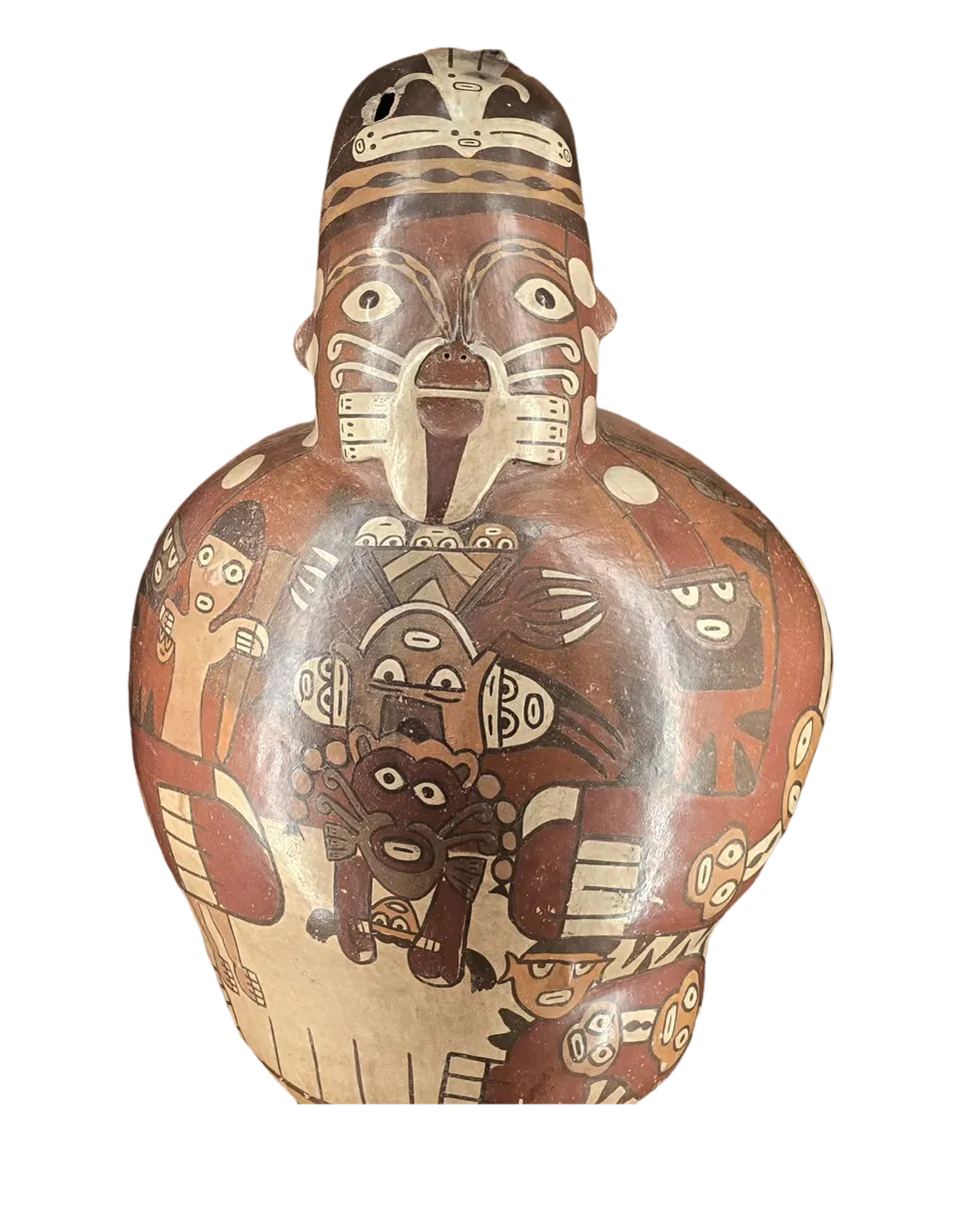
We buy because we collect. These pieces are from our own collection, and each has a documented history: an earlier collection, an earlier sale, a museum exhibition, a publication or a laboratory test. That is the standard we look for, and this site does not offer them.
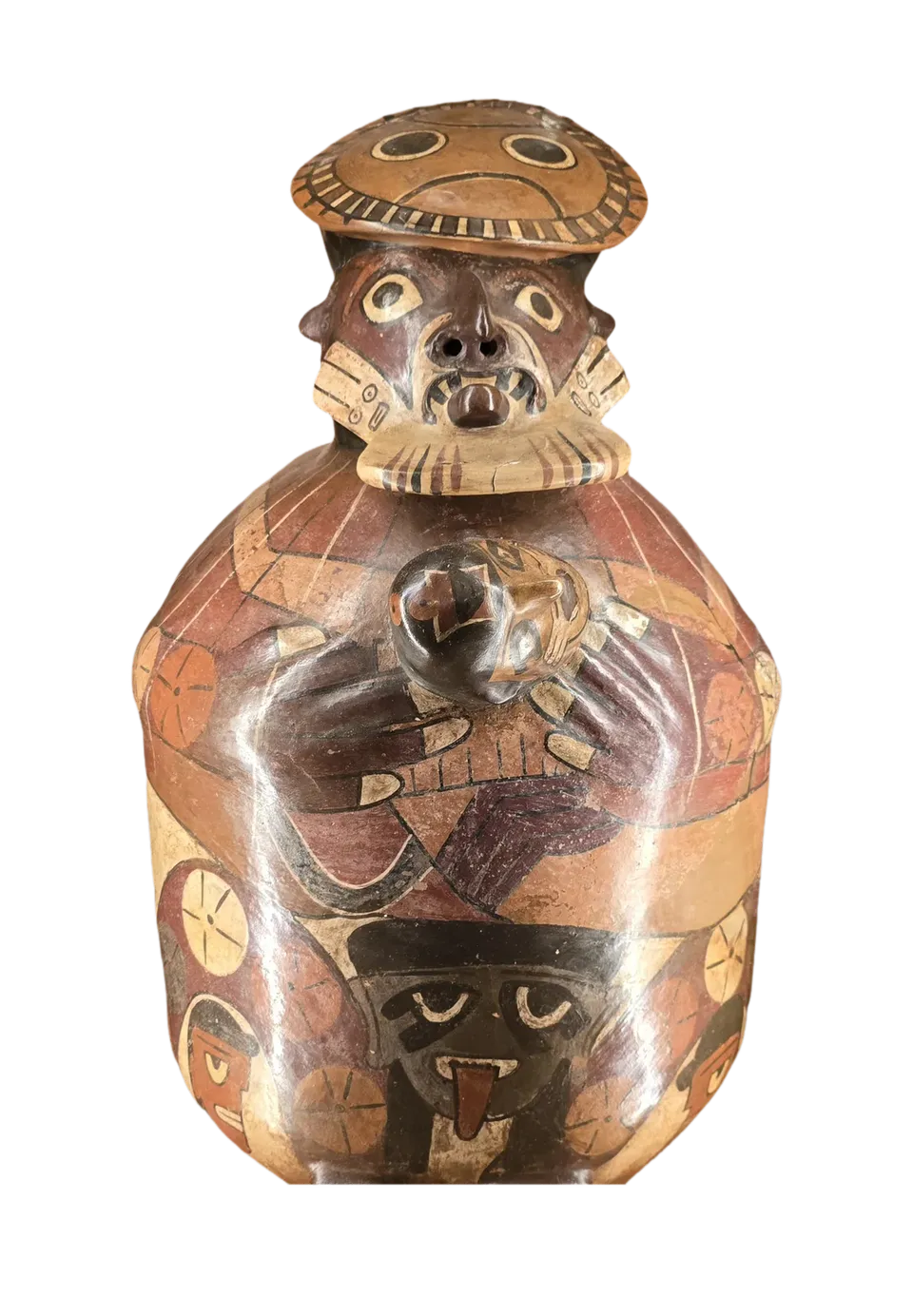
Effigy jar: a mythical being holding a small figure and trophy heads. Nazca, Peru. The Jay C. Leff collection, Uniontown, Pennsylvania. Exhibited at the Brooklyn Museum, 1966-67 (catalogue no. 553). Offered by Sotheby Parke Bernet, New York, 1975.
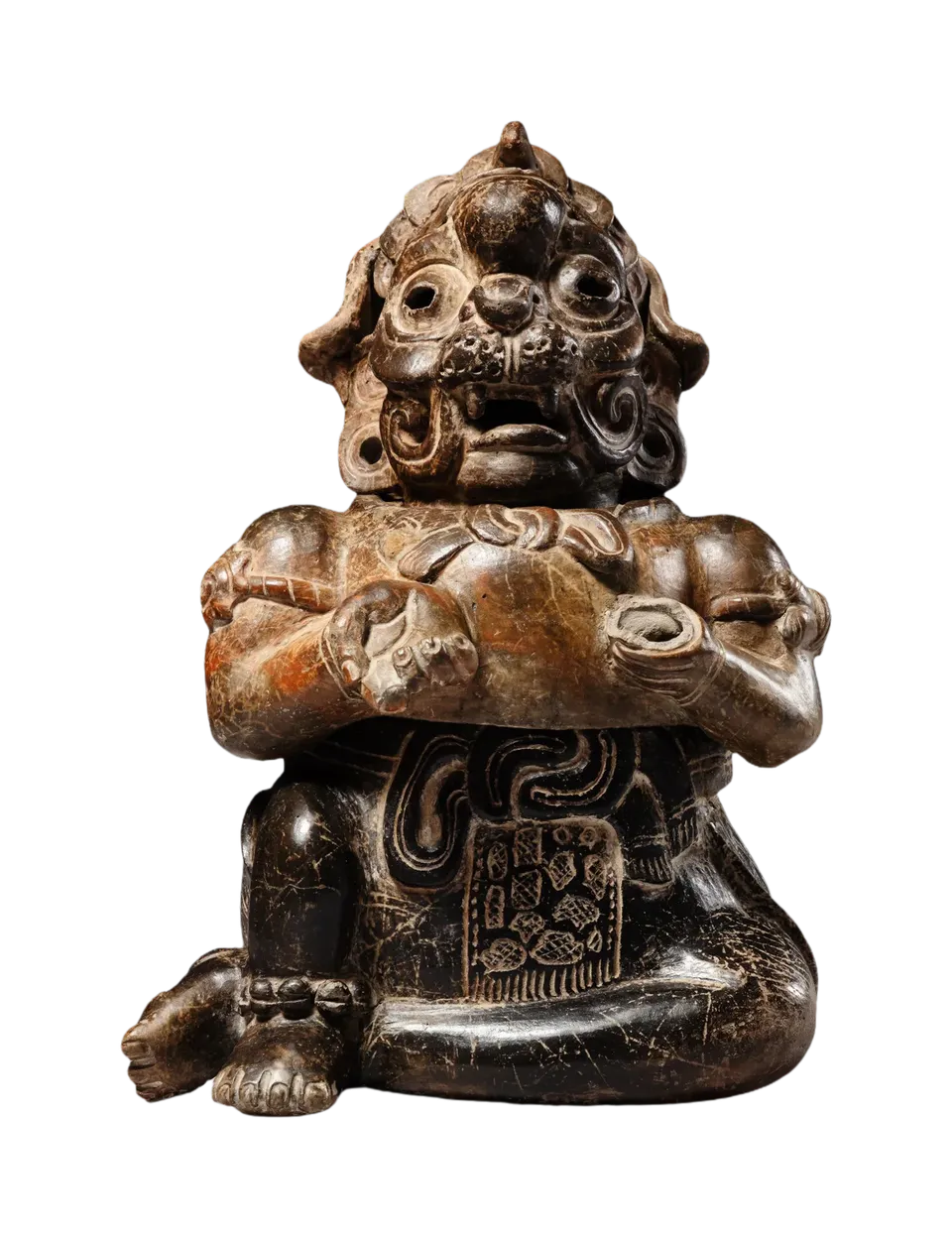
Three-part effigy vessel: a seated figure with folded arms and a glyph panel on the lap. Maya, Early Classic. From the Deletaille collection, Brussels. Exhibited at the Société Générale de Banque, Brussels, 1976-77 (no. 173), and in 'Trésors du Nouveau Monde', Musées royaux d'Art et d'Histoire, Brussels, 1992 (fig. 172). Published in 'Rediscovered Masterpieces of Mesoamerica' (1985), by Nicholas Hellmuth in 'Maya Cylindrical Tripods' (1985) and by Karl Taube in the Bulletin of the Detroit Institute of Arts (1991).
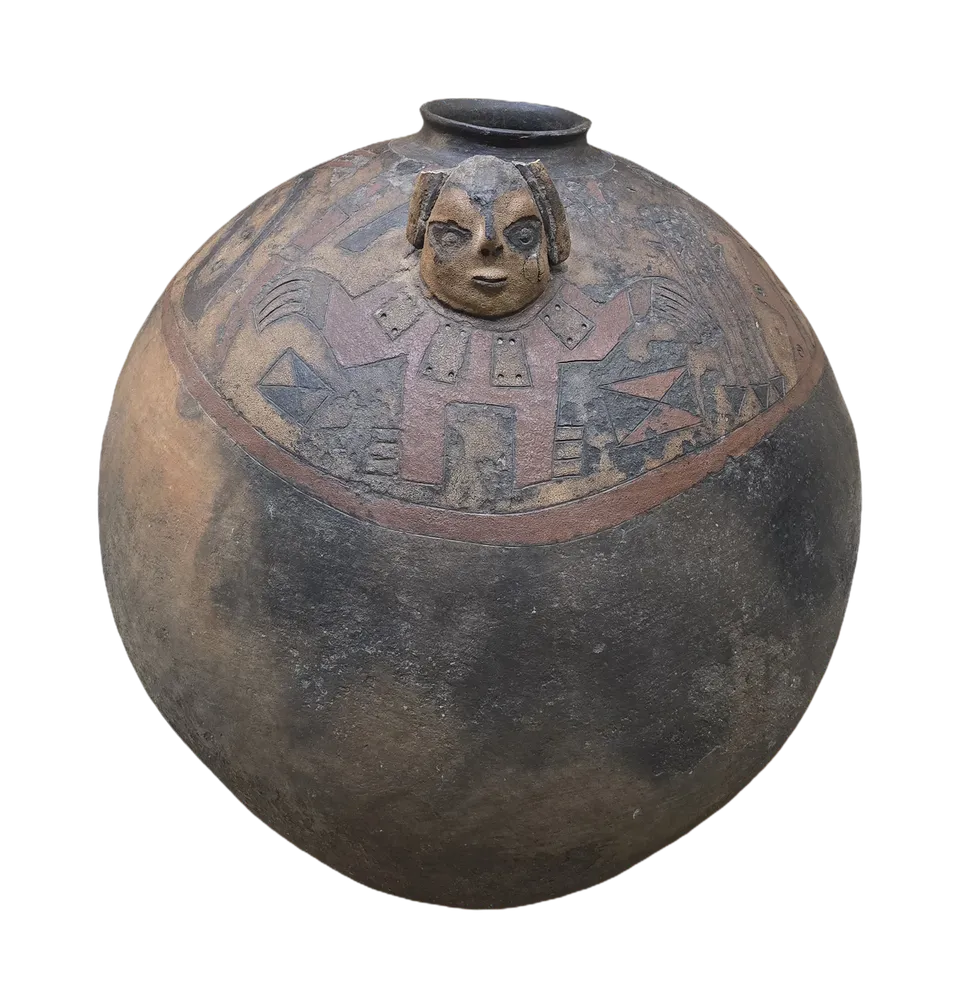
Large globular funerary jar with a figure in relief. Paracas, Peru. From the Estate of Benjamin B. Johnson. Offered at Sotheby's, New York, 18 November 1991 (sale 6239, lot 8), and at Loudmer, Hôtel Drouot, Paris, 18 March 1995 (lot 20, plate 2).
What we buy
Everything we buyCeramics
Painted and modelled pottery, from vessels and figurines to whistles and effigies: the polychrome vases of the Maya, the portrait vessels of the Moche, the dogs of Colima.
Stone and jade
Carved jade, greenstone and other hard stone: masks, pectorals, axe-heads and figures, and larger sculpture and ceremonial grinding tables.
Gold and metalwork
Cast and hammered gold, tumbaga and copper: pendants, ear and lip ornaments, plaques and necklaces from Colombia, Panama, Costa Rica, Peru and Mexico.
Shell
Worked and carved shell, above all Spondylus: ornaments, pendants, inlaid pieces, necklaces and trumpets.
Guides to pre-Columbian art
All the guidesWhat a piece is worth, how its age and maker are judged, who made it and how it is sold: plain answers from the people who buy it.
How much is pre-Columbian pottery worth?
The six things that decide what a piece is worth, and what to send to find out.
How to tell if pre-Columbian pottery is real
The evidence experts compare, the common copies and what a clay-age test actually establishes.
How to sell pre-Columbian art: choosing a route
Compare the selling routes, prepare a useful enquiry and understand what an offer actually promises.
What is provenance in art? How to trace a piece's history
What an object's documented history can tell you, and how to follow the evidence.
Colima dog meaning: pottery, history and tomb offerings
Why dogs appear in West Mexican tombs, and what their shapes and surfaces can tell you.
Pre-Columbian art timeline: cultures, dates and regions
An approximate chronology that keeps overlapping cultures and different regional period names distinct.
Who writes to us
Whatever your reason for selling
Collectors
You have built a collection over years and are ready to place it. We buy single pieces and whole collections, and we look at each one as it is.
Families and estates
You have inherited pieces and are not sure what they are. Send what you have and what you know; there is no pressure to sell.
Dealers and auction houses
You hold pieces that did not sell, or consignments you would rather place at once. We buy single pieces and lots.
How it works
Four steps, and the last one is yours
Write to us
Tell us what you have and attach photographs; phone photographs are fine. Use our message builder, or simply email info@precolumbian.com.
We study it
We identify each piece, judge its condition and look at what comparable pieces have actually sold for.
You hear back in writing
Within two working days, one of three answers: an offer with the reasoning behind it, what we still need to make one (more photographs, say), or a plain statement of what we cannot take and why. A large collection may need the second first; the reply then says when to expect the offer.
You decide
Take your time; the offer says how long it stands. To accept an offer, reply and say yes in writing: we pay by bank transfer the same day, before anything ships, and we take care of the shipping. If you say no, you owe nothing.
What do you buy?
Single pieces and whole collections of pre-Columbian art made in Mexico, Central America, the Caribbean and South America before European contact: ceramics, stone and jade, gold and other metalwork, and shell. Whether you call it Mayan pottery, Aztec figurines, Inca artifacts or antiquities from a trip, it counts. If your piece is not on that list, write anyway and we will tell you plainly whether we can take it.
Does it cost anything to ask?
No. There is no fee to ask, none for an offer and none if you say no.
I am not sure my piece is genuine. Can I still ask?
Yes. Many of the pieces people write to us about are uncertain to their owners. We tell you what we see, and if it is not something we can buy we say so plainly.
I have inherited a collection and know nothing about it. Where do I start?
Photograph the pieces, write down what you know even if it is very little (who collected them, roughly when, where they were bought) and send it to us. We tell you what you have. There is no pressure to sell.
Have something to sell?
Send us photographs and whatever you know. You hear back within two working days.
Or write straight to info@precolumbian.com