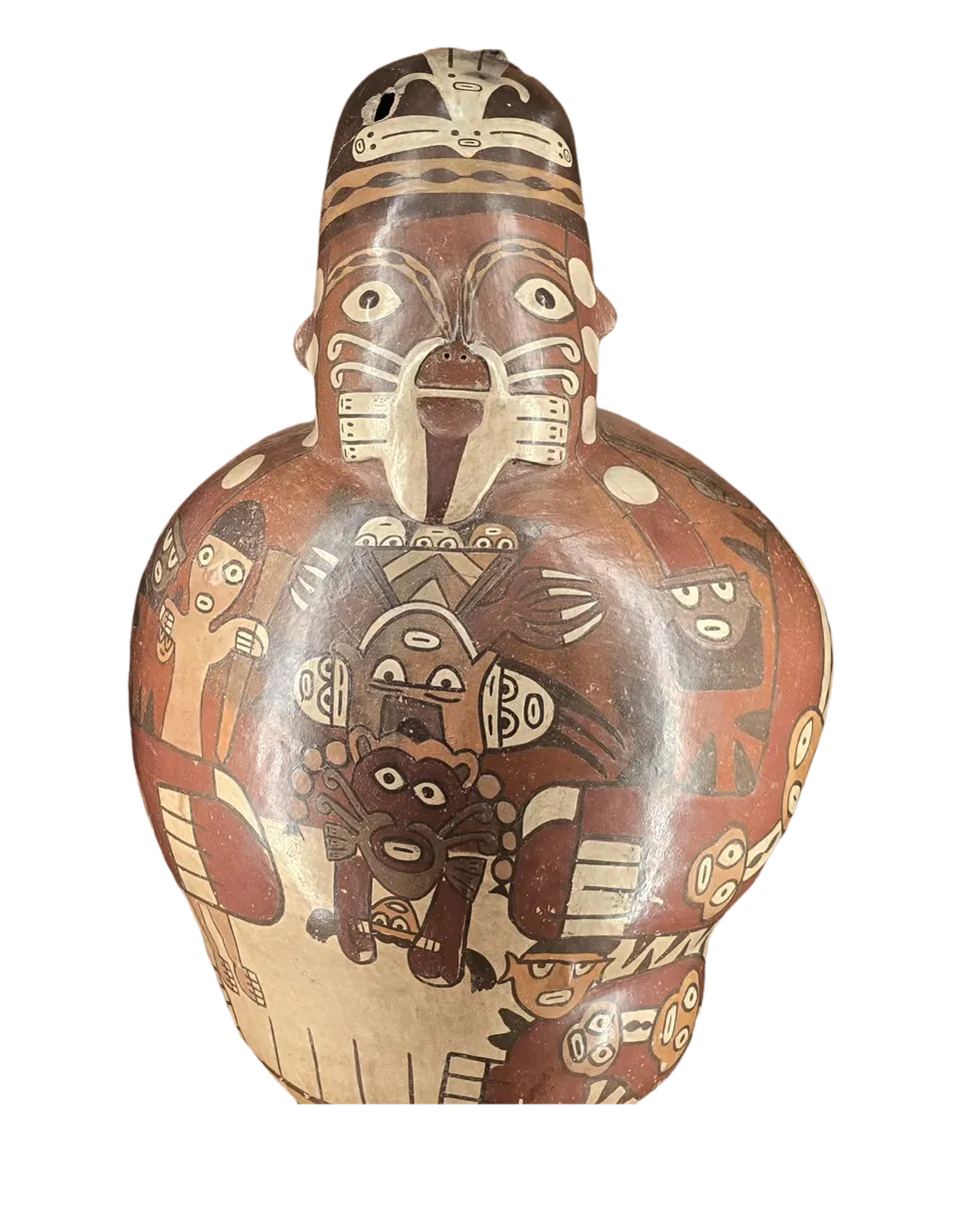
A picture guide
What is my piece?
A picture guide to the pieces that turn up most often in collections and in estates. Find the one that looks like yours, then send us a photograph.
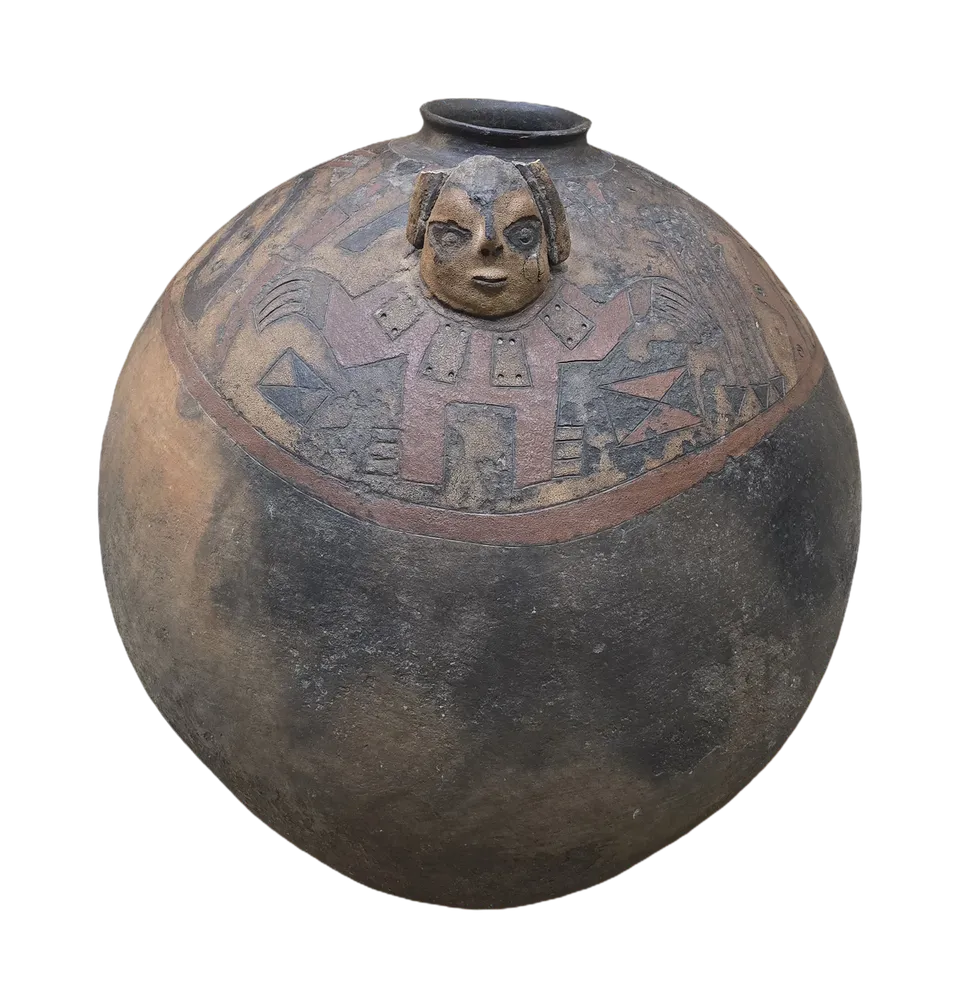
These are the usual shapes, so a piece of yours may differ in size, colour or detail and still be one of these. Where we hold a piece of the kind, with a documented history, it is pictured. If none looks right, write to us anyway.
Ceramics of West Mexico
Hollow, hand-modelled animals and figures from the shaft tombs: the Mexican ceramics that turn up most often in collections.
Colima dogs and animals
West Mexico · c. 100 BCE-300 CE
Plump, hollow animals, most often dogs, in glossy red-brown clay with a burnished surface.
Nayarit figures
West Mexico · c. 100 BCE-300 CE
Hollow figures of kneeling, seated or paired people, with painted faces and bodies and modelled jewellery.
Seated figures with headdresses
West Mexico
Hollow seated figures in red and cream slip, with a tall or horned headdress, a long nose and hands resting on the knees.
Standing figures
West Mexico
Tall hollow figures with folded arms and a banded headdress, in polished red-brown clay.
Ceramics of Peru
Painted and moulded vessels from the coasts of Peru.
Moche vessels
North coast of Peru · c. 100-800 CE
Red and cream clay vessels with a stirrup-shaped spout, or modelled as a lifelike head, an animal or a scene.
Chimu blackware
North coast of Peru · c. 900-1470 CE
Shiny black vessels, many with a single spout, often moulded as animals or figures or with raised decoration.
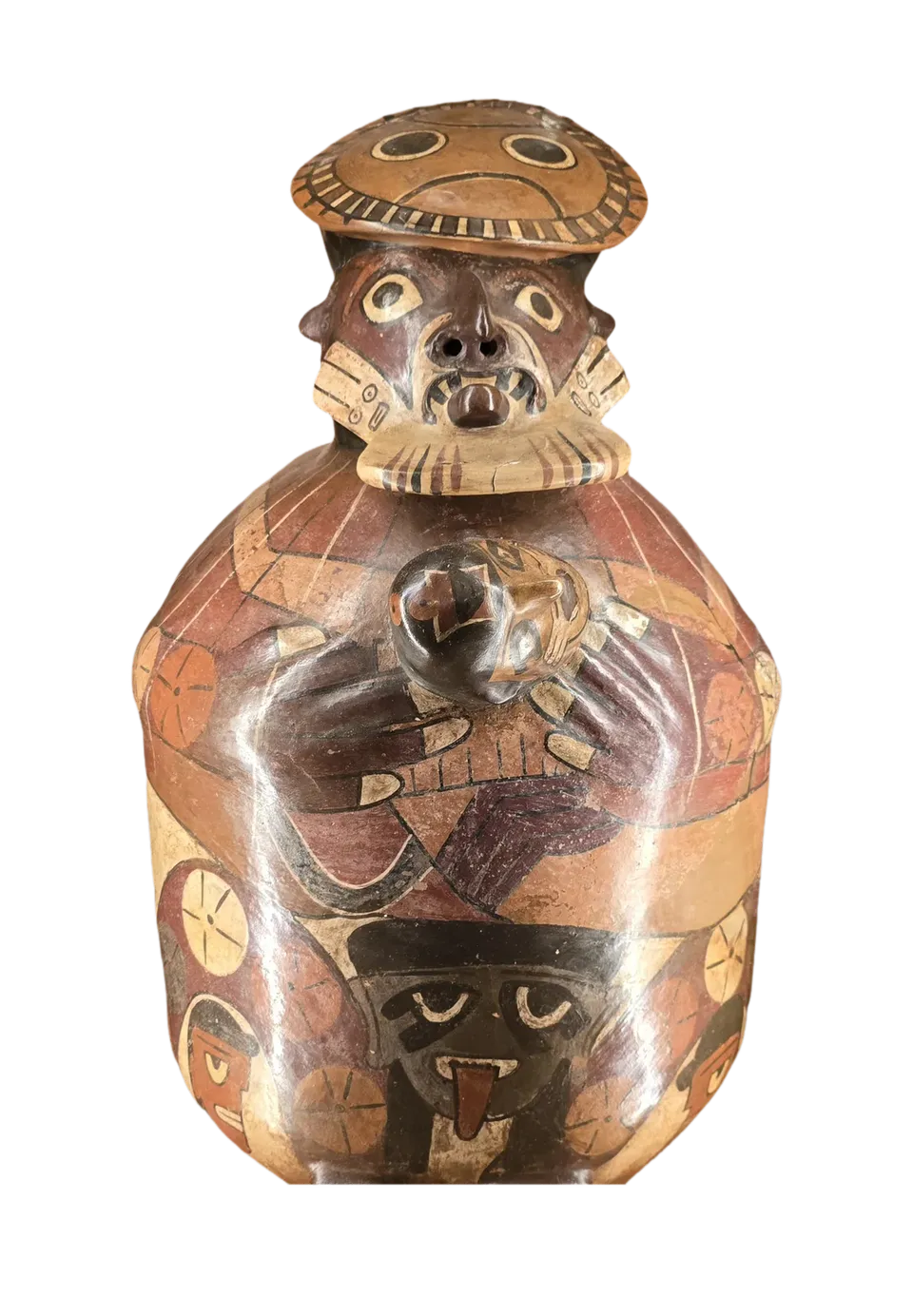
Anthropomorphic jar: a mythical being holding a warrior. Nazca, Peru. Nazca painted vessels
South coast of Peru · c. 100 BCE-800 CE
Round bottles and jars painted in several colours before firing, many with two spouts joined by a flat bridge or, as in the jar pictured, a modelled head at the top.
Nazca bowls and beakers
South coast of Peru · c. 100 BCE-800 CE
Wide bowls and tall cups painted in red, cream, black and white, with frontal figures and bands of ornament.
Maya and Central America
Modelled figures and painted jars from the Maya lowlands and Costa Rica.
Maya figures
Southern Mexico, Guatemala, Belize, Honduras and El Salvador · Classic period, c. 250-900 CE
Seated figures in brown clay wearing bead necklaces, wristlets and tall headdresses.
Nicoya polychrome
Guanacaste-Nicoya, Costa Rica
Cream jars on three feet, painted in red and black bands, with a modelled animal or figure at the shoulder.
Stone and jade
Carved from hard stone, from small polished blades to seated figures.
Seated stone figures
Mexico, in the Olmec style
Smooth, hard stone in grey-green, carved as heavy-browed seated figures with round faces and incised detail.
Standing stone figures
Mexico
Small upright figures carved in dark stone, shown with the arms close to the sides.
Polished celts
Mexico and Central America
Narrow blades of polished green stone, sometimes carved with a face at the top.
Metal, shell and textiles
Pieces that were worn or hung: hammered metal, shell with inlay, and woven cloth.
Silver and gold beakers
Peru
Tall beakers of hammered metal with a figure modelled in relief and a gilt base.
Shell with inlay
The Andes
Orange, ribbed shell mounted with a small inlaid figure.
Mosaic discs
The Andes
Round discs of shell and coloured inlay worked into a pattern around a figure.
Andean textiles
Coast and highlands of Peru
Woven and embroidered cloth in red, green, blue and white, with stepped patterns and animals, often kept framed.
Something else, or not sure?
Obsidian, wood and bone turn up in collections beside the ceramics, and so do pieces that fit none of these. Send photographs of those too, and we tell you plainly what each one is and whether we can take it.
Find the culture of a piece
Map of pre-Columbian civilizations: where the cultures lived
Three maps of the Americas: where the Olmec, Maya, Aztec, Nazca, Moche, Inca and others lived, and when.
Pre-Columbian art timeline: cultures, dates and regions
An approximate chronology that keeps overlapping cultures and different regional period names distinct.
How to tell if pre-Columbian pottery is real
The evidence experts compare, the common copies and what a clay-age test actually establishes.
Pre-Columbian art glossary: reading an object description
Plain definitions of the forms, techniques, periods and qualifications found in object descriptions.
Have something to sell?
Send us photographs and whatever you know. You hear back within two working days.
Or write straight to info@precolumbian.com