Guide: Reference
Pre-Columbian art timeline: cultures, dates and regions
A pre-Columbian art timeline follows the Indigenous arts of the Americas before the arrival of Columbus in 1492, with regional histories often carried into the early sixteenth century. It is an umbrella term, not one culture or a period that began everywhere at once. This selective chronology places familiar Mesoamerican and Andean traditions alongside one another; their dates overlap and scholars differ over the boundaries.
At a glance
- Pre-Columbian
- Before Columbus's first landfall, in the Bahamas in 1492. Regional histories often run into the early sixteenth century.
- Mesoamerican labels
- Preclassic or Formative, Classic and Postclassic. The Maya Classic is commonly placed at about 250 to 900 CE.
- Central Andean periods
- In a common outline: Early Horizon, roughly 900 to 200 BCE; Early Intermediate, 200 BCE to 600 CE; Middle Horizon, 600 to 1000 CE; Late Intermediate, 1000 to 1470 CE; Late Horizon, 1470 to 1532 CE.
- Read with care
- Schemes differ by region and scholar, and a date places a tradition without authenticating a piece.
Mesoamerica
- Olmecabout 1200 to 400 BCE
- Zapotec (Monte Albán)about 500 BCE to 800 CE
- West Mexican shaft tombsabout 300 BCE to 400 CE
- Teotihuacanabout 100 BCE to 800 CE
- Classic Mayaabout 250 to 900 CE
- Toltec (Tula)about 900 to 1150 CE
- Mixtec Postclassicabout 1200 to 1521 CE
- Aztec (Mexica)about 1325 to 1521 CE
The Andes
Colombia, Central America and the Caribbean
- Colombian metalworkingabout 500 BCE to 1550 CE
- Nicoya polychromeabout 800 to 1350 CE
- Taínoabout 1200 to 1500 CE
What does pre-Columbian mean?
Pre-Columbian means before Columbus, whose first American landfall was in the Bahamas in 1492. In art history the term groups many Indigenous traditions under a conventional heading. It does not mean that Indigenous peoples or their arts ended then. 'Ancient Americas' and 'pre-Hispanic' are other terms you will encounter, with their own contexts and limits.
There is no single pre-Columbian time period. The selected cultures below are only part of a much longer history. Nor does 'American' here mean only the present-day United States: Mexico, Central America, the Caribbean and South America all belong to the Americas. The dates identify broad traditions or major artistic phases, not the lifetime of every person or object associated with them.
The longer answer, with the three regions and the materials, is in what pre-Columbian art is.
Before the Common Era: early centres and regional traditions
Read these entries in order of their approximate beginnings, while remembering that one tradition could flourish alongside another. BCE means Before Common Era; its numbers count down toward CE. An entry beginning earlier need not end before the next one begins.
- Olmec, especially about 1200 to 400 BCE. The Gulf Coast of Mexico, notably present-day Veracruz and Tabasco, was a centre for colossal stone heads, jade and greenstone carving, and ceramics. Earlier beginnings are included in some chronologies. Olmec-style work also circulated beyond this heartland; style and findspot are different questions.
- Chavín, about 900 to 200 BCE in many outlines; newer radiocarbon dating places its main phases earlier, from about 1000 BCE or before to about 500 to 400 BCE. Centred on Chavín de Huántar in Peru's highlands, this influential tradition is known for carved stone and imagery combining human and animal features. Its influence extended beyond the ceremonial centre, without making every participating community part of a single uniform culture.
- Paracas, from about 700 BCE into the first centuries CE. On Peru's south coast, Paracas artists made embroidered textiles and distinctive ceramics, including vessels with colour added after firing. End dates differ with the treatment of transitional Paracas and Nasca traditions.
- Zapotec Monte Albán, founded about 500 BCE. This centre in Oaxaca, southern Mexico, developed over many centuries. Carved monuments, painted tombs and ceramic figures often called urns are prominent in its artistic record. The city's founding does not date every Zapotec object.
- Western Mexico shaft-tomb traditions, broadly about 300 BCE to 400 CE. Ceramics associated with Colima, Jalisco and Nayarit include people, animals and architectural models. Regional chronologies vary; the modern state names are not the names of a single ancient people.
- Teotihuacan, broadly about 100 BCE to 800 CE. In the Basin of Mexico, this great city produced monumental architecture, murals, stone sculpture and ceramics. The city was at its height about 400 CE; its central monuments burned about 550 CE and its population fell sharply after 600. All of this was earlier than the later Aztec empire, whose people encountered its already ancient monuments.
The first millennium CE: overlapping artistic centres
The word 'Classic' belongs to Mesoamerican chronology; it is not a universal date for art across the Americas. Maya, Moche and Nasca works can be broadly contemporary without belonging to the same historical system or sharing the same imagery.
- Nasca or Nazca, with roots in the last centuries BCE and a major flowering from about 1 to 700 CE, with some outlines running to about 750. Peru's south-coast artists are known for polychrome ceramics, textiles and geoglyphs. The transition from Paracas and the later interaction with Wari are reasons that short timelines give different endpoints.
- Moche, roughly 100 to 800 CE. Communities on Peru's north coast made sculptural ceramics, including portrait vessels, fine-line painted scenes and accomplished metalwork. Different valleys have different sequences, so the range is an orientation rather than a precise start and finish for all Moche production.
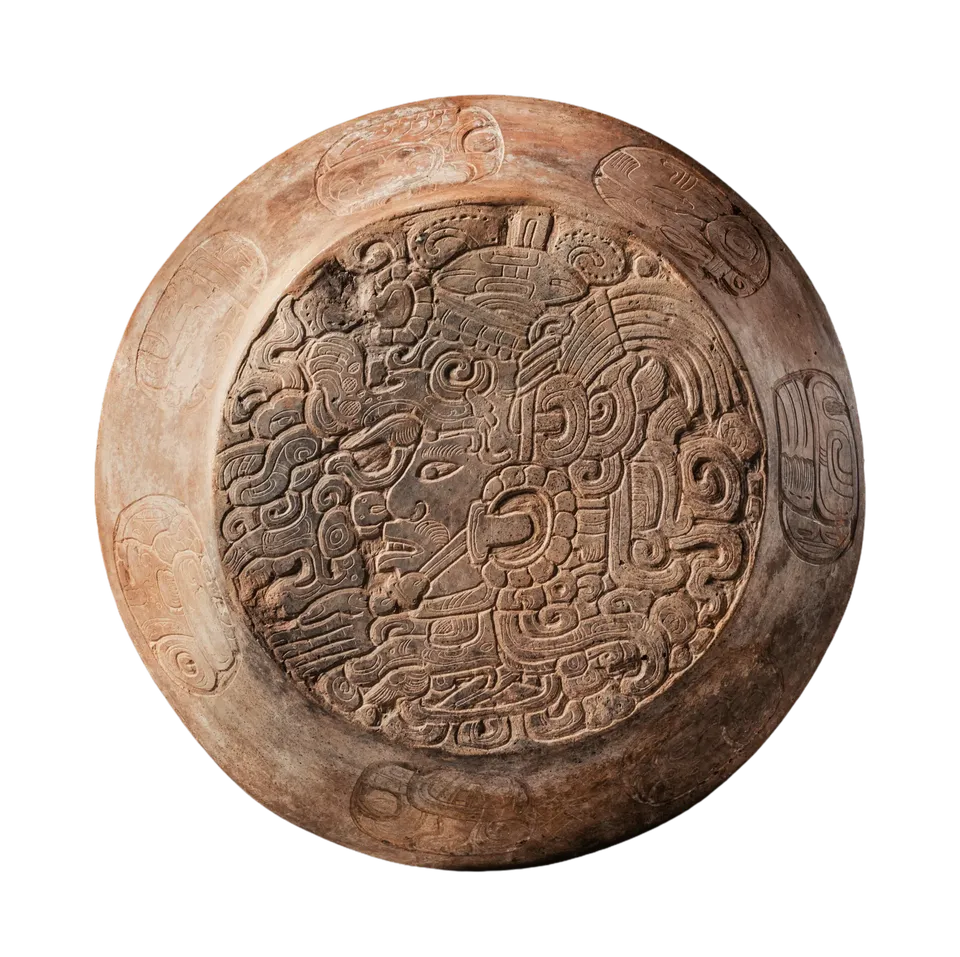
- Classic Maya, approximately 250 to 900 CE. In southern Mexico and neighbouring parts of Central America, artists made carved monuments, painted vessels and elaborate buildings. This is a period of Maya history, not the whole span of Maya culture, which began earlier and continues in living communities.
- Wari and Tiwanaku, especially about 600 to 1000 CE. Wari was centred in Peru's Ayacucho region; Tiwanaku was centred near Lake Titicaca in present-day Bolivia. They were distinct societies with related imagery, not two spellings of one culture. Wari tapestry tunics and painted vessels contrast with Tiwanaku's celebrated carved stone architecture and sculpture.
- Sicán or Lambayeque, roughly 750 to 1375 CE. This north-coast Peruvian tradition extends into the following centuries. Metal beakers, masks and ceremonial knives are especially recognisable achievements; the name is distinct from both earlier Moche and later Chimú.
Later traditions, about 1000 CE to the early sixteenth century
These entries describe major late traditions, not the first appearance of art in their regions. Local practices continued alongside larger states. A political change could alter patronage and imagery without instantly replacing every workshop or technique.
- Chimú, broadly about 1000 to 1470 CE. Peru's north-coast kingdom, centred on Chan Chan, is known for dark ceramics, fine textiles and metalwork. Some chronologies place the kingdom's beginning later. Its incorporation into the Inca realm did not erase north-coast craft skills.
- Mixtec Postclassic arts, especially about 1200 to 1521 CE. Southern Mexican traditions, particularly associated with Oaxaca, include painted books and fine metalwork. The label names a major artistic flowering, not the beginning or end of Mixtec people.
- Mexica or Aztec arts, conventionally about 1325 to 1521 CE. Central Mexico is the setting for monumental deity sculptures, animal carvings and ceramics. 'Aztec' is often used more broadly than 'Mexica'; earlier Central Mexican art should not automatically receive that label.
- Imperial Inca, conventionally about 1438 to 1532 CE, with earlier Inca roots; radiocarbon dates suggest the expansion began a few decades before the conventional date. From Cusco in Peru, the state expanded through a large part of the Andes. Finely woven textiles, standardised ceramic forms, stone architecture and miniature figures are characteristic. 'Inca' is not a name for all ancient Peruvian art.
Where do Colombia, Central America and the Caribbean fit?
Colombia has its own long sequence rather than an extension of the Inca timeline. Metalworking traditions there span roughly 500 BCE to the sixteenth century. Names such as Quimbaya, Calima, Tairona and Muisca identify different regional and chronological traditions, not interchangeable labels for gold objects. Casting and hammered metalwork appear in different combinations.
Costa Rica and Panama also supported distinct societies connected by exchange. Stone carving, ceramics and gold ornaments belong in their own regional histories. In the Caribbean, Taíno arts of the Greater Antilles are often represented in museum chronologies especially around 1200 to 1500 CE, with earlier roots. Carved ceremonial objects are part of that record. Taíno and Maya are neither synonyms nor successive stages of one culture.
How do regional period names work?
Mesoamerican descriptions commonly use Preclassic or Formative, Classic and Postclassic. A common Maya convention places the Classic at about 250 to 900 CE, but regional schemes and transitional phases differ. These labels organise evidence; they do not rank artistic quality.
Central Andean descriptions often alternate Horizons with Intermediate periods. A common outline is Early Horizon, roughly 900 to 200 BCE; Early Intermediate, roughly 200 BCE to 600 CE; Middle Horizon, roughly 600 to 1000 CE; Late Intermediate, roughly 1000 to 1470 CE; and Late Horizon, roughly 1470 to 1532 CE. Some schemes end the Early Horizon nearer 100 BCE or the Early Intermediate nearer 700 CE, and some begin the Late Horizon at 1438, the conventional start of Inca expansion. Horizons describe widely shared styles or connections, not necessarily one political arrangement.
The glossary separates these period names from material and vessel terms. For closer comparisons, read the guides to Maya pottery and Nazca pottery. They belong to different regions and need different dating systems.
What can a timeline tell me about a piece?
A timeline tests whether a description is plausible; it cannot authenticate an object. A vessel can imitate an earlier style, and an ancient object can be reused much later. An object's date of manufacture, the date of a later use and the date of its first recorded collection are separate pieces of information. To place a tradition on the ground as well as in time, use the map of the cultures.
Read any date together with the proposed culture, material, form and evidence. If you are considering a sale, what we buy explains the site's scope. A first opinion comes from clear photographs; you do not need to force an unfamiliar piece into the nearest famous culture before making an enquiry.
Further reading
- Coe, Michael D. Mexico: From the Olmecs to the Aztecs. Thames and Hudson, 1994.
- Miller, Mary Ellen. The Art of Mesoamerica: From Olmec to Aztec. Thames and Hudson, 1986.
- Kubler, George. The Art and Architecture of Ancient America: The Mexican, Maya and Andean Peoples. Penguin Books, 1962.
- Bruhns, Karen Olsen. Ancient South America. Cambridge University Press, 1994.
- Quilter, Jeffrey. The Ancient Central Andes. Routledge, 2014.
Cite this guide: Precolumbian.com, “Pre-Columbian art timeline: cultures, dates and regions”, 2026, https://precolumbian.com/guides/pre-columbian-art-timeline.html
Common questions
What is pre-Columbian art?
It is a conventional umbrella term for Indigenous art of the Americas before the arrival of Columbus in 1492. Regional art histories often extend into the early sixteenth century. It includes many distinct cultures and does not imply that Indigenous art or communities ended then.
Were the Maya, Aztec and Inca alive at the same time?
Their histories overlap, but the famous Classic Maya period was earlier than the Aztec and Inca empires. Maya communities continued through the Postclassic and continue today. The three names describe different histories, not a sequence in which one people simply replaced the next.
Why do timelines give different dates for the same culture?
Some describe a culture's broad history, others its principal artistic flowering or a particular political state. Regional sequences, transitional styles and new archaeological evidence also affect boundaries. Approximate dates should be read with the region and phase being discussed.
Is all ancient Peruvian art Inca?
No. Inca imperial art belongs to the late part of a much longer Andean history. Chavín, Paracas, Nasca, Moche, Wari and Chimú are among the other traditions. A Peruvian origin by itself does not establish an Inca attribution or date.
Keep reading
Pre-Columbian art glossary: reading an object description
Plain definitions of the forms, techniques, periods and qualifications found in object descriptions.
Olmec art: jade, colossal heads and the meaning of its symbols
Distinguish Gulf Coast culture, the wider Olmec style and uncertain readings of familiar symbols.
Mayan pottery history: painted vessels, figures and glyphs
Read the shapes, painted scenes and glyphs, and distinguish a style from proof of age.
Nazca pottery history: colours, forms and painted beings
How Nazca potters made their colours, what the images show, and what a mouse label really means.
Inca art and artifacts: pottery, textiles, metal and stone
What makes a piece Inca: standard pottery forms, textiles, miniature figures and misleading old labels.
Have something to sell?
Send us photographs and whatever you know. You hear back within two working days.
Or write straight to info@precolumbian.com