Guide: Peru, Ecuador and the Andes
Chancay Pottery: Cuchimilcos, Dolls and Textiles
Chancay pottery is the ceramic tradition of the Chancay culture on Peru's central coast, made mainly between about 1000 and 1470 CE. It is known for large, mould-made black-on-white vessels and for cuchimilcos, standing figures with short arms held out. Chancay artists also made textiles, including gauze headcloths and small dressed figures often called textile dolls. The name is sometimes applied loosely to central-coast material, and modern dolls are also sold as Chancay.
- ChancayThe Chancay valley, north of Lima, a centre of the culture
- HuauraA central-coast valley of the Chancay culture
- ChillónThe valley south of Chancay, towards Lima
- Region
- Central coast of Peru, especially the Chancay and Chillón valleys
- Dates
- About 1000 to 1470 CE; some museum labels run to 1475
- Made of
- Fired clay with white or cream slip and dark paint; cotton and camelid fibre textiles
- Forms
- Large jars, bowls, effigy vessels, cuchimilcos and small figurines
- Painting
- Mainly black or dark brown on white; surfaces often unburnished
- Textiles
- Gauze headcloths, painted cloth and small dressed figures
Where and when was Chancay pottery made?
Chancay communities lived on the central coast of Peru, in the valleys from Fortaleza and Pativilca down through Huaura, Chancay, Chillón, Rímac and Lurín. The Chancay and Chillón valleys are usually named as the centre; the Chancay valley lies about 80 kilometres north of Lima. The coast is desert, cut by rivers that made agriculture and settlement possible.
The culture is dated from about 1000 to 1470 CE, in the Late Intermediate period. The Metropolitan Museum gives 1000 to 1475 for its Chancay ceramics, and the Inca expansion into the region is placed in the later fifteenth century. These are broad ranges for a tradition, not the date of an individual pot.
Chancay potters produced ceramics on a large scale, using moulds and stamps. That production is one reason Chancay vessels can look repetitive, and one reason a modern moulded copy can resemble an ancient one. The Chimú guide describes the neighbouring north-coast tradition, which is distinct.
Cuchimilcos: the raised-arm figures
A cuchimilco is a standing Chancay ceramic figure, usually made in a mould and painted with black over a white slip. The type has a broad face, a flat or modelled body, short hands extending from the sides with no separate arms, prominent genitalia, a navel and modelled feet. Many examples can stand upright. The term raised-arm figure is a common description; the hands are held out and often forward rather than high above the head.
Cuchimilcos are found in tombs. Their exact function is not known. The Metropolitan Museum suggests they may have been companions or guardians of the dead, and other writers have proposed ancestors or attendants. Chancay human figures were often made in male-female pairs and originally wore clothing, so a single figure may be part of a larger group.
The painted face, cap or headdress and body designs vary. A dark cap with a geometric border, lines radiating from the eyes and patterns under the chin occur on published examples. Those details are useful for description, but they do not translate into a single meaning or a date.
Chancay black-on-white pottery and its forms
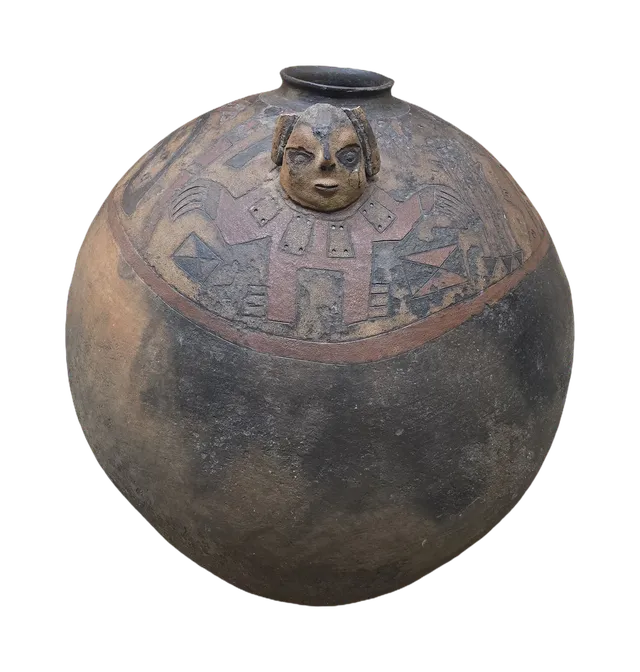
The typical Chancay vessel is painted dark brown-black on a white or cream slip. The paint can be bold and quickly applied, sometimes running beyond the design. The surface is often granular rather than glossy because the clay was not burnished. Chancay potters also used dark brown pigment and left some vessels the natural red of the clay.
Forms include large egg-shaped jars, jars with narrow necks and wide mouths, open bowls and anthropomorphic urns or effigy vessels. Human faces, birds, llamas and geometric patterns are common. Some vessels were made in moulds, with details added by hand. The Nazca pottery guide describes a very different south-coast painted tradition, and the Inca guide covers the later imperial style.
Chancay pottery is relatively large by Andean standards, and much of it comes from cemetery contexts. That does not make every large black-on-white vessel Chancay, and it does not make every cemetery find ancient. The label describes a regional tradition, not a single workshop.
Textile dolls, gauze and Chancay cloth
Chancay textiles are among the culture's best-known products. They include open-weave cotton gauze headcloths with repeating interlocking zoomorphic heads, painted cloth panels and garments. The pre-Columbian textiles guide explains the weaves and the conditions that preserved cloth on Peru's desert coast.
The objects called textile dolls are small figures with wooden or plant-fibre bodies dressed in carefully made garments. The Walters Art Museum dates one to 1000-1450 and describes it as a wood figure dressed in cloth, found in a tomb; the Brooklyn Museum's funerary doll is cotton, camelid fibre and reeds, about 1100-1350. Their precise meaning is unknown. They may represent the dead, family members or attendants, but the evidence does not settle the question.
Distinguish an ancient dressed figure from a modern tourist doll. In the twentieth century, Peruvian artisans began making stylised dolls from pieces of ancient textile for the souvenir trade. Those dolls are modern objects, even when the cloth fragments in them are old. A label that says Chancay doll can therefore describe either an ancient tomb figure or a modern craft object.
Ancient, later and loosely attributed Chancay pieces
Chancay is not a single tightly defined style. The name is used for a range of central-coast pottery and cloth, and dealers sometimes apply it to pieces that are later, provincial or simply black-on-white. A loose attribution is not necessarily dishonest, but it is broad. The object still needs a form, a surface and a history that agree.
Modern copies range from tourist cuchimilcos to convincing moulded figures and dolls. Common signs of a modern piece include a very uniform surface, crisp mould lines, paint that sits on top of the clay without the wear of age, and a doll made from obviously modern cloth. Ancient pieces can also be repaired, repainted or assembled from fragments, so condition needs close looking.
A documented collection history, an old photograph or an early museum label can help. It cannot replace examination of the object. Is my pottery real explains the difference between a visual impression and an attribution.
What helps identify a Chancay piece
For a vessel, describe the form, the paste colour, the slip, the paint, the surface finish, the wear and any repairs. For a figure, note whether it is mould-made, how the hands and feet are modelled, whether it stands, and whether the paint is black on white or another scheme. For a textile doll, separate the ancient cloth from the modern assembly and record the garments and body material.
Photographs should show the whole object, the base, the face, the joins and any damaged areas. Dimensions and what you know of its history are useful. We buy single pieces and collections; we do not sell. Tell us about your piece for a first opinion, and how we value explains the factors we compare. There is no fee and no obligation.
Further reading
- Stone-Miller, Rebecca. Art of the Andes: From Chavín to Inca. 3rd ed. Thames & Hudson, 2012.
- Morgan, Alexandra. The Pottery Figurines of Pre-Columbian Peru, Volume II: The Figurines of the Central Coast. BAR Publishing, 2017.
- D'Harcourt, Raoul. Textiles of Ancient Peru and Their Techniques. University of Washington Press, 1962.
- Bennett, Wendell C. Ancient Arts of the Andes. Museum of Modern Art, 1954.
Cite this guide: Precolumbian.com, “Chancay Pottery: Cuchimilcos, Dolls and Textiles”, 2026, https://precolumbian.com/guides/chancay-pottery-and-cuchimilcos.html
Common questions
What is Chancay pottery?
Chancay pottery is the ceramic tradition of the Chancay culture of Peru's central coast, made mainly between about 1000 and 1470 CE. It is usually black or dark brown on a white or cream slip, often large and mould-made, and includes cuchimilcos and effigy vessels.
What are Chancay figurines?
Chancay figurines are small ceramic human and animal sculptures, often made in moulds and painted black on white. The best-known human type is the cuchimilco, a standing figure with short extended hands. Human figures were often made in male-female pairs.
What is a cuchimilco?
A cuchimilco is a standing Chancay ceramic figure with a broad face, short hands and no separate arms, prominent genitalia and modelled feet. Cuchimilcos are found in tombs, but their exact role is not known; companions or guardians of the dead have been proposed.
What is a Chancay textile doll?
A Chancay textile doll is a small figure with a wooden or plant-fibre body dressed in woven garments, found in ancient tombs and dated to the Chancay period. Modern Peruvian artisans also make dolls from old textile scraps for the souvenir trade, so the term covers both ancient and modern objects.
How old is Chancay pottery?
The culture is usually dated from about 1000 to 1470 CE, with museum labels sometimes running to 1475. These are broad ranges for the tradition. An individual vessel needs its own comparison and, where possible, a documented history.
Are Chancay dolls ancient?
Some dressed figures are ancient tomb objects. Many dolls sold as Chancay are twentieth-century tourist pieces made from pieces of old cloth. The cloth can be ancient while the doll is modern, so the two parts need to be described separately.
Why is so much pottery called Chancay?
Chancay is a convenient regional label for central-coast Peru, and black-on-white pottery is widespread there. The name is sometimes applied loosely to later, provincial or tourist pieces. Form, surface, cloth and history still need to agree before an attribution is strong.
Keep reading
Pre-Columbian textiles: Peruvian cloth, weaving and identity
Read the fibre, weave and original garment before assigning a culture or trusting an ancient date.
Chimu pottery: blackware, moulded vessels and coastal art
Why Chimú vessels are black, how their shapes were made, and what separates them from earlier Moche work.
Inca art and artifacts: pottery, textiles, metal and stone
What makes a piece Inca: standard pottery forms, textiles, miniature figures and misleading old labels.
How to tell if pre-Columbian pottery is real
The evidence experts compare, the common copies and what a clay-age test actually establishes.
How much is pre-Columbian pottery worth?
The six things that decide what a piece is worth, and what to send to find out.
Have something to sell?
Send us photographs and whatever you know. You hear back within two working days.
Or write straight to info@precolumbian.com