Guide: Peru, Ecuador and the Andes
Inca art and artifacts: pottery, textiles, metal and stone
Inca art and artifacts are the objects and visual traditions associated with the Inca state, centred on Cusco in the Andes. For identifying objects, about 1400 to 1532 CE is a useful broad frame, rather than a claim that Inca traditions began and ended in those years. Surviving work includes textiles, pottery, fine metalwork, shell figures and carved stone; 'Inca' is not a general term for everything ancient from Peru.
- CuscoThe Inca capital in the southern highlands
- CajamarcaWhere the Spanish captured the Inca ruler in 1532
- QuitoThe Inca empire's northern centre, in Ecuador
- Region
- Centred on Cusco, Peru; imperial reach across a large part of the Andes
- Dates
- About 1400 to 1532 CE as a broad object-identification frame; traditions continue later
- Made of
- Fired clay, cotton and camelid fibre, metals, shell, stone and wood
- Known for
- Urpu jars, geometric textile designs, miniature figures and stoneworking
- Recognition
- Distinguish Cusco style, regional Inca-period work and later Andean traditions
When and where was Inca art made?
The Inca state grew around Cusco, also spelled Cuzco, in present-day Peru. Its imperial expansion belongs especially to the fifteenth and early sixteenth centuries. At its greatest extent, it reached from northern Ecuador through Peru and Bolivia into central Chile and western Argentina. Inka is another spelling, not a separate culture.
An object's date range need not match the political dates of the empire exactly. The year 1532 is a conventional historical marker associated with the capture of the ruler Atahualpa, not the instant when Andean artists stopped making things. Inca-derived forms continued in the Colonial period. That continuity makes a careful distinction between imperial Inca and later Andean work more useful than a confident but unsupported old label.
The pre-Columbian art timeline separates the Inca from earlier traditions. Nazca pottery and Moche portrait vessels belong to much earlier centuries, even though all are often grouped together as ancient Peruvian art.
What is distinctive about Inca art?
Recognisable forms and repeated design systems helped give imperial objects a shared appearance. Fine ceramics and garments could communicate relationships with the state through familiar shapes, materials and decoration. Standardised does not mean machine-made, and it does not mean every community produced exactly the same object.
Geometric organisation is particularly conspicuous in woven garments and painted pottery. Repeated bands, panels and balanced compositions can be more characteristic than a single dramatic figure. Naturalistic forms also occur, notably metal plants such as maize; metal human and animal figures are more stylised. Neither geometry alone nor the absence of figures is enough to establish an Inca attribution.
Because the empire incorporated other Andean communities, an object can combine local and imperial features. It may be more accurate to describe an Inca-period regional work than to force it into a narrowly defined Cusco style. The distinction concerns how and where the piece was made, not whether it is a better or worse work of art.
Inca pottery history: what is an aryballos or urpu?
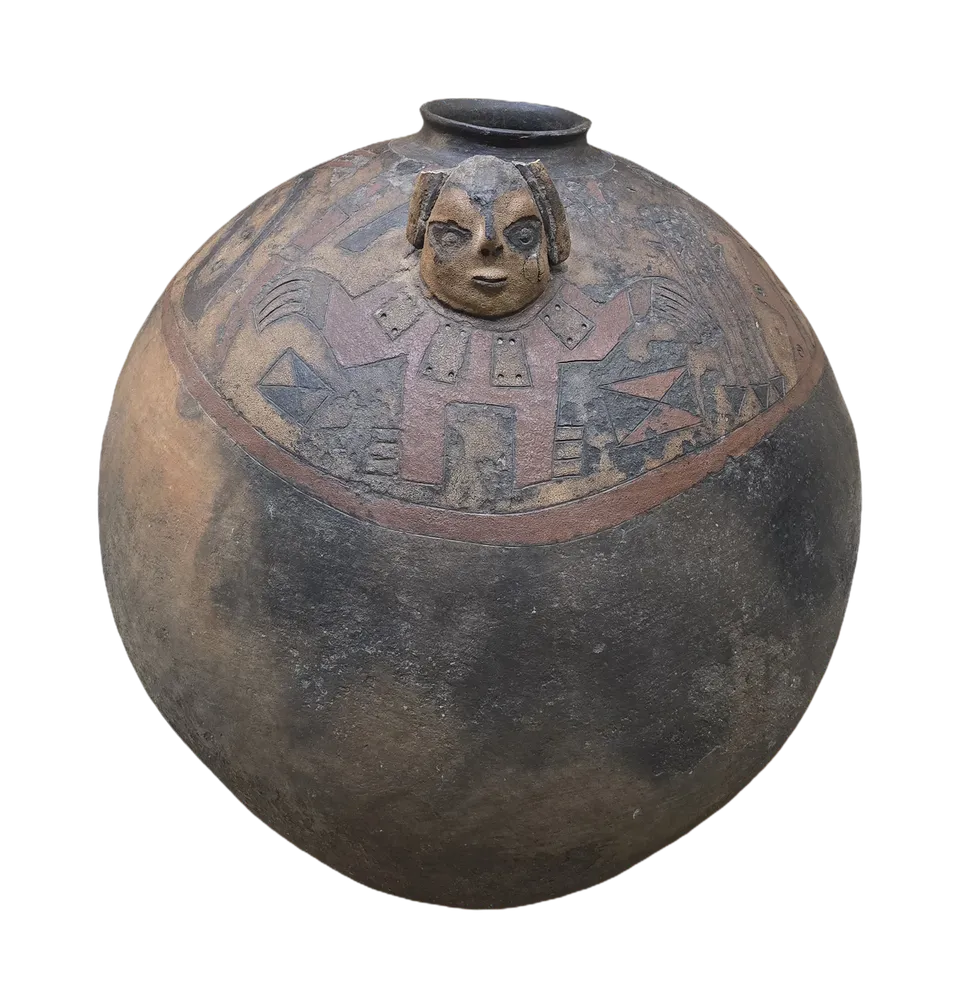
The urpu is one of the most recognisable Inca ceramic forms. It has a rounded body tapering to a pointed base, a tall neck with a flaring rim, two side loops and often a projecting lug on the shoulder. The name aryballos, or aryballo, is a comparative term borrowed from Greek pottery terminology. It does not imply that the Inca shape came from Greece.
Large urpus were associated with brewing and carrying chicha, a fermented maize drink, as well as other food uses. Smaller examples could serve different purposes, including offerings. Scale and context therefore matter: a small jar should not automatically be given the same function as a much larger one of similar outline.
Cusco-style jars often have geometric slip-painted designs in black and red on a cream ground. Inca potters also made shallow dishes, bowls and other vessel shapes, so not being an urpu does not rule out an Inca attribution. The whole combination of shape, construction and decoration must be compared with documented examples.
Why are textiles central to Inca art history?
Textiles were central to status, ritual and political relationships. Fine cloth could be a prestigious gift, and its significance cannot be measured simply by comparing the raw material with gold. Surviving tunics and other garments show how fibre choice, spinning, weaving and pattern worked together.
Cotton and camelid fibres were used in Andean weaving. Alpaca is one source of camelid fibre; the word is not a synonym for sheep's wool. Fine Inca garments often use tightly organised geometric designs. Tocapu, also written t'oqapu, are patterned rectangular or square units that may appear in bands or across a larger field.
Scholars connect tocapu with identity, rank and the organisation of the empire, but their individual meanings are not all securely established. A grid of motifs should not be presented as a fully translated alphabet. Textile structure and the placement of designs are evidence for attribution alongside the motif itself.
What are the miniature figures in gold, silver and shell?
Most Inca gold and silver work was melted down or destroyed after the Spanish conquest; what survives includes small human, animal and plant figures. Small human and camelid figures occur in gold, silver, metal alloys and Spondylus shell. Some human figures have survived with miniature garments. Many metal examples were made from hammered sheet joined into a hollow form, although cast examples also exist. It is inaccurate to call every Inca figurine a solid casting.
Figures occur in offerings associated with sacred places and, in some cases, the ceremony known as capac hucha or capacocha. The archaeological setting matters: not every isolated miniature can be assigned to a particular ceremony. The Spondylus guide explains why shell belongs alongside metal in this discussion, rather than being treated as a lesser imitation.
Material is not an attribution by itself. A small gold llama needs comparison of its form and method of making just as a ceramic jar does. Surface colour cannot settle the composition of an alloy, and an appealing label cannot replace a history that actually belongs to the figure.
What survives in stone?
Inca stoneworking ranges from monumental architecture to small carved vessels and animal-shaped objects. Some small stone effigies are described as conopas or canopas, votive objects. A miniature animal carved in stone is therefore not inherently out of place in an Inca discussion, but its shape alone does not establish a date or ritual function.
Closely fitted architectural masonry is a familiar achievement, yet it is a poor shortcut for judging a portable carving. Each kind of object needs comparisons from its own material and tradition. Toolwork, proportions and documented parallels are more useful than a general claim that the Inca were skilled stoneworkers.
What is often mislabelled Inca?
An old label may use the best-known name for the Andes rather than a precise attribution. Treat it as part of the object's collecting history and ask what supports it. These distinctions help turn 'Inca artifact' into a description that can be checked.
- Earlier Peruvian work. A Nazca polychrome bottle or a Moche portrait head is not Inca merely because it comes from Peru. It belongs to a different ceramic tradition and period.
- Regional work. An object made during Inca rule may retain a local style. An imperial-period date and a Cusco-style attribution are different claims and need different support.
- Colonial work. Andean makers continued older forms and techniques after the imperial period, sometimes combining them with European designs. Later does not mean modern reproduction.
- Modern copies. A recently made jar can follow an ancient outline. Calling its shape Inca-style does not establish that the jar itself belongs to the Inca period.
How to ask about an Inca piece
For a first opinion, send clear photographs of all sides, the base, surface details, dimensions and anything written on an old label. Add any receipts, earlier photographs or collection notes. What provenance means explains the difference between a documented history and a cultural attribution; assessing authenticity explains why neither a famous shape nor a photograph alone settles age.
Attribution, workmanship, original surface, completeness, repairs and documented history affect value. How we value explains those comparisons. We buy single pieces and whole collections; we do not sell. Write with photographs for a first opinion. We reply within two working days, with an offer in writing where we can make one, with no fee and no obligation.
Further reading
- D’Altroy, Terence N. The Incas. Blackwell, 2002.
- Morris, Craig, and Adriana von Hagen. The Inka Empire and Its Andean Origins. Abbeville Press, 1993.
- Moseley, Michael E. The Incas and Their Ancestors: The Archaeology of Peru. Thames and Hudson, 1992.
Cite this guide: Precolumbian.com, “Inca art and artifacts: pottery, textiles, metal and stone”, 2026, https://precolumbian.com/guides/inca-art-and-artifacts.html
Common questions
What is Inca art best known for?
Inca art is known for finely woven textiles, distinctive ceramic forms, metal and shell miniatures, and accomplished stoneworking. Repeated geometric designs and recognisable vessel shapes helped express an imperial style, but regional variation and naturalistic imagery also belong to the tradition.
What do Inca art symbols mean?
Some designs can be connected broadly with status, identity and ritual, but there is no dependable one-symbol dictionary for all Inca art. Tocapu are geometric patterned units whose specific meanings remain debated. Their material, arrangement and context matter as much as the individual design.
What was Inca pottery used for?
Inca pottery served food preparation, brewing, carrying, serving and ceremonial purposes. Large urpu jars were associated with chicha, a fermented maize drink, while smaller vessels could have other roles, including offerings. A vessel's size and archaeological context help distinguish possible uses.
Is all ancient Peruvian art Inca?
No. Peru has many artistic traditions that preceded or overlapped with the Inca. Nazca and Moche ceramics belong to much earlier centuries. Some objects made during Inca rule retain regional styles, and later Colonial works can continue Inca forms without being imperial-period objects.
Keep reading
Nazca pottery history: colours, forms and painted beings
How Nazca potters made their colours, what the images show, and what a mouse label really means.
Moche portrait vessels: faces, making and meaning
Individual faces in clay: how the vessels were made, what the portraits may mean, and what to compare.
Famous pre-Columbian artifacts: 15 works and where they are
Fifteen famous objects and monuments of the ancient Americas, with where each was found and where it is kept.
Pre-Columbian gold and tumbaga: alloys, casting and value
Why a golden surface, an alloy recipe and an ancient attribution are different questions.
Pre-Columbian art timeline: cultures, dates and regions
An approximate chronology that keeps overlapping cultures and different regional period names distinct.
Have something to sell?
Send us photographs and whatever you know. You hear back within two working days.
Or write straight to info@precolumbian.com