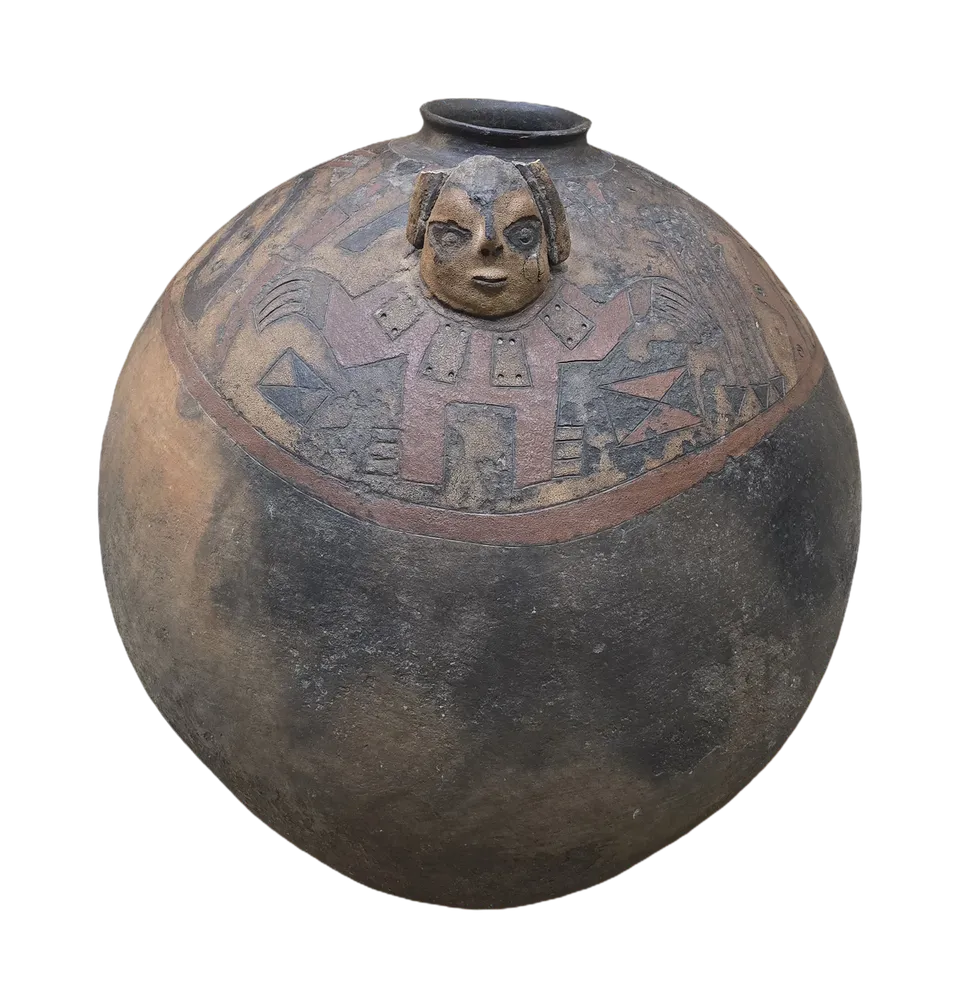
Guide: Peru, Ecuador and the Andes
Nazca pottery history: colours, forms and painted beings
Nazca pottery history centres on the south coast of Peru, where potters developed vessels painted in several colours of slip before firing. The tradition, also spelled Nasca, belongs mainly to the centuries around the beginning of the Common Era through about 700 CE, with boundaries that vary by chronology. Double-spout bottles, bowls and effigy jars show animals, plants, people and composite beings whose precise meanings are not always recoverable.
- Region
- South coast of Peru, especially the Ica and Rio Grande de Nazca valleys
- Dates
- Mainly around the beginning of the Common Era to about 700 CE; chronologies vary
- Made of
- Fired clay with coloured slips; many surfaces are burnished
- Known for
- Polychrome painting, spout-and-bridge bottles, natural and mythical imagery
- Recognition
- Compare shape, slip technique and the whole design; no single motif proves attribution
- CahuachiThe Nazca ceremonial centre in the valley of the Río Nazca
Where and when was Nazca pottery made?
The Ica and Rio Grande de Nazca valleys on Peru's south coast were central to this ceramic tradition. Nazca is a particular Andean culture and style, not a general name for ancient Peruvian pottery. Its painted vessels developed from earlier Paracas traditions, long before the rise of the Inca state.
Early, Middle and Late Nazca are useful divisions, but they describe changes in ceramic style rather than three periods with universally agreed starting years. A date attached to one vessel is normally a range. The pre-Columbian art timeline places Nazca beside neighbouring traditions; it also explains why a shared century does not make two cultures the same.
How was Nazca polychrome pottery made?
Polychrome means several colours. A slip is a suspension of fine clay particles in water, with minerals providing colour. Nazca potters built vessels by hand, often using coils, and applied coloured slips before firing. Their palette includes cream and white, reds, orange, yellow, brown, black and other tones. Not every vessel uses every colour, and a large palette alone does not identify the maker.
The paintings combine solid areas of colour with fine outlines. Mineral ingredients and firing affect the final tones: iron compounds can produce reds and yellows, while manganese minerals are associated with black. Burnishing gives many examples their smooth sheen. That sheen should not automatically be called a glaze. The art glossary separates slip, paint and burnishing, terms that are easily confused in an old description.
What shapes help identify Nazca culture pottery?
A familiar bottle has two upright spouts joined by a solid bridge above a rounded body. This differs from a stirrup spout, where a hollow arch meets a single upright outlet. Neither shape is an exclusive cultural signature: spout-and-bridge forms also occur in the earlier south-coast tradition.
Nazca potters also made bowls, dishes, beakers and vessels modelled as people, animals or plants. The painted design and the modelled form can work together, so a vessel needs to be read all the way around. A frontal photograph may show a face while concealing the repeated figures or geometric bands that help place it within the style.
What do the mythical beings and trophy heads mean?
Natural subjects include birds, fish, cultivated plants and small mammals. Other figures combine human faces, animal features, ornaments and elaborate appendages. Scholars use descriptive names such as Anthropomorphic Mythical Being for recurring combinations. These are modern analytical labels, not ancient names that can be translated from the pot.
Trophy heads appear as objects carried by figures and as repeated painted motifs. Scholars interpret these images through evidence of warfare, ritual and ideas of fertility or regeneration; they differ over particular figures and meanings. It is more accurate to describe the visible head and its setting than to give every severed head the same explanation or identify every composite creature as a named god.
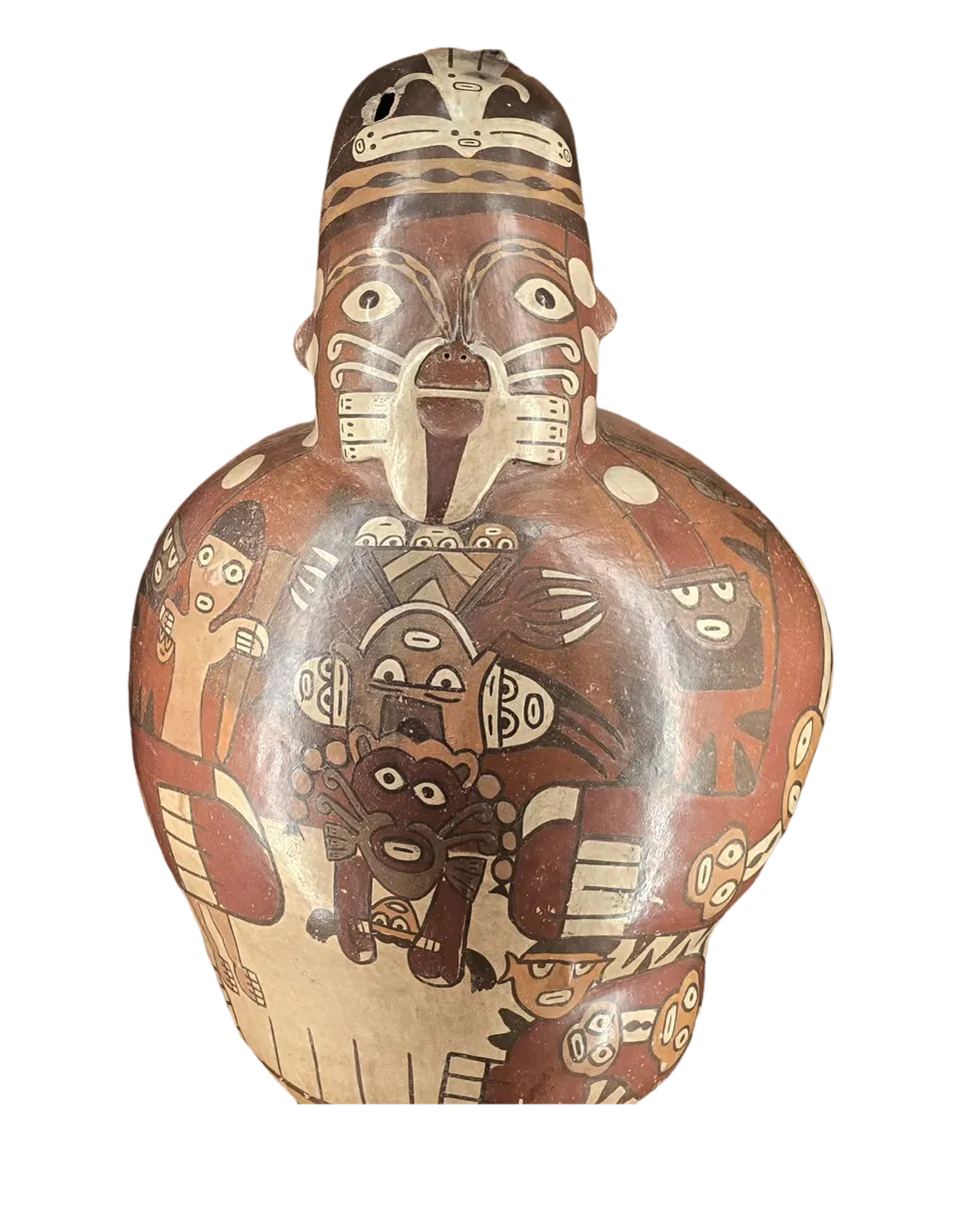
Our pieces page includes a Nazca effigy jar of a mythical being holding a small figure and trophy heads. The specific subject matters more than a loose description such as 'colourful Peruvian jar'.
Why do people search for Nazca mouse pottery?
The label comes from the animal motifs: some Nazca vessels show rows of small creatures described as mice, rats or, more cautiously, rodents. There are bowls and beakers with such designs, so 'Nazca mouse pottery' does not name one standard shape. Nor is it a separate archaeological phase.
The cautious word is useful. A stylised painted creature need not allow a confident species identification, and recognising a rodent does not establish what it meant to its painter. The crop reading comes from vessels where mice appear among plants beside a whiskered, cat-masked figure who seems to keep them from the harvest; it is one interpretation, not a translation of every rodent image. A mouse motif by itself also cannot establish that a vessel is ancient or Nazca: the surrounding design and the ceramic technique still matter.
Early, Middle and Late Nazca: what changes?
A practical sequence follows the changing treatment of images. Scholars differ on the calendar dates and on some phase groupings, so these are tendencies for comparison, not a way to date a jar from one motif. The numbered phases are a classification of ceramic styles.
- Early Nazca. Often associated with phases 2 to 4, it includes comparatively legible plants, animals and supernatural figures, sometimes called the Monumental style. The preceding transitional phase is often called Proto-Nazca.
- Middle Nazca. Commonly associated with phase 5, this is a transition toward more elaborate designs, with additional rays, tassels and other elements around the principal figures.
- Late Nazca. Often associated with phases 6 and 7, it includes densely elaborated, more abstract imagery, described as Proliferous because of the multiplication of details.
How does Nazca differ from Paracas and Wari?
Many earlier Paracas vessels have incised designs coloured with resin-bound paint after firing. Nazca polychrome pottery is particularly associated with slips applied before firing. This is a useful technical distinction, not an absolute claim that every Paracas vessel has the same surface treatment.
Later Wari influence brought highland imagery into south-coast ceramic traditions, especially around the seventh century CE and afterwards. Some works combine local colour traditions with Wari forms or images. A label such as Nazca-Wari acknowledges that interaction; it should not be read as another spelling of either a purely Nazca or an Inca attribution.
Reproductions, repairs and a useful first opinion
A convincing painted animal is not a test of age. A reproduction can repeat an ancient design, and later repainting can change the appearance of an ancient vessel. Attribution therefore needs agreement between form, construction, surface and imagery, not just a recognisable motif. How experts assess pottery explains why photographs are a beginning and no visual checklist replaces specialist examination.
For a first opinion, send clear photographs of the whole vessel, its base, its decoration and any repairs, together with dimensions and what you know of its history. We buy single pieces and whole collections; we do not sell. Tell us about your piece. We reply within two working days, with an offer in writing where we can make one. There is no fee and no obligation.
Further reading
- Proulx, Donald A. A Sourcebook of Nasca Ceramic Iconography: Reading a Culture through Its Art. University of Iowa Press, 2006.
- Silverman, Helaine, and Donald A. Proulx. The Nasca. Blackwell, 2002.
- Moseley, Michael E. The Incas and Their Ancestors: The Archaeology of Peru. Thames and Hudson, 1992.
Cite this guide: Precolumbian.com, “Nazca pottery history: colours, forms and painted beings”, 2026, https://precolumbian.com/guides/nazca-pottery.html
Common questions
Is Nasca the same as Nazca?
Yes. Nasca and Nazca are alternative spellings used for this south-coast Peruvian culture and its art. Neither spelling indicates a different ceramic phase, level of quality or date. The vessel's particular shape, decoration and technique still need to be described.
What is Nazca pottery best known for?
Nazca pottery is best known for multicoloured slip painting and forms such as the double-spout-and-bridge bottle. Its imagery includes animals, plants, human figures and composite mythical beings. The colours were applied before firing rather than simply painted onto an already finished pot.
What do mice on Nazca pottery mean?
Mice and other rodents are genuine subjects in Nazca ceramic imagery, sometimes repeated in rows. The label describes a motif, not a separate pottery type or period. Scholars do not have a single secure translation for every rodent image, and the species itself may be uncertain.
Can bright colours prove Nazca pottery is a reproduction?
No. Bright colours are compatible with ancient Nazca slip painting, but they also occur on later copies and repainted pieces. Colour alone establishes neither age nor authenticity. Form, construction, surface, decoration and the piece's documented history need to be considered together.
Keep reading
How old are the Nazca Lines? Their age, making, makers and meaning
How old the Nazca Lines are, what they are made of, who made them and why, and how many figures are known.
Moche portrait vessels: faces, making and meaning
Individual faces in clay: how the vessels were made, what the portraits may mean, and what to compare.
How to tell if pre-Columbian pottery is real
The evidence experts compare, the common copies and what a clay-age test actually establishes.
Pre-Columbian art timeline: cultures, dates and regions
An approximate chronology that keeps overlapping cultures and different regional period names distinct.
Pre-Columbian art museum guide: where to see the great collections
Museums in Mexico, Peru, Colombia, Costa Rica, the United States and Europe, what each holds, and three maps.
Have something to sell?
Send us photographs and whatever you know. You hear back within two working days.
Or write straight to info@precolumbian.com