Guide: Mexico and the Maya region
Mayan pottery history: painted vessels, figures and glyphs
Mayan pottery history is the story of fired-clay vessels and figures made by Maya communities across southern Mexico and northern Central America. It includes everyday containers, painted cups for courtly feasts, offerings and elaborate incense burners. The famous multicoloured cylinder vessels are one part of a much longer tradition; shape, surface, imagery and writing must be read together to place a piece.
- Region
- Southern Mexico, Guatemala, Belize and parts of Honduras and El Salvador; lowlands and highlands.
- Dates
- Preclassic before about 250 CE; Classic about 250 to 900 CE; Postclassic thereafter until the Spanish conquest: the sixteenth century in most areas, 1697 in the central Petén.
- Made of
- Fired clay with temper; slips, pigments and sometimes modelled or incised decoration.
- Known for
- Painted cylinder vessels, glyph bands, tripod bowls, effigy vessels, figurines and censers.
- How to recognise
- Compare form, surface, painting and writing together; no single feature proves age or origin.
- PalenqueA western Maya city in Chiapas, Mexico
- TikalA great lowland city of the Petén in Guatemala
- CopánThe southeastern Maya city in Honduras
- Chichén ItzáThe great northern Yucatán city
Where and when was Maya pottery made?
The Maya world includes lowlands and highlands in present-day southern Mexico, Guatemala and Belize, and parts of Honduras and El Salvador. Its communities did not form one continuous empire with a single pottery style. A highland vessel and a lowland vessel may look different while both belong within Maya ceramics history. Modern national borders are useful geographical references, not ancient workshop boundaries.
The Preclassic period precedes about 250 CE; pottery was already well established during the first millennium BCE. The Classic is conventionally about 250 to 900 CE, with many celebrated painted vessels belonging to its later centuries. The Postclassic follows, roughly from 900 CE into the sixteenth century. Dates vary by region and scholar, and ceramic traditions overlap these divisions. Maya people and artistic traditions continue today. The pre-Columbian art timeline sets these periods beside neighbouring cultures.
How did the Maya make and paint pottery?
Potters built vessels by hand, including by coiling clay, rather than on a potter's wheel. They mixed clay with added materials called temper and shaped the walls before applying surface decoration. A slip is a liquid clay-rich mixture used to colour or finish the surface; it is not the same thing as a glassy glaze. Painted Classic vessels commonly carry red, cream, orange and black passages, with substantial variation between workshops.
Polychrome means several colours. On many fine vessels the coloured slips were applied before firing, so the picture and the ceramic surface form a coherent fired finish. Incised lines, modelled relief and single-colour surfaces also belong to Maya pottery. Some objects, including figurines and later incense burners, received paint after firing. It is therefore a mistake to expect every genuine piece to have the same sheen or paint texture. The art glossary explains these surface terms.
What do cylinder vessels and their glyph bands mean?
A cylinder vessel is a straight-sided container, often with a painted scene extending around its wall. Many Classic examples were drinking cups, including for cacao beverages. Scenes can show rulers, attendants, musicians, ballplayers or supernatural beings. A court scene is not automatically a picture of the person named in the inscription, and an elaborate costume does not by itself identify a god.
The band of writing near the rim often contains a dedicatory text, sometimes called the Primary Standard Sequence. Such texts can name the vessel's type, intended contents and owner, rather than narrate the picture below. Other glyphs can label participants in a scene. Reading the whole inscription is specialist work: an isolated sign copied from a photograph is a poor basis for assigning a royal name. A complete photographic sequence around the vessel makes the relationship between words and picture easier to assess.
What are codex-style pottery, tripod bowls and effigy vessels?
Codex-style pottery takes its modern name from its resemblance to painted Maya books, or codices. It usually has fine dark outlines on a cream or pale ground, often framed by red bands. Many examples show mythological scenes. The label describes a particular painting tradition, not every vessel with writing, and it does not mean that the pot is the same age as the surviving books.
Tripod means three supports. Maya bowls and plates can stand on three feet, sometimes hollow, but three feet alone do not make a vessel Maya. Early Classic pottery, roughly 250 to 600 CE, includes modelled effigy and lidded forms as well as painted containers. An effigy vessel incorporates a person, animal or supernatural being into its shape. A lid can carry a sculpted figure while the chamber below remains a working container. The relation of lid, rim and body matters when judging whether separate parts belong together.
What are Jaina figurines and Maya incense burners?
Jaina-style figurines take their name from an island off Campeche, Mexico, where many were found in burials. They depict richly dressed people, performers, warriors and supernatural characters; some are also whistles or rattles. Examples can be modelled by hand or made with moulds and individually finished. The style was produced across a wider area, so a label saying Jaina is not proof that a particular figure came from the island.
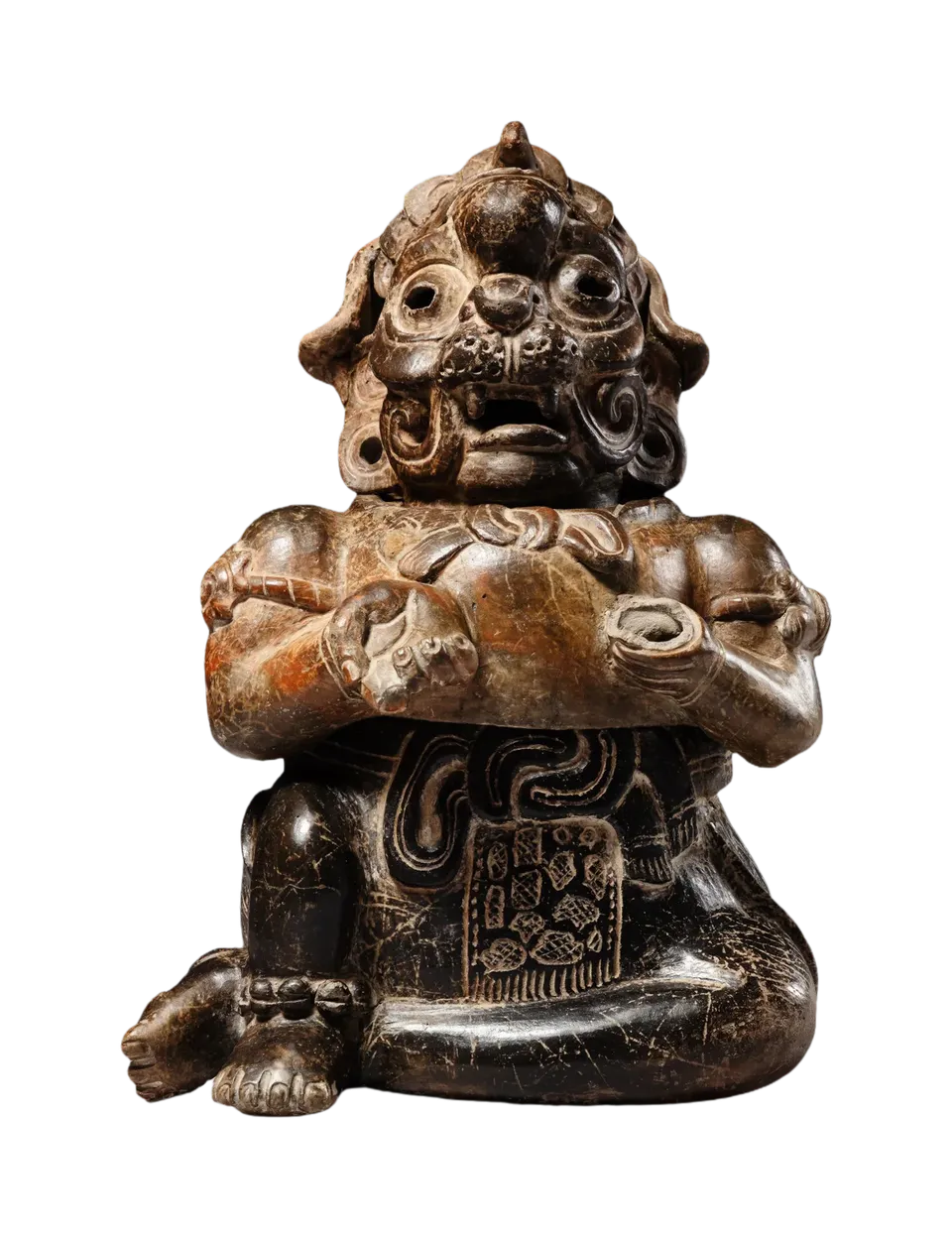
Incense burners, also called censers, are another important sculptural form. Early Classic examples can combine a chamber with an imposing seated figure, while later traditions use different shapes and deity imagery. Scholars interpret their smoke and images in relation to ceremonies involving ancestors and gods. A complex headdress needs comparison with securely identified examples before its wearer receives a specific name. These objects are not simply enlarged versions of the painted drinking cups.
Is it authentic Mayan pottery, and what moves its value?
Modern reproductions are common. A convincing profile or a recognisable glyph is not enough: a specialist compares the clay, construction, surface, painting and imagery with documented examples. An ancient ceramic body can also carry extensive modern repainting. Age and the originality of the picture are separate questions. Our guide to recognising genuine pottery explains why no photograph checklist can replace expert examination.
Mayan pottery value depends on the attribution, quality, subject, completeness, surviving original surface and documented history. Repairs matter differently from an invented scene painted across the whole wall. The pottery value guide explains the distinctions. For a first opinion, send clear photographs and what you know through sell to us. We buy single pieces and whole collections, and reply within two working days with an offer in writing or a plain statement of what we cannot take. There is no fee and no obligation.
- Record the form: cylinder, bowl, plate, lidded vessel, figure or incense burner.
- Show the complete scene and glyph band, not just the most attractive figure.
- Include the base, interior, dimensions, repairs and any earlier photographs or written descriptions.
- Keep the proposed culture, proposed date and evidence for authenticity as separate questions.
Further reading
- Doyle, James. “Ancient Maya Painted Ceramics.” Heilbrunn Timeline of Art History. The Metropolitan Museum of Art, 2017.
- Reents-Budet, Dorie. Painting the Maya Universe: Royal Ceramics of the Classic Period. Duke University Press, 1994.
- Miller, Mary, and Simon Martin. Courtly Art of the Ancient Maya. Thames and Hudson, 2004.
- Schele, Linda, and Mary Ellen Miller. The Blood of Kings: Dynasty and Ritual in Maya Art. George Braziller, 1986.
- Sharer, Robert J., with Loa P. Traxler. The Ancient Maya. 6th ed. Stanford University Press, 2006.
Cite this guide: Precolumbian.com, “Mayan pottery history: painted vessels, figures and glyphs”, 2026, https://precolumbian.com/guides/maya-pottery.html
Common questions
Is Maya pottery the same as Mayan pottery?
Both expressions commonly refer to pottery made by Maya communities. Maya is the usual name for the people and their art, while Mayan is often used for their languages. Neither wording identifies a particular period, workshop or degree of authenticity.
What was Maya polychrome pottery used for?
Many finely painted Classic vessels served food or drink at elite feasts and circulated as gifts. Some later accompanied the dead or became offerings. The shape, inscription and archaeological context help establish a particular vessel's use; a painted scene alone rarely settles it.
Does every Maya cylinder vessel have a readable inscription?
No. A cylinder is a shape, not a promise of writing. Where a glyph band survives, its text may identify the container, contents or owner, while separate captions describe figures. A specialist must establish what can actually be read before a name becomes part of the attribution.
Does a Jaina-style figurine come from Jaina Island?
Not necessarily. The name comes from the island off Campeche where many figurines were found, but related figures were made across a broader region. Jaina-style describes visual and technical relationships; a specific place of discovery needs its own supporting record.
Can old clay prove that a painted Maya vase is genuine?
Old clay does not prove that all the painting is ancient. A genuine vessel may have repaired sections, replacement parts or a substantially repainted scene. An assessment needs to distinguish the ceramic body from the surface and establish how much original work remains.
Keep reading
How to tell if pre-Columbian pottery is real
The evidence experts compare, the common copies and what a clay-age test actually establishes.
How much is pre-Columbian pottery worth?
The six things that decide what a piece is worth, and what to send to find out.
What is provenance in art? How to trace a piece's history
What an object's documented history can tell you, and how to follow the evidence.
Pre-Columbian art glossary: reading an object description
Plain definitions of the forms, techniques, periods and qualifications found in object descriptions.
Pre-Columbian jade: beads, pendants, figures and masks
Separate jadeite from greenstone, and a stone's identity from the age and origin of its carving.
Have something to sell?
Send us photographs and whatever you know. You hear back within two working days.
Or write straight to info@precolumbian.com