Guide: Reference
Pre-Columbian art glossary: reading an object description
This pre-Columbian art glossary defines the materials, techniques, forms, periods and qualifications used in descriptions of ancient American objects. Each term answers a different question: what a piece is made of, how it was made, its proposed date or its recorded history. None alone proves authenticity.
The terms
Ceramic surfaces and painted decoration
Vessel forms, figures and functions
Metal, stone, shell and textile terms
Mesoamerican periods and style labels
Central Andean Horizons and Intermediate periods
Evidence, attribution and condition
Ceramic surfaces and painted decoration
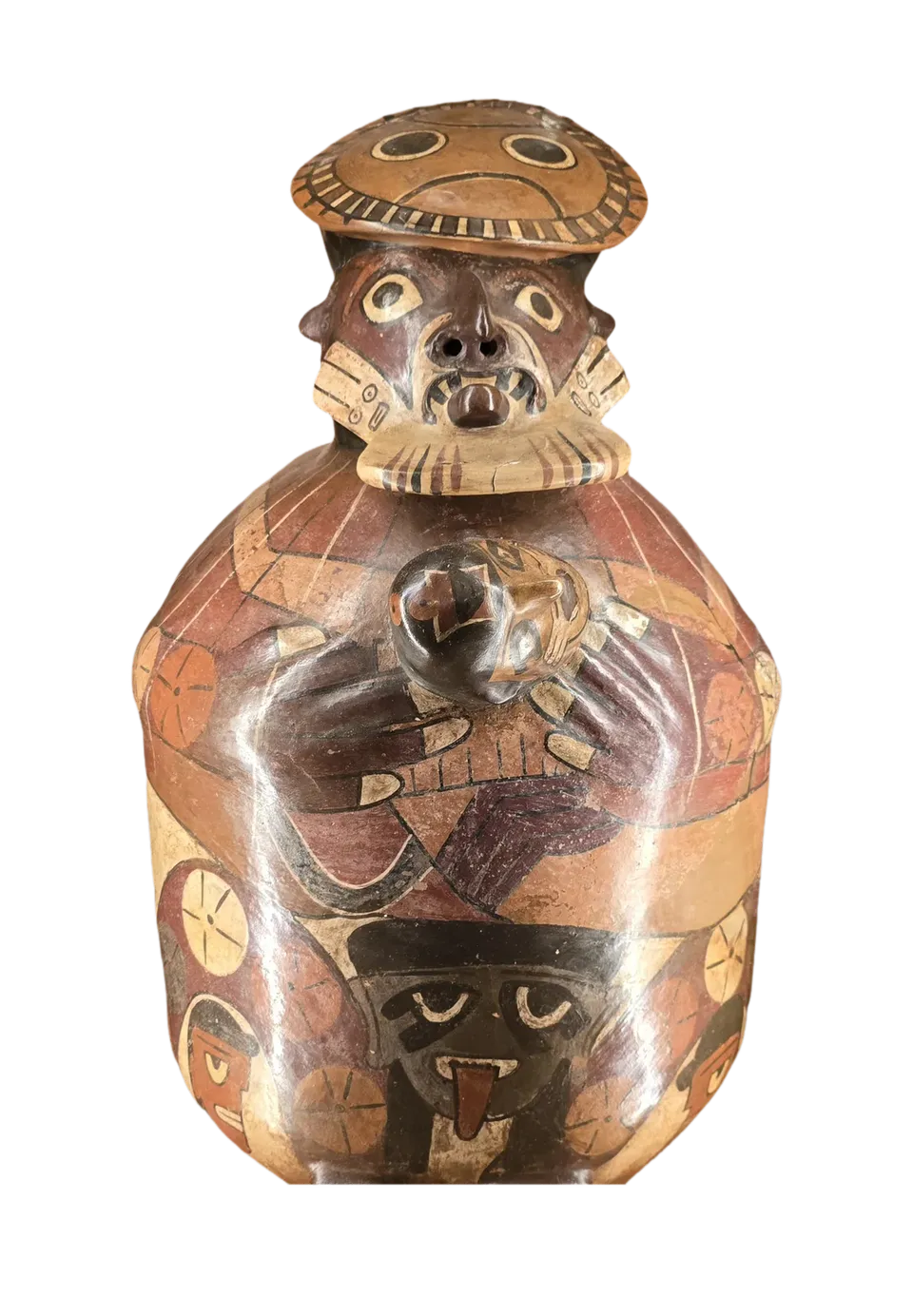
These words describe a surface, not a culture. Several can apply to one vessel: a pot may be slipped, burnished and polychrome. A sheen need not mean a glassy glaze.
- Slip. A liquid suspension of clay and sometimes other mineral ingredients, used for coating or decoration, commonly before firing. It differs from glassy glaze.
- Polychrome. Decorated in several colours. The word describes appearance, not a particular culture, recipe or age.
- Burnishing. Smoothing and compressing an unfired clay surface with a smooth tool to produce a sheen. The shine comes from the worked surface, rather than a glaze.
- Fired and unfired paint. Fired decoration was present during a firing; unfired or post-fire paint was added afterwards without refiring. Ancient artists used both approaches, so post-fire colour is not automatically modern.
- Resist. A decorative process in which selected areas repel or are masked from another coating, producing a negative pattern. Materials and sequences vary.
Vessel forms, figures and functions
Form describes shape; function describes use. 'Tripod' names supports, while 'incense burner' proposes a use. A shape can occur in several regions; an interpretation needs evidence beyond resemblance.
- Stirrup spout. A hollow arch rising from two points on a vessel to a single upright spout. Familiar on Moche pottery, it also occurs in other Andean traditions and in early ceramics of western and central Mexico.
- Effigy vessel. A container shaped as a person, animal or other represented being. The term alone identifies neither a deity nor a ceremonial purpose.
- Whistle bottle. A vessel incorporating a whistle, sounded by introduced air or air displaced as liquid moves between chambers, depending on its construction.
- Tripod. Having three supporting feet or legs, which may be solid or hollow. It is a structural description, not a culture name.
- Cylinder vessel. A container with a broadly cylindrical body, familiar in Maya ceramics. Shape alone does not establish its use, workshop or precise period.
- Incense burner. A container or support used for burning incense, also called a censer. Traces of use and archaeological comparisons can support that interpretation.
- Figurine. A small sculpted figure, human, animal or composite. It is not automatically a toy, a deity or a portrait.
- Tomb figure. A figure associated with burial, or compared with known burial figures. Familiar in western Mexican descriptions, the category does not establish an unrecorded object's precise findspot.
Metal, stone, shell and textile terms
Separate substance from process: gold is a material; casting is a technique. A green colour is an observation, whereas an exact mineral identification is a more specific claim.
- Tumbaga. Gold-copper alloys, often also containing silver. Proportions vary, and surface colour alone does not establish composition throughout an object.
- Lost-wax casting. Casting metal in a mould formed around a wax model. The wax is removed before molten metal enters the resulting cavity.
- Repoussé. Relief decoration worked from the reverse of metal sheet. It differs from casting, though an object can combine techniques.
- Spondylus. Spiny bivalves, often called thorny oysters, whose shells became ornaments and offerings. Warm-water Pacific species feature in Andean art. Shell trumpets were made from large sea snails such as conch, not from Spondylus.
- Jade. In strict mineral usage, jadeite jade or nephrite. Ancient American catalogues sometimes use the word more broadly, so the identification needs more than colour.
- Greenstone. A broad descriptive label for green-coloured carving stones, including jade and other materials. It is not a single mineral.
- Obsidian. Natural volcanic glass, worked into blades, ornaments and other objects. Its presence alone does not establish a culture or date.
- Warp, weft and tapestry. Warp yarns form a woven textile's lengthwise framework; wefts cross them. Tapestry is a weft-faced plain weave with discontinuous wefts: each coloured weft is worked back and forth only within its own area of the design, covering the warps.
Mesoamerican periods and style labels
A culture can span several periods. Boundaries vary by region and author; the art timeline keeps the different regional schemes separate.
- Preclassic, Classic and Postclassic. Broad chronological divisions commonly used in Mesoamerican studies. They do not mean primitive, excellent and declining; they organise time rather than rank quality.
- Formative. A label for early phases of settled communities and increasing social complexity. In Mesoamerica it is another name for the Preclassic period, not a separate one; elsewhere its scope and dates vary, and it is not one continent-wide date range.
Central Andean Horizons and Intermediate periods
Horizons describe broad archaeological connections. Intermediate periods emphasise regional diversity between them. These are analytical categories, not ancient communities' own names.
- Early Horizon. Associated with widely circulating Chavín-related styles and ideas. Not every contemporary object was made at Chavín de Huántar.
- Early Intermediate. Between the Early and Middle Horizons, including prominent Moche and Nasca traditions with distinct regional histories.
- Middle Horizon. Associated especially with Wari and Tiwanaku connections. They were distinct societies despite related imagery.
- Late Intermediate. Between the Middle Horizon and Inca imperial expansion, including regional traditions such as Chimú, rather than one uniform style.
- Late Horizon. Associated with Inca imperial expansion. Regional styles continued alongside imperial forms.
- Geoglyph. A figure or line made on the ground itself, by clearing dark surface stones to show the paler ground or by piling stones. The best known are the Nazca Lines of southern Peru, made over many centuries, mostly by the Nasca people.
Evidence, attribution and condition
Read qualifications as carefully as culture names. An old label records an earlier description, not proof that it was right. Provenance and authenticity answer connected but different questions.
- Thermoluminescence. TL estimates the time since suitable sampled fired material was heated sufficiently to reset its signal. It does not automatically date every joined part or painted addition, or identify a culture.
- Provenance. An object's recorded history, including earlier collections and sales; exhibitions and publications can help trace it. It differs from findspot and stylistic attribution.
- Attribution. An evidence-based assignment to a maker, workshop, culture or period. Qualifications such as 'possibly' or 'in the style of' limit the claim.
- Restoration. Later work repairing damage or supplying missing parts. Its extent may include joins, additions and altered decoration; the word alone does not specify how much.
- In-painting. Later paint added to areas of loss to make a damaged surface appear more continuous. Its extent affects how much of the visible design is original.
How to read a description without filling its gaps
Read a hypothetical label in parts: 'Maya' is an attribution, 'cylinder vessel' a form, 'polychrome' a surface description and 'repaired' a condition statement. None supplies a missing date, precise origin or extent of repainting.
For what the field itself covers, and why its name is debated, see what pre-Columbian art is.
If you are considering selling, how we value explains the assessment. A first opinion comes from clear photographs. Describe what you know and what you do not: vocabulary helps frame questions without settling the answers.
Further reading
- Miller, Mary Ellen, and Karl Taube. The Gods and Symbols of Ancient Mexico and the Maya: An Illustrated Dictionary of Mesoamerican Religion. Thames and Hudson, 1993.
- Miller, Mary Ellen. The Art of Mesoamerica: From Olmec to Aztec. Thames and Hudson, 1986.
- Kubler, George. The Art and Architecture of Ancient America: The Mexican, Maya and Andean Peoples. Penguin Books, 1962.
Cite this guide: Precolumbian.com, “Pre-Columbian art glossary: reading an object description”, 2026, https://precolumbian.com/guides/pre-columbian-art-glossary.html
Common questions
Does polychrome mean that a vessel is Maya?
No. Polychrome means decorated in several colours, not made by a particular culture. It can describe ceramics from different regions and periods, including modern work. Attribution requires a combination of form, decoration, materials and other evidence, rather than a colour term.
Is greenstone another word for jade?
Greenstone is a broader descriptive label that can include jade and other green stones. Jade itself has stricter mineral meanings, though historical usage is sometimes broad. A green colour in a photograph does not establish the exact mineral.
Does a TL report prove that the whole vessel is ancient?
A thermoluminescence result concerns the sampled fired material and must be read with its stated limits. It does not automatically date every joined part or painted addition, identify the culture or establish the object's complete authenticity. Other evidence is still needed.
Does restored mean reproduction?
No. Restoration can be later work on an ancient object, ranging from a join to substantial replacement and repainting. The important question is how much of the object and its visible design is original. The word alone does not answer that.
Keep reading
Pre-Columbian art timeline: cultures, dates and regions
An approximate chronology that keeps overlapping cultures and different regional period names distinct.
What is provenance in art? How to trace a piece's history
What an object's documented history can tell you, and how to follow the evidence.
How to tell if pre-Columbian pottery is real
The evidence experts compare, the common copies and what a clay-age test actually establishes.
Pre-Columbian gold and tumbaga: alloys, casting and value
Why a golden surface, an alloy recipe and an ancient attribution are different questions.
Mayan pottery history: painted vessels, figures and glyphs
Read the shapes, painted scenes and glyphs, and distinguish a style from proof of age.
Have something to sell?
Send us photographs and whatever you know. You hear back within two working days.
Or write straight to info@precolumbian.com