Guide: Peru, Ecuador and the Andes
Stirrup Spout Vessel: Identify Its Form and Origin
A stirrup spout vessel is a bottle whose chamber is connected to a single upright spout by two hollow branches that meet in an arch. The shape is named for a riding stirrup, but it is an ancient ceramic bottle form, not a horse fitting. Potters on the north coast of Peru made it from at least the twelfth century BCE, and Cupisnique, Moche, Chimú and other traditions continued it. This guide shows how to recognize the form, how it differs from a double-spout-and-bridge bottle, what the dates and find settings can suggest, and where the evidence stops.
At a glance
- Region
- North coast of Peru is the core area; also documented in Formative Mexico and Ecuador
- Dates
- Cupisnique 12th-5th century BCE; Moche 1st-8th century CE; Chimú 12th-15th century CE
- Made of
- Fired clay, usually slip-painted or burnished; some sculptural chambers
- Form
- Two hollow branches rising from a chamber and joining at one upright spout
- Size
- Hand-sized to about 30 cm high; scale varies by tradition and vessel
- Known for
- Single outlet, hollow arch, animal and human effigy chambers
- Distinguish
- Double-spout-and-bridge has two open spouts joined by a solid bridge
- Copies
- Common; a stirrup shape alone does not establish age or culture
How do you recognize a stirrup spout vessel?
Start with the opening. A stirrup spout has one upright outlet. Below it, two hollow branches rise from the chamber and meet beneath the outlet, forming an arch. The arch is not a solid strap with a spout stuck on top: it is a pair of tubes that carry air and liquid between the chamber and the opening. The chamber may be round, oval, animal-shaped or modelled as a human figure.
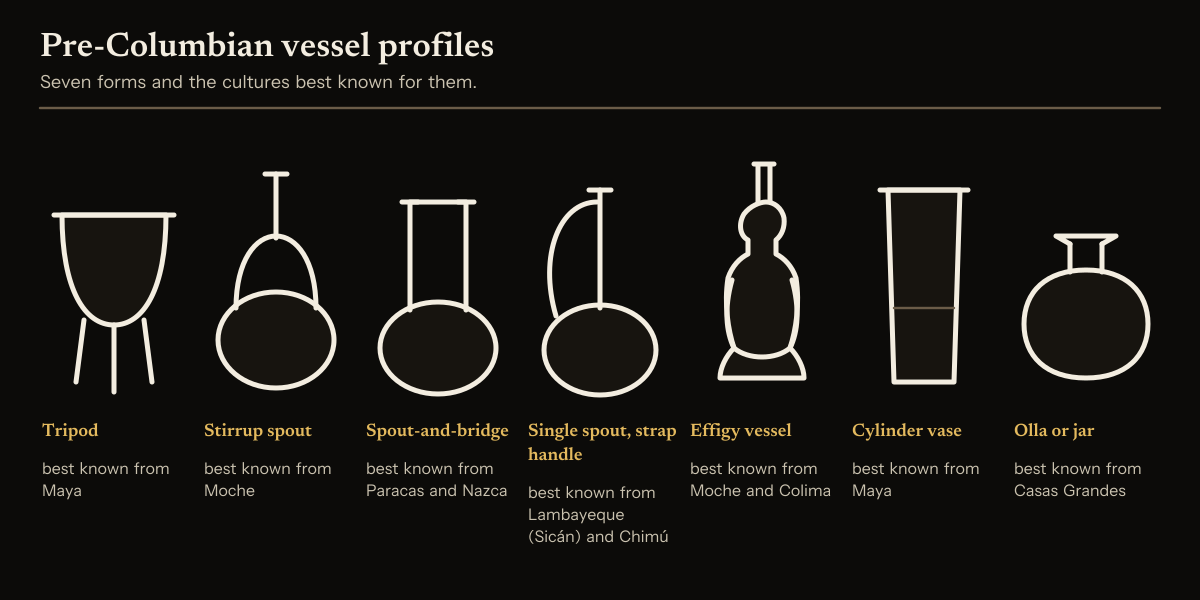
The whole object should be hollow and continuous. A seam may show where the chamber was joined, and the arch may carry a small modelled animal or human figure at its meeting point. Those details are useful comparisons, not requirements. The chart below places the stirrup spout beside six other vessel profiles, including the spout-and-bridge bottle that is most often confused with it. A shape can be described without naming a culture, and that description is the safest place to begin.
Stirrup spout or double-spout-and-bridge?
A double-spout-and-bridge bottle has two separate upright spouts joined by a solid bridge. Both spouts are open, and the bridge is a strap rather than a hollow tube. Paracas and Nazca potters made this form in great numbers, and it can look like a stirrup spout in a small photograph. Turn the vessel over or look into the openings: one outlet points to a stirrup spout, two outlets to a bridge bottle.
A single-spout bottle with a solid strap is a third form. It has one opening and a solid strap running from the spout to the chamber, familiar in later Lambayeque and Chimú work. The strap does not join two hollow branches, so it is not a stirrup. These distinctions matter because a seller may use the three names interchangeably. Ask for a view from above and a view into the spout before accepting a label.
Which cultures made stirrup spout vessels?
The form is older than the Moche. The Met dates a Cupisnique stirrup spout bottle to the twelfth to fifth century BCE. Cupisnique potters on the north coast made sculptural chambers with animals and incised imagery, and the form belongs to that early coastal tradition. Moche potters then made it one of their standard shapes between the first and eighth centuries CE, and Chimú potters were still using it in the twelfth to fifteenth centuries.
The long history means that a stirrup spout, best known from Peru's north coast but also made in Formative Mexico, including at Tlatilco, and in Formative Ecuador, is a clue to a tradition, not a signature of one culture. Chamber shape, surface finish, pigment and imagery do the harder work of attribution. A plain stirrup bottle can be placed in the wider north-coast sequence without being assigned to a named phase. The Moche pottery guide sets out the Moche sequence, the Chimú guide explains later blackware, and the Chavín guide places Cupisnique in its early setting.
What was a stirrup spout vessel used for?
The form is a container, and its construction is suited to holding liquid. That is an observation about the object, not a finding about its contents. Residues would be needed to say what a particular bottle held, and most vessels no longer carry that evidence. A stirrup bottle should not be assigned to chicha, water or a ritual drink on shape alone.
The Moche evidence is better for use than for contents. The Met's essay on Moche decorated ceramics says many fine vessels were placed in burials, but most were made to be used by the living. Many burial examples show abrasion, chipping or repair, which fits use before deposition. Some categories may have been reserved for burial or elite ritual. A find setting can support a domestic, burial or ceremonial reading; the vessel shape by itself cannot choose among them.
How confident can a date or attribution be?
Keep three levels separate. Observed: the vessel is hollow, has one outlet, two hollow branches and a chamber. Probable: it was made to hold liquid and belongs to one of the regions where the form is documented, above all Peru's north coast. Proposed: a specific culture, phase, workshop, contents or ritual meaning. The first level can be checked from good photographs and a description; the second needs comparison with published vessels; the third needs a record that names the find or a specialist who has studied the piece.
Museum dates often cover a broad tradition rather than the moment a pot was made. The Met's Cupisnique example spans eight centuries, and its Chimú example spans four. A dealer's phase name can look more precise than the evidence allows. Confidence labels are not a hedge for every sentence; they are a way to show which claim would survive a closer look. The glossary keeps form names separate from culture names.
What should you record before an attribution?
A useful record starts with the whole object and works inward. Photographs from the front, both sides, the top and the base show the arch, the outlet and the chamber. A view into the opening shows whether one spout or two are present. Measurements and a note on the surface help comparisons more than a style name does. If you want our view of a piece, what we buy says what we look at.
- Outlet: one opening or two; whether the rim is worn or chipped.
- Arch: hollow branches or a solid bridge; where they join the chamber.
- Chamber: round, oval, animal or human; any modelled details at the junction.
- Surface: slip, paint, burnish, mould seams, repairs and burial deposits.
- Breaks: old or fresh; whether the spout and arch are continuous with the body.
- Record: any findspot, old label or photograph that connects the piece to a place.
Further reading
- Bernier, Hélène. “Moche Decorated Ceramics.” Heilbrunn Timeline of Art History. The Metropolitan Museum of Art, 2009.
- Donnan, Christopher B. Moche Art of Peru. Museum of Cultural History, University of California, Los Angeles, 1978.
- Donnan, Christopher B., and Donna McClelland. Moche Fineline Painting: Its Evolution and Its Artists. Fowler Museum of Cultural History, University of California, Los Angeles, 1999.
- Burger, Richard L. Chavin and the Origins of Andean Civilization. Thames and Hudson, 1992.
- Quilter, Jeffrey. The Ancient Central Andes. Routledge, 2014.
Cite this guide: Precolumbian.com, “Stirrup Spout Vessel: Identify Its Form and Origin”, 2026, https://precolumbian.com/guides/stirrup-spout-vessels.html
Common questions
What is a stirrup spout vessel?
A bottle with a chamber connected to a single upright spout by two hollow branches that meet in an arch. The arch resembles a riding stirrup, which gives the form its modern name. It is an ancient ceramic bottle shape, not a piece of horse equipment.
What is the difference between a stirrup spout and a double-spout-and-bridge bottle?
A stirrup spout has one outlet and two hollow branches. A double-spout-and-bridge bottle has two open spouts joined by a solid bridge. A single-spout bottle with a solid strap has one opening and a solid strap. Counting the openings is the quickest check.
Which culture made stirrup spout vessels?
Several traditions. The form is best known from north-coast Peru: Cupisnique potters made them by the twelfth to fifth century BCE, Moche potters used them as a standard shape in the first to eighth centuries CE, and Chimú potters continued the form later. Related bottles are also documented in Formative Mexico and Ecuador. The shape alone does not name a culture.
How old are stirrup spout vessels?
The earliest examples in the Met's records are Cupisnique, dated to the twelfth to fifth century BCE. Moche examples run from the first to eighth centuries CE, and Chimú examples from the twelfth to fifteenth centuries. These are broad ranges, not dates for individual pots.
What were stirrup spout vessels used for?
They are containers built to hold liquid, but the contents are rarely known. Moche evidence shows that decorated vessels were used by the living and also placed in burials. Some may have been reserved for ritual. The shape supports a liquid-container reading, not a specific drink or ceremony.
Are all stirrup spout vessels Moche?
No. Cupisnique examples are earlier, and Chimú examples are later. Related bottles are also documented in Formative Mexico and Ecuador. A stirrup spout is most common on Peru's north coast; the clay, surface, imagery and chamber form are needed to place a piece in a region, culture or phase.
How can I tell an ancient stirrup spout from a copy?
Look for a continuous hollow body, a single outlet, wear inside the spout and arch, and joins that fit the modelling. Copies can be moulded or assembled from parts and may have fresh seams, uniform surfaces or an arch that does not connect. A photograph is a first step, not a test of age.
What does the arch of a stirrup spout do?
It carries air and liquid between the chamber and the single outlet, and it gives a grip. It is not a solid strap. The hollow connection is the feature that separates a stirrup spout from a bottle with a solid strap or a solid bridge.
Keep reading
Moche Pottery: Forms, Fineline Painting and Uses
The shapes, painted scenes, making and phases of Peru's north-coast Moche pottery.
Moche portrait vessels: faces, making and meaning
Individual faces in clay: how the vessels were made, what the portraits may mean, and what to compare.
Chimu pottery: blackware, moulded vessels and coastal art
Why Chimú vessels are black, how their shapes were made, and what separates them from earlier Moche work.
Chavin pottery and art: forms, fangs and the Early Horizon
Separate the highland centre, the wider Chavín style and coastal Cupisnique pottery.
Pre-Columbian art glossary: reading an object description
Plain definitions of the forms, techniques, periods and qualifications found in object descriptions.
Have something to sell?
Send us photographs and whatever you know. You hear back within two working days.
Or write straight to info@precolumbian.com