Guide: Peru, Ecuador and the Andes
Moche Pottery: Forms, Fineline Painting and Uses
Moche pottery is the ceramic tradition of the Moche, or Mochica, culture of Peru's north coast, made mainly between the first and eighth centuries CE. It is known for moulded vessels in the shapes of people, animals and plants, for stirrup-spout bottles and flaring bowls, and for fineline painting that records hunting, warfare, ritual and myth. Portrait heads are treated in a separate guide; this page covers the rest of the tradition.
- Chicama valleyNorth of the Moche valley; portrait heads are known from here
- Moche valleyHuacas de Moche, the southern Moche centre near Trujillo
- Virú valleySouth of the Moche valley; portrait heads are known from here
- SipánThe Lambayeque valley, where the tomb of the Lord of Sipán was found
- Region
- North coast of Peru, especially the Moche, Chicama and Virú valleys
- Dates
- About 100 to 800 CE; regional chronologies differ
- Made of
- Fired clay with coloured slips, largely mould-made with modelled details
- Forms
- Stirrup-spout bottles, effigy vessels, flaring bowls, dippers, jars and figurines
- Painting
- Mostly red on cream or white; fineline narrative scenes
- Subjects
- Animals, plants, people, deities, hunts, warfare and ritual
Where and when was Moche pottery made?
Moche communities lived in the river valleys of Peru's northern desert coast, from the Lambayeque region towards the Nepeña valley. The Moche, Chicama and Virú valleys, near modern Trujillo, are central to the story, and the site of Huacas de Moche gives the culture its name. Moche is a particular culture and ceramic style, not a general word for ancient Peruvian pottery.
Most accounts place Moche pottery between about 100 and 800 CE, although regional chronologies end at different points and some use a narrower range. Scholars often distinguish a northern Moche sphere, in the Jequetepeque and Lambayeque valleys, from a southern one around Moche and Virú. The same broad phase labels are used across both, but not every vessel fits neatly into one regional sequence. The Andean timeline places Moche beside Nazca and before Chimú.
Moche pottery by shape: bottles, bowls, dippers and figurines
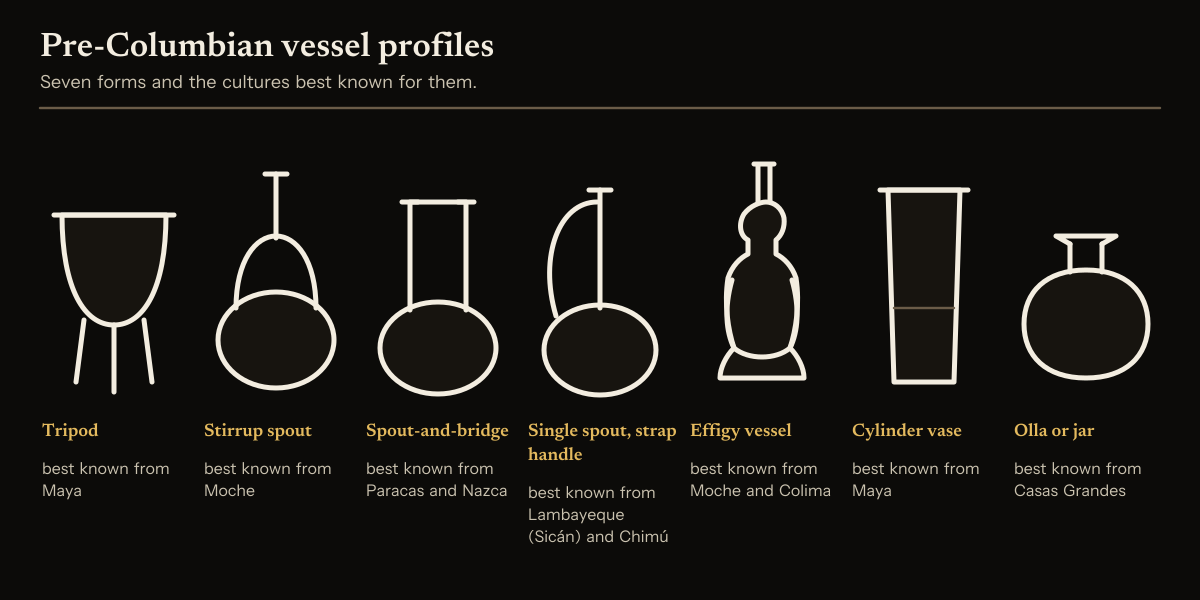
The best-known Moche form is the stirrup-spout bottle: a single vertical spout joined to the vessel body by a hollow arch. The arch is more than decoration; it is part of the vessel's construction and pouring behaviour. Moche potters made the form in moulds and added modelled details by hand, so related bottles can share a standard shape while differing in face, animal or scene.
Effigy vessels make the body itself a subject: a seated person, a fox, a bird, a fish, a plant or a composite being. Flaring bowls open outward at the rim and often carry painted scenes on their inner or outer surfaces. Dippers combine a small bowl with a projecting element, and the tradition also includes neck jars, neckless jars, cups, crucibles and small human figurines. Some figures incorporate a whistle, as the guide to whistling vessels explains, although a whistle cannot be assumed from the outside alone.
Portrait heads are a specialised Moche achievement and are covered in the guide to Moche portrait vessels. They are not the whole tradition: a Moche vessel can be a plain stirrup-spout bottle, an animal effigy, a painted bowl or a small modelled figure.
Moche pottery designs: animals, plants and painted scenes
Most Moche decorated vessels are painted in red on a white or cream ground. White-on-red schemes and black paint applied after firing also occur, but they are less common. The paint is a slip, a suspension of fine clay and mineral colour in water, applied before firing. Moche artists used it for broad colour fields, outlines and the very fine lines that give fineline painting its name.
Animals are everywhere in Moche art: camelids, deer, felines, foxes, rodents, monkeys, bats, sea lions, birds, fish, shells, arachnids and reptiles. Some are shown realistically, some are hybridised, and some behave like people. Maize, squash, tubers and beans appear among the plants. Human subjects include rulers, warriors, prisoners, priests, healers, skeletal figures and fanged deities. The motif dictionary explains why a feline or bird on a pot is not a fixed symbol.
The painting is not a random picture book. Moche artists repeated a small number of interrelated themes: deer and sea-lion hunts, sacrifice ceremonies, warriors in battle or procession, and messengers running in a line. Scholars read these scenes as ritual or mythical narrative, not as photographs of daily life. Some images may refer to historical events or people, but the names and exact meanings are not recovered.
Moche fineline painting: how scholars read the scenes
Fineline painting uses thin, controlled brushwork to fill a scene with figures, costume, plants and architecture. The result can look like a drawing carried around a pot. Because the scenes repeat, scholars can compare versions and identify a cast of recurring characters, gestures and objects. Modern names such as the presentation theme are descriptions by researchers, not titles preserved from Moche times.
A reader should resist translating one motif as a fixed word. A fanged figure, a prisoner and a sacrificed captive can belong to a larger composition, and the same animal can appear in different roles. The scene, the vessel shape and the archaeological context matter together. The glossary explains some of the terms used for Andean imagery.
Mould-making, firing and the five Moche phases
Moche pottery was largely mould-made, with hand-modelled additions. Potters pressed clay into moulds, joined parts, smoothed the surface and applied slip before firing. The regularity of Moche shapes is one reason the tradition can be sorted into types; it is also a reason a modern moulded copy can look convincing.
Rafael Larco Hoyle defined five phases of Moche ceramics in 1946, using changes in stirrup-spout bottles: the shape of the arch and spout, the spout rim, the proportion of body to spout, the paint and the sculptural detail. The sequence is still used, and it is supported by the positions of tombs in which vessels were found. The phases are relative orderings, not calendar dates. A label such as Moche IV does not by itself date a vessel to a particular century.
The northern and southern Moche regions do not follow one identical sequence. A piece may be assigned to a phase on the basis of its spout and painting, but the attribution should be read with the region and the comparanda in view. The Moche portrait guide discusses the portrait phases in more detail.
Moche, Chimú and Nazca pottery: what is the difference?
Moche is the earlier north-coast tradition. Chimú blackware belongs to a later kingdom centred on Chan Chan, generally dated from about 900 or 1000 CE to about 1470, and depends on dark reduced firing and extensive moulding. A Chimú vessel can share the stirrup spout with Moche work, but the surface, proportions and imagery usually point to a different tradition. The Chimú guide sets out the comparison.
Nazca is a south-coast tradition, roughly contemporary with Moche in its middle centuries. Nazca potters are known for multicoloured slip painting and double-spout-and-bridge bottles, not for the Moche range of modelled portraits and fineline scenes. A shared century does not make the two cultures the same, and the Nazca pottery guide explains the southern tradition.
What helps identify a Moche piece?
Start with the whole object: shape, proportions, paste, surface, paint and any repairs. A stirrup-spout bottle should be considered with its arch, spout, body and modelled subject together. Moche vessels often show wear from use, including abrasion, chips and old repairs; many were also placed in burials. Those traces are evidence to describe, not a certificate of age.
A photograph of the base, the spout opening, the joins and any restored areas is more useful than a single dramatic view. Recorded history, old labels, collection records and the circumstances in which a piece was acquired can matter as much as its style. The Pre-Columbian pottery identification key for stirrup-spout and support shapes compares those forms across cultures before the paint and modelling. How experts assess pottery explains why no one feature settles authenticity.
Modern copies and asking about a piece
Moche pottery is widely reproduced, from simple souvenir vessels to careful copies of famous subjects. A modern copy may have a sharp, uniform mould line, a flat or excessively even surface, simplified painting or colours that sit differently from an ancient slip. None of those observations proves the piece modern, because ancient vessels vary and copies can be aged.
The practical course is to compare the object with published Moche vessels and to have the material, surface and paint examined by someone who knows the tradition. For a first opinion, send clear photographs of the whole vessel, base, spout, decoration and repairs, with dimensions and what you know of its history. We buy single pieces and collections; we do not sell. Tell us about your piece; how we value sets out the factors we compare.
Further reading
- Bernier, Hélène. “Moche Decorated Ceramics.” Heilbrunn Timeline of Art History. The Metropolitan Museum of Art, 2009.
- Donnan, Christopher B., and Donna McClelland. Moche Fineline Painting: Its Evolution and Its Artists. Fowler Museum of Cultural History, University of California, Los Angeles, 1999.
- Bawden, Garth. The Moche. Blackwell, 1996.
- Donnan, Christopher B. Moche Art of Peru. Museum of Cultural History, University of California, Los Angeles, 1978.
Cite this guide: Precolumbian.com, “Moche Pottery: Forms, Fineline Painting and Uses”, 2026, https://precolumbian.com/guides/moche-pottery.html
Common questions
What is Moche pottery known for?
Moche pottery is known for modelled and painted vessels from Peru's north coast: stirrup-spout bottles, effigy vessels, flaring bowls and fineline scenes of animals, people, ritual and warfare. It is also known for portrait heads, which are treated in a separate guide.
What are Moche pottery designs?
Moche designs include animals, plants, geometric patterns and narrative scenes. Common animal subjects are camelids, deer, felines, foxes, rodents, monkeys, bats, sea lions, birds, fish and reptiles. Human and mythical figures appear in hunts, processions, battles and sacrifice scenes.
What is Moche fineline painting?
Fineline painting is the fine, controlled slip painting used on many Moche vessels, especially to carry complex scenes around bottles and bowls. Scholars compare repeated scenes to identify characters and themes, but the names given to those themes are modern descriptions.
What are Moche animal vessels?
Moche animal vessels are effigy pots whose body is modelled as an animal, sometimes with a stirrup spout or painted details. They include mammals, birds, fish, reptiles and shellfish. An animal shape does not by itself identify the species or prove the vessel ancient.
What do the five Moche phases mean?
The five phases are Rafael Larco Hoyle's relative sequence for Moche ceramics, based on changes in stirrup-spout bottles. They order vessels by shared features; they are not fixed calendar dates. Regional sequences differ, so a phase label is a starting point for comparison.
How can you tell Moche pottery from a modern copy?
Look at the whole vessel: shape, moulding, joins, surface, paint, wear and repairs. Copies often have simplified painting or very even surfaces, but ancient pieces vary and copies can be aged. No single feature is a test; specialist examination and documented comparisons are needed.
What is the difference between Moche and Chimú pottery?
Moche is earlier and is known for painted cream-and-red vessels, modelled effigies and fineline scenes. Chimú blackware is later, generally darker from firing, heavily moulded and associated with Chan Chan. The two can share a stirrup spout, but they are distinct traditions.
Keep reading
Moche portrait vessels: faces, making and meaning
Individual faces in clay: how the vessels were made, what the portraits may mean, and what to compare.
Chimu pottery: blackware, moulded vessels and coastal art
Why Chimú vessels are black, how their shapes were made, and what separates them from earlier Moche work.
Nazca pottery history: colours, forms and painted beings
How Nazca potters made their colours, what the images show, and what a mouse label really means.
Pre-Columbian history timeline: art, cultures and dates
An approximate chronology that keeps overlapping cultures and different regional period names distinct.
How to tell if pre-Columbian pottery is real
The evidence experts compare, the common copies and what a clay-age test actually establishes.
Have something to sell?
Send us photographs and whatever you know. You hear back within two working days.
Or write straight to info@precolumbian.com