Guide: Peru, Ecuador and the Andes
Valdivia figurines and the pottery traditions of Ecuador
Valdivia figurines are small stone and fired-clay human images made by early communities on Ecuador's coast and adjacent lowlands. Most ceramic examples appear female, with prominent breasts and carefully arranged hair, although some combine attributes read as male and female. Often called Valdivia Venus figurines, they belong to an early American sculptural tradition whose precise purposes remain uncertain.
- Jama-CoaqueThe coast of Manabí, Ecuador
- ValdiviaReal Alto, on the Santa Elena peninsula of coastal Ecuador
- La TolitaA centre on the northern coast of Ecuador
- Region
- Coast and adjoining lowlands of Ecuador; important sites include Real Alto and Loma Alta.
- Dates
- Valdivia broadly about 3300 to 1500 BCE in one museum sequence; broader chronologies begin earlier.
- Made of
- Carved stone and fired clay; many familiar ceramic figures are small and solid.
- Known for
- Human figurines, elaborate hairstyles and an early ceramic tradition that also includes vessels.
- How to recognise
- Compare material, construction and whole form; distinguish later coastal styles and modern copies.
Where and when were Valdivia figurines made?
The coastal and lowland region of present-day Ecuador is the main setting, with important discoveries at sites including Real Alto and Loma Alta. Valdivia is the name of an archaeological culture and ceramic tradition, not a generic word for every ancient Ecuadorian figure. The name also belongs to a modern place; an attribution does not establish that an object came from that village.
About 3300 to 1500 BCE is one museum timeline's broad range for Valdivia cultures. Other chronologies begin earlier, and accounts of the early stone images can reach back toward 4000 to 3500 BCE. The dates of an individual figure are narrower questions than the span of the whole culture. Valdivia pottery belongs among the early ceramic traditions of the Americas; calling every piece 'the oldest pottery in America' turns a complicated chronology into an unsupported superlative. The art timeline helps distinguish the early tradition from later coastal art.
How were the stone and clay figures made?
Early stone figures include simple flattened forms and more carefully carved bodies and faces. Their compactness can make them look very different from the familiar clay figures with elaborate hair. Material should be recorded first: a pale stone figure and a red ceramic figure do not necessarily belong to the same point in the sequence.
Many clay figures were formed from two rolls of clay pressed together for the body. A separate cap-like addition created the hairstyle, while arms could be only lightly indicated and a cut separated the legs. Incised lines articulate hair and facial features. These observations describe a construction tradition, not a recipe that proves a figure ancient whenever it is followed.
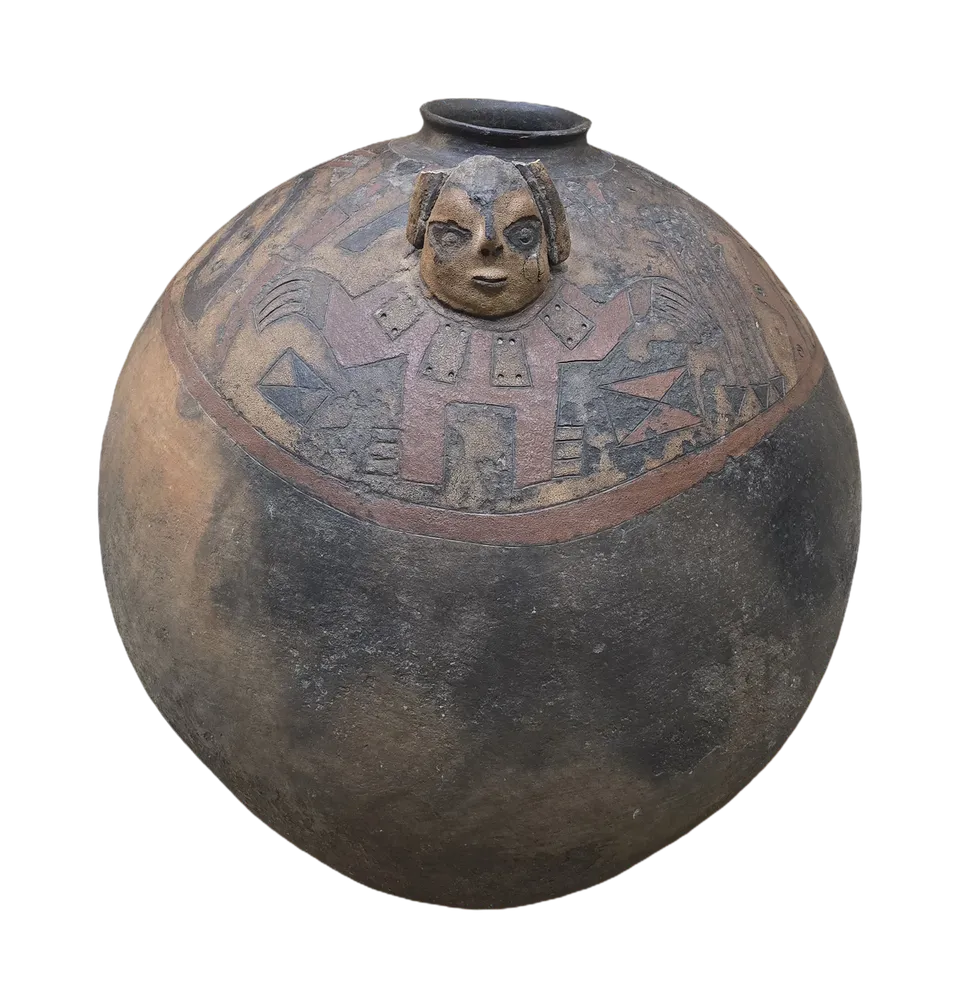
Valdivia culture pottery also includes vessels: the figurines are one part of a much larger ceramic history. A small human image should not be used as the template for every bowl or jar. Conversely, a vessel's proposed Valdivia attribution needs comparisons with vessels, not simply with the best-known figurines. The glossary separates modelling, incision, slip and other terms used in those comparisons.
Were Valdivia female figurines fertility goddesses?
Most of the ceramic figurines appear female, but that does not establish one identity for all of them. Some have features interpreted as both male and female, and bodies and hairstyles vary. Venus is a modern comparative nickname, not a recovered local deity's name or evidence of a connection with the Mediterranean goddess.
Fertility is the most common interpretation, partly because of the emphasis on sexual characteristics and their archaeological settings. At Real Alto, figures occur in several kinds of context, including burials and household refuse; most were found near hearths and food preparation areas. Their exact use remains unknown. A find near a hearth is evidence about a setting, not proof that every figure had the same ritual purpose.
The useful distinction is between what can be seen and what is inferred. 'A figure with prominent breasts and incised hair' is an observation. 'A fertility goddess' is an interpretation requiring more evidence. Keeping those statements separate makes a description more accurate without pretending the imagery lacked meaning to its makers.
What came after Valdivia: Machalilla and Chorrera?
Machalilla is conventionally placed about 1500 to 1100 BCE in one broad sequence, though transitions and boundaries vary. Its pottery includes stirrup-spout bottles, in which two hollow branches join a single outlet. The form is important in a longer northwestern South American history; seeing one does not automatically make a bottle Peruvian or Moche.
Chorrera follows within later Formative developments, broadly about 1100 to 300 BCE in that sequence, with other accounts beginning earlier. Finely finished bottles can take the shapes of plants and animals; whistling bottles and rounded human figures are particularly familiar. Chorrera human figures are typically hollow, either freestanding or forming a vessel, and can be much larger than the small solid clay figures commonly associated with Valdivia; many had mould-made fronts and hand-finished backs.
Chorrera ceramics often emphasise full rounded volumes, restrained anatomical detail and burnished surfaces. Burnishing is polishing during manufacture and need not involve a glaze. Not every Chorrera bottle whistles, and an attractive sheen cannot establish a date. The form, surface and construction should agree before a cultural name is attached.
How do Bahia and Jama-Coaque figures differ?
Bahía and Jama-Coaque belong to the later regional traditions of coastal Ecuador. Many celebrated examples fit broadly within the centuries around 300 BCE to 600 CE, although their full sequences begin or end differently in different accounts. Jama-Coaque continued into the sixteenth century, so this is not the full span of that culture. These names describe regional developments that overlap in time, not consecutive reigns of one country-wide kingdom.
Bahía ceramics include seated and standing people, some modelled at a much larger scale than Valdivia statuettes. Jewellery, pose and clothing contribute to their identity. Different Bahía types have different construction methods, so neither size nor the presence of a mould is enough to establish a particular attribution.
Jama-Coaque figures are often elaborately dressed, with headdresses, necklaces and other applied details. Artists used moulds and added separately made elements; paint could be applied after firing. Figures carrying ritual paraphernalia are read as priests and those holding a staff as political leaders, but a general costume resemblance does not identify a named individual. An elaborately adorned hollow figure should not be labelled Valdivia merely because both are Ecuadorian.
What is La Tolita or Tolita-Tumaco art?
Tolita-Tumaco connects the northern Ecuadorian and southern Colombian Pacific coast. Museum chronologies often use about 500 BCE to 300 CE for the tradition, while other accounts give somewhat different limits. Its ceramic figures can be strikingly individual, including seated people, elders and beings with combined human and animal features. Benches and ornaments may communicate rank, although each proposed identity needs its own supporting comparison.
The region is also important for gold and platinum work. Metalworkers combined platinum particles with gold using powder-based techniques, rather than simply melting platinum as if it behaved like gold. That achievement belongs to a later setting than the early Valdivia clay figures. The gold and tumbaga guide explains why a material name and a manufacturing technique are different kinds of evidence.
Shell belongs in the wider history as well. Coastal Ecuador was important in networks involving Spondylus, the spiny oyster whose colourful shell carried major significance in the Andes. The Spondylus guide follows that material. A shared interest in shell does not collapse the coast's many cultures into a single tradition.
A checklist for identifying an Ecuadorian figurine
Start with its construction and complete form before choosing the most familiar culture name. This is an enquiry checklist, not an authentication test.
- Material: distinguish carved stone from fired clay and record any separate metal or shell ornaments.
- Construction: small solid body, hollow figure, vessel, whistle or figure attached to another object.
- Features: describe hair, clothing, posture and sexual characteristics without assigning a deity from them alone.
- Surface: distinguish incision, applied details and surviving paint, including areas of later repainting or repair.
- History: match old photographs and written descriptions to the actual figure, rather than repeating a broad Ecuador label.
Modern copies and an opinion on your figure
Valdivia figures have a documented history of modern copying. Simplicity does not make a figure easy to authenticate, and an apparent match to a museum image cannot settle its age. Later Ecuadorian traditions also need their own comparisons. A piece can be genuinely ancient yet belong to a different period from the one on its label. Assessing pottery means considering construction, surface, style and history together.
We buy single pieces and whole collections; we do not sell. For a first opinion, send clear photographs and what you know, including dimensions and earlier labels. We reply within two working days, with an offer in writing where we can make one. There is no fee and no obligation.
Further reading
- Meggers, Betty J., Clifford Evans, and Emilio Estrada. Early Formative Period of Coastal Ecuador: The Valdivia and Machalilla Phases. Smithsonian Institution Press, 1965.
- Bruhns, Karen Olsen. Ancient South America. Cambridge University Press, 1994.
Cite this guide: Precolumbian.com, “Valdivia figurines and the pottery traditions of Ecuador”, 2026, https://precolumbian.com/guides/valdivia-and-ecuador-figurines.html
Common questions
What are Valdivia Venus figurines?
Valdivia Venus is a modern nickname for small early Ecuadorian human figures, especially ceramic examples read as female. It is not the name of a securely identified ancient deity. Some figures combine attributes interpreted as male and female, and their precise purposes remain uncertain.
Were all Valdivia figurines female?
No. Most ceramic examples appear female, but some combine characteristics interpreted as male and female. The earlier stone figures often combine female and male attributes. Sexual characteristics are important observations, yet they do not establish that every figure represented the same person, spirit or ritual role.
Is every ancient Ecuadorian figure Valdivia?
No. Ecuador has many later figurine traditions, including Chorrera, Bahía, Jama-Coaque and Tolita-Tumaco. Their figures can differ greatly in scale, construction, costume and surface. A country attribution is only a starting point; the particular regional tradition needs separate evidence.
Can a familiar hairstyle prove a Valdivia figure is ancient?
No. Elaborate hair is characteristic of many Valdivia clay figures, but modern copies can repeat it. A specialist must consider the whole form, clay construction, surface and documented history. Recognising an ancient design and establishing ancient manufacture are different conclusions.
Keep reading
Spondylus shell meaning: the thorny oyster in ancient art
What thorny oyster shell is, why it mattered, and why a red bead does not establish age.
Pre-Columbian gold and tumbaga: alloys, casting and value
Why a golden surface, an alloy recipe and an ancient attribution are different questions.
Pre-Columbian art timeline: cultures, dates and regions
An approximate chronology that keeps overlapping cultures and different regional period names distinct.
How to tell if pre-Columbian pottery is real
The evidence experts compare, the common copies and what a clay-age test actually establishes.
Have something to sell?
Send us photographs and whatever you know. You hear back within two working days.
Or write straight to info@precolumbian.com