Guide: Peru, Ecuador and the Andes
How old are the Nazca Lines? Their age, making, makers and meaning
How old are the Nazca Lines? About 2,000 years: the World Heritage record dates the figures and lines on this desert in southern Peru to between 500 BCE and 500 CE, and radiocarbon, pottery and luminescence studies narrow the range for particular sites. Below: what the lines are made of, who made them and why, how they were found, how many are known, and what Nazca Lines artifacts are.
- PalpaThe town in the Palpa valleys, where most of the dating studies in this guide were carried out
- Pampa de NascaThe plain between the Ingenio and Nasca valleys, where the geoglyphs are most numerous and where the World Heritage property is centred
- CahuachiThe ceremonial centre of early Nasca society and the starting point of paths to the geoglyphs, according to the British Museum
- Where
- The desert of southern Peru, about 400 km south of Lima, in the provinces of Nasca and Palpa
- Age
- 500 BCE to 500 CE in the World Heritage record; most figures of the Nasca period, about 200 BCE to 650 CE
- Makers
- The Paracas, then the Nasca people
- Method
- Dark surface gravel removed to show the paler ground; some lines built of piled stones
- Area
- About 450 square kilometres in the World Heritage record, more than 500 in the British Museum's
- Figures known
- 733 figurative geoglyphs in 2024: 50 giant line-type and 683 small relief-type
- Found
- Seen in 1927, presented to scholars in 1939, listed as World Heritage in 1994
How old are the Nazca Lines?
No single date fits, because the lines were made over many generations. The short description in the World Heritage record says the lines were scratched on the ground between 500 BCE and 500 CE. The nomination file behind it counts three phases: a first of 500 to 300 BCE, when figures were outlined by piling stones; a Paracas phase of 400 to 200 BCE; and the Nasca phase of 200 BCE to 500 CE, which it says holds the great majority of the geoglyphs. The British Museum dates the Nasca people themselves to 200 BCE to 650 CE.
A careful answer is a range with its method: about 2,000 years, with most figures from the Nasca period, roughly 200 BCE to 650 CE. Each end of that range rests on a different kind of evidence, and one researcher disagrees about the straight lines.
- Pottery on the lines. Johny Isla and Markus Reindel surveyed the geoglyphs of the Palpa valleys and dated each by the pottery lying on and beside it, reasoning that the oldest style present marks the time it was built. In 2005 they reported that most date to the early and middle phases of the Nasca culture and fewer to its late phase, and that they found no geoglyph building after that time in the area they studied. A figure with no pottery near it is dated by its likeness to the designs on Nasca pottery and textiles, which is weaker evidence than a measured date.
- Radiocarbon. A 2007 study of more than 100 samples from settlements, tombs and geoglyph sites around Nasca and Palpa put the Paracas and Nasca cultures, the makers of the lines, between about 800 BCE and 650 CE.
- Luminescence. In 2005 Jack Rink and J. Bartoll dated the sand buried when stones were laid down in two stone-line geoglyphs near Palpa. They concluded that the lines were probably built between 400 and 650 CE, late in the Nasca period.
- Disagreement. In 1990 Persis Clarkson dated the straight lines and trapezoids later than the animal figures, to the Middle Horizon or the Late Intermediate Period. Isla and Reindel found no evidence for that in Palpa, and the stone lines that Rink and Bartoll dated belong to the Nasca period.
What are the Nazca Lines made of, and how were they made?
Nothing was added to most of them. The desert plain is covered with sand and gravel that weathering has turned dark, and the makers removed that top layer to show the paler ground underneath. The World Heritage record describes the method as removing the overlying weathered gravels to reveal the lighter bedrock, and the British Museum describes the same removal of a top layer of earth. A very dry, windless and stable climate, the museum notes, has kept many of them.
The nomination file names two techniques. In the earliest figures the gravel was removed and piled inwards, so that the figure stands in slight relief; for the most part the gravel was removed from the whole figure, leaving a solid shape that contrasts with its surroundings. Researchers today sort the figures into giant line-type figures and smaller relief-type figures laid out in stones. Some geometric lines are built up, too: the stone lines near Palpa that Rink and Bartoll dated are walls of piled stone, one of them 1.5 to 2 metres wide.
The figures are large and the cut is shallow. An inventory of the Peruvian tourism ministry gives the depth of the trace as between 15 and 30 centimetres. The nomination file lists a spider of 46 metres, a monkey of 55, a lizard of 180, a guano bird of 280 and a pelican of 285 metres. Straight lines and geometric designs run for several kilometres.
How the makers laid out a figure is less certain than what it is made of. The World Heritage record credits a construction technology that allowed large figures with outstanding geometric precision, and does not describe it. Maria Reiche, who studied the lines for most of her life, argued that the makers drew each figure first on a small plot, some of which can still be seen beside the big figures, and enlarged it with cords stretched between stakes; wooden stakes have been found in the ground at the ends of some lines. On that account no one needed to see a figure from above to make it, though the British Museum notes that the figures can be seen whole only from the sky.
Who made the Nazca Lines?
The Paracas people began them and the Nasca people made most of them. The British Museum says the Nasca lived on the southern desert coast and the western slopes of the Andes between 200 BCE and 650 CE, and arose from the Paracas culture of the Pisco and Ica valleys, about 200 kilometres to the north; genetic studies, it adds, show that the two were the same ethnic group. The nomination file says the Nasca culture derived directly from that of Paracas.
Pottery ties the lines to these people. Nasca pottery lies on and beside the geoglyphs, and the animals and beings of the lines match the motifs painted on Nasca vessels and woven into their textiles. The settlements stand beside them. Cahuachi, in the valley of the Río Nazca, was the most important centre of early Nasca society, about 50 to 300 CE, according to the British Museum: the place where water gathered from the highlands was shared out and the starting point of the paths that led to the geoglyphs and ceremonial areas.
Why were the Nazca Lines made?
No one knows for certain, and the leading reading has changed over the decades. Three readings are in print, and the evidence for each is partial. Because the lines were made over many centuries, the readings need not exclude one another.
- A calendar in the sky. Paul Kosok, an American scholar who studied the lines from about 1940, proposed that they formed an agricultural calendar. Maria Reiche argued that lines pointed to places on the horizon where the sun or certain stars rose and set on important dates, and that some figures stood for constellations. The World Heritage record still says the lines are believed to have had ritual astronomical functions.
- Paths walked in ritual. Since about 1980, work in the Nasca valleys has read the lines as sacred places made and kept up by groups working together, who held rituals there in a cult of mountains, water and fertility; in 2005 the archaeologist Karsten Lambers noted that the evidence from the sites was still sparse. The British Museum adds that the Nasca walked along the lines in groups, with music and dance, that offerings and pottery have been found along them, and that tests of the compacted soil show the lines were heavily walked.
- Two kinds of figure for two audiences. In 2024 Masato Sakai and colleagues compared the two types. The giant line-type figures are mostly wild animals (64 per cent), lie on average 34 metres from the network of straight lines and trapezoids, and were probably made and used by whole communities for ritual. The small relief-type figures show mostly people and things people changed, such as domesticated animals and severed heads (81.6 per cent); they lie on average within 43 metres of ancient trails and were most likely made and seen by individuals or small groups.
How were the Nazca Lines discovered?
The Peruvian archaeologist Toribio Mejía Xesspe saw the lines in 1927, while working on a University of San Marcos expedition led by Julio C. Tello, and described them as sacred roads. He presented them to the scholarly world in 1939, at the 27th International Congress of Americanists in Lima, in a paper on the ancient aqueducts and roads of the Río Grande de Nazca basin.
Paul Kosok began to study them from about 1940, and Maria Reiche, a mathematician born in Dresden, devoted most of her life to them; the Peruvian Air Force gave her flights and aerial photographs from 1944. Kosok and Reiche published an article with aerial photographs in the magazine Natural History in 1947. The lines joined the World Heritage List in 1994. Sources differ by a year or two on some of these dates.
How many Nazca figures are known, and are more still found?
The count depends on what is counted. The 1994 nomination file counts about seventy large figures of animals, plants and imaginary beings, besides the lines and geometric designs.
More are still found. In 2024 a team from Yamagata University in Japan and IBM Research reported in the Proceedings of the National Academy of Sciences that nearly a century of searching had found 430 figurative geoglyphs. They trained an AI system on aerial images, surveyed the places it suggested on foot between September 2022 and February 2023, and confirmed 303 new figures in six months. The total is now 733: 50 giant line-type figures and 683 small relief-type figures. The team also found 42 new geometric geoglyphs.
The small figures were missed for a reason. The giant line-type figures are easy to see from the air, while the small relief-type figures are, in the paper's words, very difficult to discern.
What are Nazca Lines artifacts?
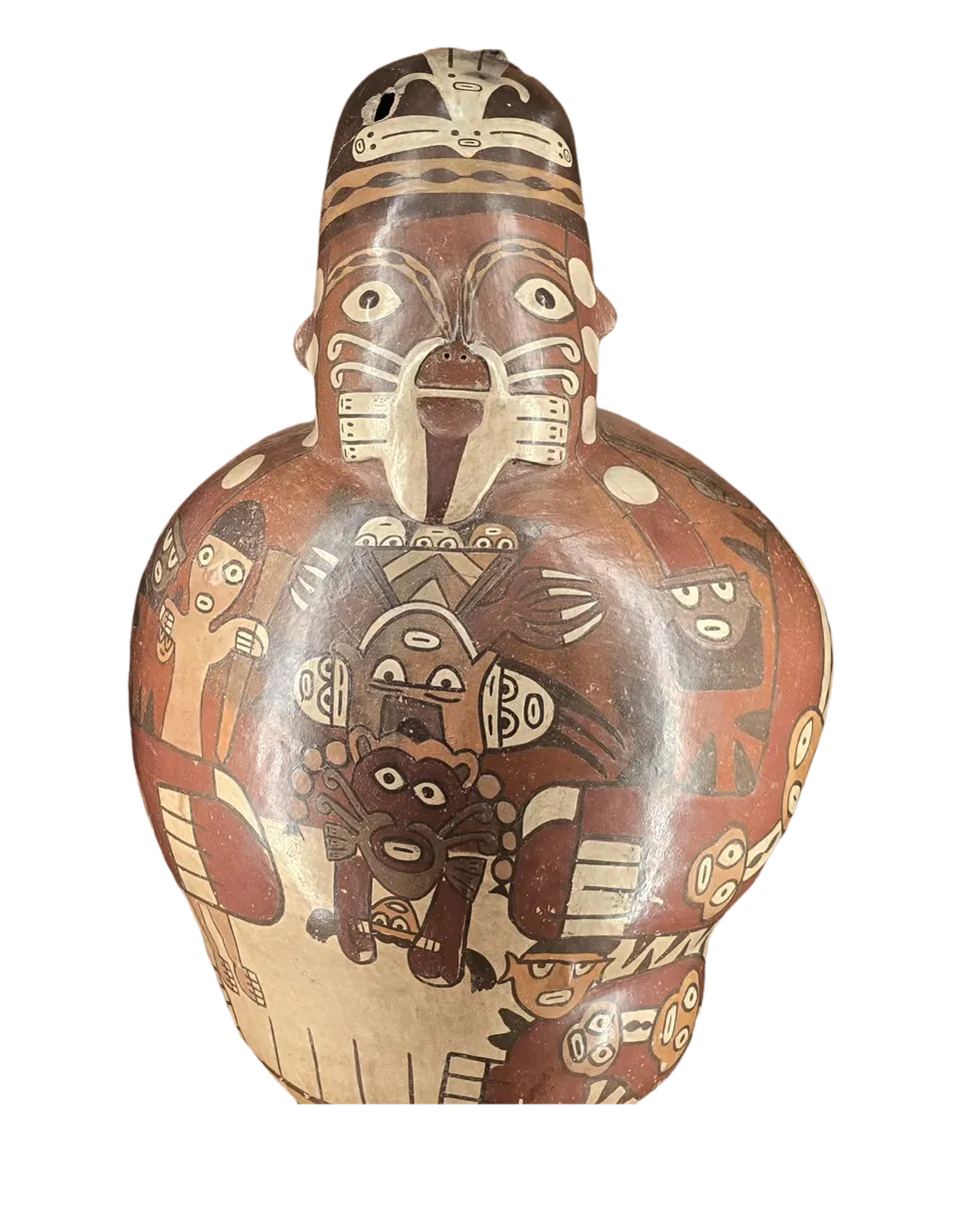
The lines are drawn on the land itself, so Nazca Lines artifacts means the objects made by the people who drew them. Painted pottery is the best known: bottles, bowls and effigy jars decorated with slips of several colours and with the same animals, plants and composite beings as the figures on the desert. Textiles and musical instruments such as panpipes, whistles and drums belong to the same world.
Pottery on the lines themselves matters in a different way: a sherd lying on a figure is how archaeologists date it. A whole vessel in a collection tells its own story only if its history is recorded, and a painted hummingbird or monkey does not prove age on its own. The Nazca pottery guide explains the bottles and colours, the Paracas guide the cloths of the earlier culture, and how to tell whether pottery is real why a familiar motif is not enough. What provenance means sets out which records count.
If you hold a piece of Nasca pottery or textile, what we buy says what we look at, and sending photographs takes a few minutes. The timeline and the list of famous works put the lines in a wider setting.
Further reading
- Aveni, Anthony F. Between the Lines: The Mystery of the Giant Ground Drawings of Ancient Nasca, Peru. University of Texas Press, 2000.
- Isla, Johny, and Markus Reindel. “New Studies on the Settlements and Geoglyphs in Palpa, Peru.” Andean Past 7, 2005.
- Unkel, Ingmar, Bernd Kromer, Markus Reindel, Lukas Wacker, and Günther Wagner. “A Chronology of the Pre-Columbian Paracas and Nasca Cultures in South Peru Based on AMS 14C Dating.” Radiocarbon 49 (2), 2007.
- Rink, W. Jack, and J. Bartoll. “Dating the Geometric Nasca Lines in the Peruvian Desert.” Antiquity 79 (304), 2005.
- Sakai, Masato, Akihisa Sakurai, Siyuan Lu, Jorge Olano, and Conrad M. Albrecht. “AI-Accelerated Nazca Survey Nearly Doubles the Number of Known Figurative Geoglyphs and Sheds Light on Their Purpose.” Proceedings of the National Academy of Sciences, 2024.
Cite this guide: Precolumbian.com, “How old are the Nazca Lines? Their age, making, makers and meaning”, 2026, https://precolumbian.com/guides/nazca-lines.html
Common questions
How old are the Nazca Lines?
About 2,000 years. The World Heritage record gives 500 BCE to 500 CE, with the great majority made in the Nasca phase, 200 BCE to 500 CE. Radiocarbon puts the Paracas and Nasca cultures between about 800 BCE and 650 CE, and luminescence dates two stone-line sites near Palpa to 400 to 650 CE.
What are the Nazca Lines made of?
Nothing was added to most of them. The makers removed the dark, weathered gravel from the desert surface and showed the paler ground beneath. Some lines are built instead from piled stones. The cut is shallow, between 15 and 30 centimetres according to an inventory of the Peruvian tourism ministry.
How were the Nazca Lines made?
By removing the dark top layer of stones to show the lighter ground. Maria Reiche argued that the makers sketched each figure on a small plot and enlarged it with cords and stakes; wooden stakes have been found at the ends of some lines. The World Heritage record does not describe the layout.
Who made the Nazca Lines?
The Paracas and then the Nasca people of the south coast of Peru. The Nasca lived there from about 200 BCE to 650 CE and arose from the Paracas culture. Nasca pottery lies on and beside the lines, and the animals of the lines match the motifs on Nasca vessels and textiles.
When were the Nazca Lines discovered?
Toribio Mejía Xesspe saw them in 1927 and presented them to scholars in 1939. Paul Kosok and Maria Reiche studied them from the early 1940s, and they joined the World Heritage List in 1994. New figures are still found: 303 in a survey of 2022 and 2023, so 733 figurative geoglyphs are now known.
Why were the Nazca Lines made?
Scholars disagree. Early studies saw an astronomical calendar; later work sees paths walked in rituals about mountains, water and fertility. A 2024 study finds that the giant animals were made for community ritual and the small figures for individuals or small groups beside trails.
Did aliens make the Nazca Lines?
No evidence supports it. The pottery lying on the lines, the settlements beside them and the matching animals on Nasca vessels tie them to the Paracas and Nasca peoples, and the 1994 expert evaluation of the site said that theories linking the lines to extraterrestrial beings can be summarily rejected.
Are there Nazca Lines artifacts?
The lines themselves are on the land, but the people who made them left painted pottery, textiles and musical instruments, which museums and private collections hold. The Nazca pottery guide describes the bottles and the painted beings.
Keep reading
Nazca pottery history: colours, forms and painted beings
How Nazca potters made their colours, what the images show, and what a mouse label really means.
Paracas pottery and textiles: resin paint, mantles and Topará
Post-fire ceramic colour and embroidered cloth, with the distinctions between Paracas, Topará and Nazca.
Famous pre-Columbian artifacts: 15 works and where they are
Fifteen famous objects and monuments of the ancient Americas, with where each was found and where it is kept.
Pre-Columbian art timeline: cultures, dates and regions
An approximate chronology that keeps overlapping cultures and different regional period names distinct.
Map of pre-Columbian civilizations: where the cultures lived
Three maps of the Americas: where the Olmec, Maya, Aztec, Nazca, Moche, Inca and others lived, and when.
Have something to sell?
Send us photographs and whatever you know. You hear back within two working days.
Or write straight to info@precolumbian.com