Guide: Peru, Ecuador and the Andes
Paracas pottery and textiles: resin paint, mantles and Topará
Paracas pottery is a south-coast Peruvian ceramic tradition particularly known for incised designs coloured with resin-bound paint after firing. Paracas textiles are equally distinctive, especially embroidered mantles associated with elaborate funerary bundles. A broad frame is about 700 BCE to 100 CE, although some ceramic dates begin around 800 BCE and some accounts extend the textile tradition later; pottery style, cemetery use and cultural history do not have identical boundaries.
- Region
- South coast of Peru, including the Paracas Peninsula and Ica region
- Dates
- Broadly about 700 BCE to 100 CE; some ceramics begin earlier and some accounts extend traditions later
- Made of
- Fired clay with pigments and organic binders; textiles of cotton and camelid fibre
- Known for
- Incised post-fire painting, spout-and-bridge bottles and embroidered mantles
- How to recognise
- Distinguish ceramic style, textile technique, cemetery context and the overlapping Topará tradition
- Paracas PeninsulaThe desert peninsula where the Paracas burials were found
Where and when was Paracas culture?
Paracas is associated with Peru's south coast, including the Paracas Peninsula and the Ica region. It names a site and a wider set of artistic and archaeological traditions. A jar described as Paracas is not necessarily documented as coming from the peninsula itself. The geography of a style and the recorded place of discovery of one object are separate questions.
About 700 BCE to 100 CE is a commonly used broad outline, with museum ceramics also dated as early as about 800 BCE. Other introductory accounts extend Paracas to about 200 CE. The differences matter especially around the transition to Nasca, also spelled Nazca, when several south-coast traditions overlapped. The art timeline provides a broad sequence without turning those changing regional relationships into a single moment of replacement.
How was resin-painted Paracas pottery made?
Potters incised designs into the clay and added colour after the vessel was fired. Mineral pigments mixed with organic binders produced the characteristic post-fire paints, often called resin paint. Incision outlines the coloured areas on many examples. The painted layer and the fired clay are different components of the object, which matters when describing surviving original decoration.
Post-fire describes the sequence of making, not the age of the paint. Ancient Paracas painters used this method, and later repainting can also sit on an older ceramic body. Calling every painted surface original because the clay seems old overlooks that distinction. A description should say what remains visible and what is uncertain, rather than assume that every coloured area has the same history.
This is a characteristic technique, not a demand that every Paracas vessel have a complete multicoloured design. Bottles, bowls and jars have different treatments, and worn or incomplete surfaces can obscure the original appearance. The glossary explains incision, pigment and slip, three terms that describe different things.
What is a double-spout-and-bridge bottle?
Two upright spouts rise from the chamber and are connected by a solid bridge. On many Paracas bottles one spout is modelled as a head, often a bird's, which may be closed or act as a whistle, so only the other spout pours. The arrangement differs from a stirrup spout, whose hollow branches meet beneath one upright outlet. The double-spout form is an important south-coast comparison, but it also appears in Topará and Nasca pottery. It cannot identify Paracas independently of the rest of the vessel.
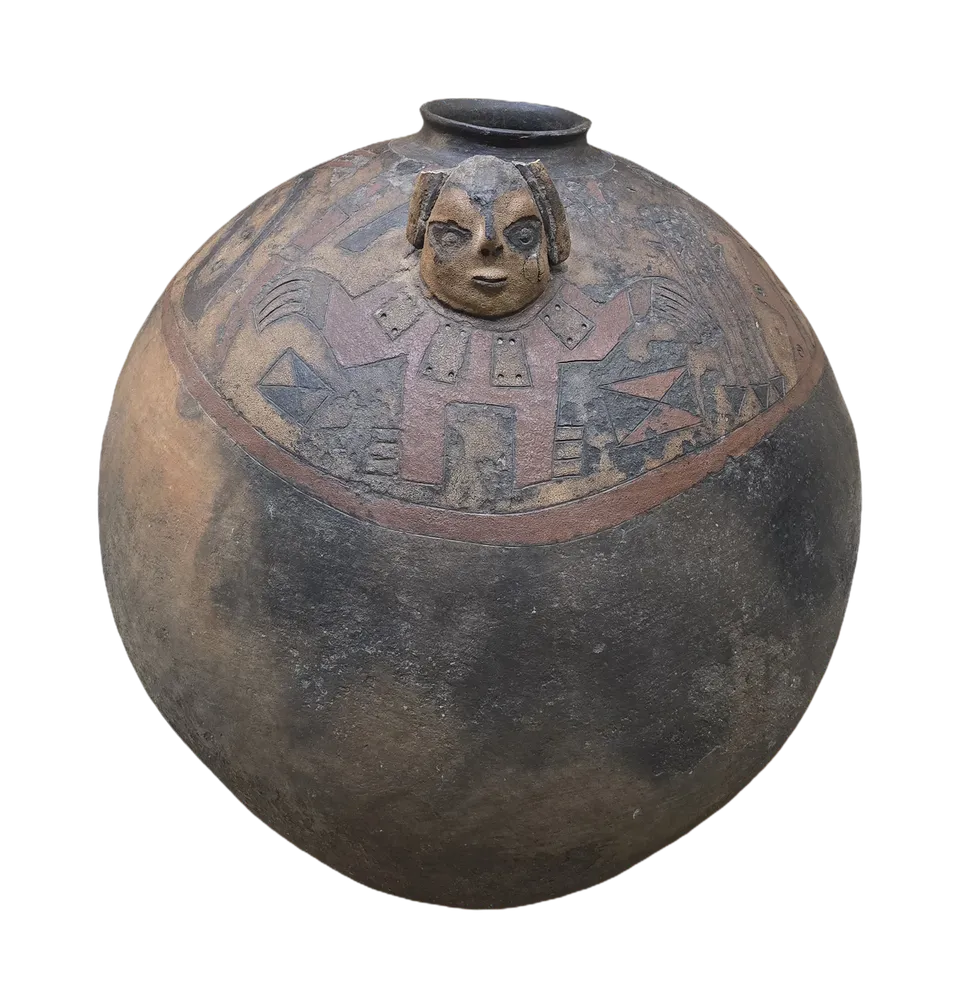
Paracas artists also made single-spout bottles, bowls and larger jars, sometimes combining modelled features with painted imagery. Our pieces page includes a Paracas globular jar with a modelled face. That is one form, rather than a template for all Paracas pottery: the relationship of chamber, spout and decoration needs to be described for each object.
What do the figures and animals mean?
Early Paracas imagery drew on northern traditions including Chavín-related designs, then developed distinct south-coast forms. Felines, birds, fish, serpents and composite beings occur in the wider artistic repertoire. Oculate Being is a scholarly name for prominent-eyed supernatural imagery, not a recovered ancient personal name. Specific compositions can include flying figures and severed heads, but a single explanation should not be assigned to every occurrence.
The meaning depends on the complete figure and its setting. A frontal face on a jar, a repeated animal on a mantle and a complex flying figure are different kinds of evidence. Similar motifs across cloth and pottery allow comparison; they do not prove that every maker gave them an identical meaning. Describe the visible features first and keep interpretations visibly provisional.
What are the Paracas Necropolis and its textiles?
Necropolis means a cemetery. In Paracas studies it is also the name associated with famous burial groups at Wari Kayan on the peninsula, investigated by Julio C. Tello and colleagues in the 1920s. The layered funerary bundles contained clothing and other textiles, including embroidered mantles. Their survival reflects the exceptionally dry coastal environment, rather than a claim that every Andean region preserved cloth equally well.
A mantle is a large cloth garment, not a synonym for any fragment of embroidery. Paracas textile makers used cotton and camelid fibres. In many embroidered works, cotton forms the ground cloth and dyed camelid threads form the decoration, although structures and fibre combinations vary. Embroidery adds stitches to an existing fabric; it is not the same as weaving the image into the cloth. The textiles guide develops those technical distinctions.
Linear Style embroidery organises designs through repeated lines and geometric relationships. Block Color embroidery gives figures broader areas of colour and often more open space. These styles overlapped rather than replacing one another everywhere on a single date. Differences in imagery and stitching therefore need to be assessed together, rather than treated as a simple early-versus-late colour chart.
How does Topará fit into Paracas history?
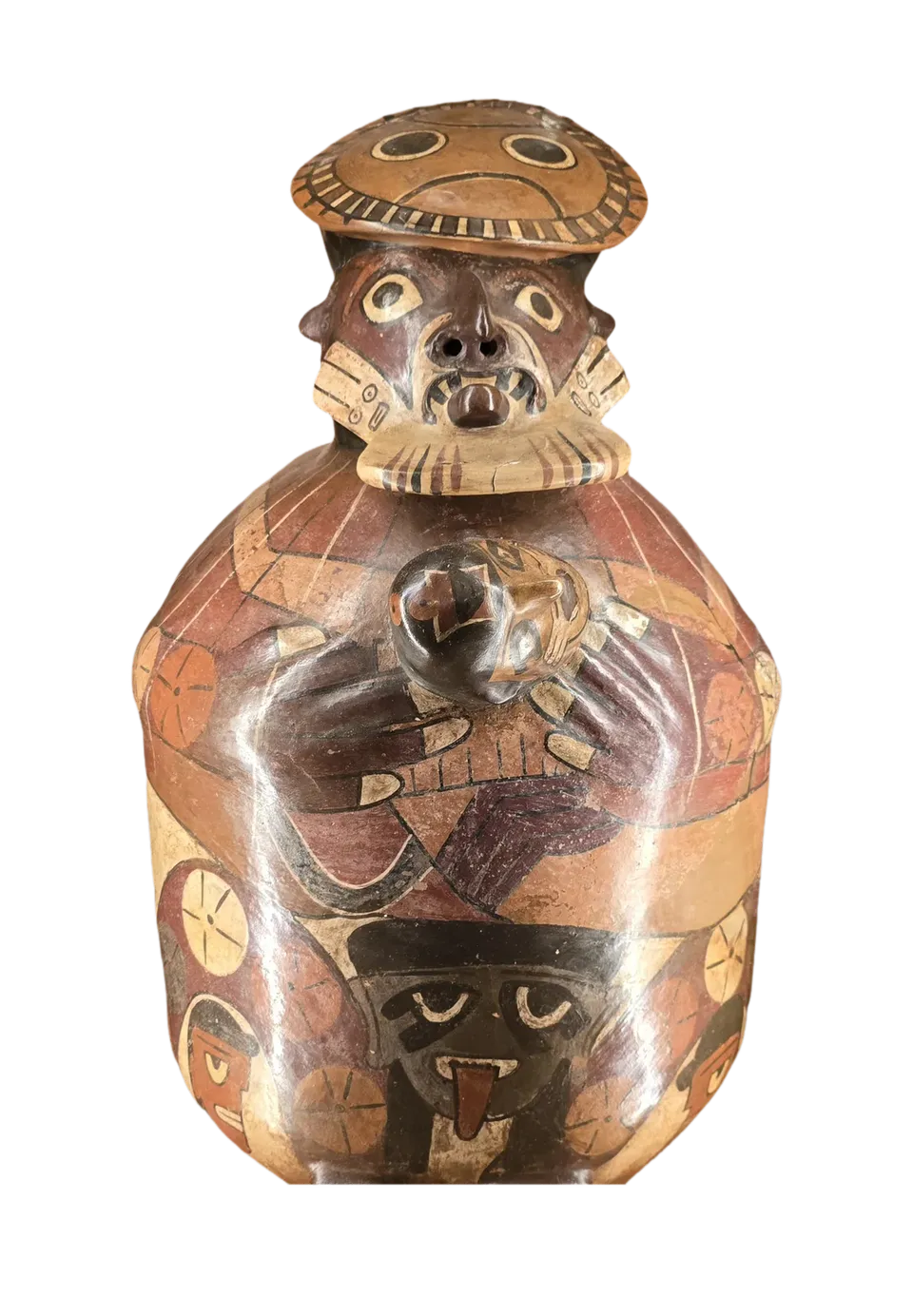
Topará names a distinct ceramic tradition overlapping late Paracas and early Nasca; some museum accounts treat it as a Paracas substyle, others as a separate tradition. Its familiar vessels favour simple forms, thin walls, polished surfaces and single colours, sometimes with bodies resembling gourds. Examples include cream or orange-red slip-painted ceramics rather than the incised resin-painted decoration commonly associated with Paracas.
Tello distinguished two groups of burials on Cerro Colorado: the Cavernas shaft tombs, associated with incised resin-painted Paracas pottery, and the later Necropolis pit tombs, associated with fine slip-painted pottery later named Topará. Research on the Necropolis finds late Paracas, Topará and early Nasca traditions in use while the cemetery was being created. Paracas Necropolis is therefore not a label for incised resin-painted pottery. Cemetery, textile tradition and pottery tradition are related categories whose names do not always align.
- Paracas ceramic comparison: incision and post-fire resin-bound colour are characteristic, though not universal.
- Topará ceramic comparison: thin-walled, polished and often single-coloured vessels can accompany related funerary textiles.
- Nasca ceramic comparison: polychrome slips applied before firing became a defining technical and visual emphasis.
- Necropolis: a cemetery and mortuary context, not one exclusive ceramic recipe or an exact synonym for a textile style.
Paracas versus Nazca: what changed?
Nasca potters developed the south-coast colour tradition through mineral slips applied before firing. The contrast with Paracas post-fire paint is useful, while forms such as the double-spout bottle continued. Textile techniques and imagery also crossed the conventional boundary. A transition means continuity and change, not that an entire population abruptly vanished.
Some famous cloths traditionally called Paracas are now attributed to early Nasca. A familiar name may reflect reported discovery or an older classification rather than the maker's culture. The Nazca pottery guide explains that later ceramic tradition. Compare the specific structure, technique and imagery instead of dating a work simply from the name attached to its most famous published comparison.
Reproductions and asking about Paracas artifacts
A reproduction can repeat an incised bottle shape or a familiar embroidered figure. Resemblance alone cannot establish antiquity. For a ceramic, the body and original painted surface need separate attention; for a textile, distinguish the surviving cloth and embroidery from later additions. The authenticity guide explains why an assessment uses several kinds of evidence rather than one supposedly decisive visual clue.
For a first opinion, send clear photographs of the complete piece and details, dimensions, repairs and any earlier records. We buy single pieces and whole collections; we do not sell. See what we buy to ask about pottery or a textile. We reply within two working days, with an offer in writing where we can make one, with no fee and no obligation.
Further reading
- Paul, Anne, ed. Paracas Art and Architecture: Object and Context in South Coastal Peru. University of Iowa Press, 1991.
- McHugh, Julia. “Andean Textiles.” Heilbrunn Timeline of Art History. The Metropolitan Museum of Art, 2020.
- Moseley, Michael E. The Incas and Their Ancestors: The Archaeology of Peru. Thames and Hudson, 1992.
Cite this guide: Precolumbian.com, “Paracas pottery and textiles: resin paint, mantles and Topará”, 2026, https://precolumbian.com/guides/paracas-pottery-and-textiles.html
Common questions
Was Paracas pottery painted before or after firing?
Many characteristic Paracas vessels received resin-bound pigment after firing, often within incised outlines. This differs from the pre-fire coloured slips associated with Nasca polychrome ceramics. The distinction describes techniques, rather than requiring every vessel attributed to either tradition to have an identical finish.
What are Paracas textiles made of?
Paracas textiles use cotton and camelid fibres. Embroidery in dyed camelid fibre is stitched onto plain-woven grounds of cotton or camelid fibre, and many of the best-known Necropolis mantles are camelid fibre throughout. Their images may be created through embroidery or other textile structures, so colour and subject alone do not identify the technique.
Is Topará another name for Paracas?
No. Topará is a distinct south-coast pottery style that began after about 400 BCE and overlapped late Paracas and early Nasca; some museum accounts treat it as a Paracas substyle, others as a separate tradition. Its thin-walled, polished vessels are the pottery Tello found with the Necropolis burials on the Paracas Peninsula.
What is the Paracas Necropolis?
The name refers to famous burial groups at Wari Kayan on Cerro Colorado, at the neck of Peru's Paracas Peninsula. They are especially known for layered funerary bundles and embroidered textiles. The cemetery's use overlapped changing south-coast traditions, so its name is not an exclusive cultural attribution for every object associated with it.
Keep reading
Nazca pottery history: colours, forms and painted beings
How Nazca potters made their colours, what the images show, and what a mouse label really means.
How old are the Nazca Lines? Their age, making, makers and meaning
How old the Nazca Lines are, what they are made of, who made them and why, and how many figures are known.
Pre-Columbian textiles: Peruvian cloth, weaving and identity
Read the fibre, weave and original garment before assigning a culture or trusting an ancient date.
Chavin pottery and art: forms, fangs and the Early Horizon
Separate the highland centre, the wider Chavín style and coastal Cupisnique pottery.
How to tell if pre-Columbian pottery is real
The evidence experts compare, the common copies and what a clay-age test actually establishes.
Have something to sell?
Send us photographs and whatever you know. You hear back within two working days.
Or write straight to info@precolumbian.com