Guide: Reference
Pre-Columbian Symbols and Motifs: What They Show
Pre-Columbian symbols and motifs are the repeated shapes and creatures carved, painted and woven across ancient Mexico, Central America and the Andes: crossed bands, cleft heads, felines, birds, snakes, stepped patterns, tocapu squares and staff-bearing figures. A motif can be described precisely and still be hard to translate. This dictionary separates what is visible on an object from what scholars propose it meant.
At a glance
- Cultures
- Olmec, Maya, Teotihuacan, Aztec (Mexica), Chavín, Moche, Wari, Inca and others.
- Date range
- About 1200 BCE to 1532 CE, across Mesoamerica and the Andes.
- Media
- Carved stone, pottery, jade, gold, textiles and wall painting.
- What a motif is
- A repeated visual form, not a fixed word.
- Best evidence
- The object's date, place and setting, not the motif alone.
How to read a motif
A motif is a visual form that recurs: a way of drawing a head, a cat, a snake, a band or a square. Recurrence makes it useful for comparison. It does not make it a word. The same shape can appear on objects from different cultures and centuries, and a familiar name can hide a change in meaning.
Read every motif in four steps. First describe what is actually there: outline, proportions, added marks, colour and position. Second place it: culture, region, date and the kind of object. Third ask what scholars have proposed, and on what evidence. Fourth ask how secure that proposal is. The entries below follow those four steps, and each points to the guide that treats its culture in full.
Crossed bands

What you see. Two bands cross at the centre of a bordered field, making an X. The bands are often drawn as parallel outlines rather than solid bars, and small discs or circles can sit in the spaces around the crossing. The pattern is symmetrical and reads clearly from either side.
Where and when. The motif appears on Olmec greenstone objects. A jadeite celt-pendant in the Metropolitan Museum's collection, dated about 900 to 600 BCE, carries a U-shaped element filled with crossed bands connected to a circle. The Olmec guide sets the object beside the other carved greenstones of the period.
What scholars read in it. One museum reading compares the crossed-band layout to a quincunx: four quarters arranged around a centre. In later Mesoamerican thought the quincunx can stand for the four directions and the middle. Whether an Olmec maker intended that meaning is a further step, not something the pattern states by itself.
How sure that reading is. The date, material and carved layout are secure. The quincunx comparison is a museum interpretation, and the jump from a four-part pattern to four world directions depends on later sources. Treat the direction reading as plausible and unproven, not as a translation.
The cleft head
What you see. A head, usually rounded or slightly pointed, with a deep V-shaped notch cut into the top. The notch can run a short way into the forehead or much farther. Some examples add a short line or sprout below it; many do not.
Where and when. Cleft heads are a hallmark of Olmec art of the Gulf Coast, especially in the centuries around 1200 to 400 BCE. They occur on small greenstone figures and pendants as well as on larger carvings. The Olmec guide covers the related baby-faced and composite figures.
What scholars read in it. The Metropolitan Museum's catalogue of a cleft jadeite celt-pendant reads the V as the hole in the earth where maize seed was planted, with the sprout emerging above. It identifies the figure as the Olmec Maize God. Other accounts list several possibilities: an open fontanelle, the groove in a male jaguar's skull, or a toad's head. Maize sprouting is one reading among these, not a definition of every cleft.
How sure that reading is. Scholars differ. The notch is easy to see; its meaning is not settled. The maize reading fits objects that also show sprouts or a maize-like setting, and it should not be carried to every cleft head. A cleft alone does not identify a deity.
Feline imagery
What you see. A cat can be drawn in profile or from the front, with rounded ears, a broad muzzle, a long tail and clawed feet. Some images are naturalistic; others combine a human body with feline teeth, claws or pelt. Spots may be painted, incised or left out.
Where and when. Felines occur in Olmec art and in the Chavín art of highland Peru, among many other traditions. Chavín's Lanzón stela, carved between about 900 and 200 BCE, shows a figure with fangs and talon-like nails that scholars associate with the jaguar and the caiman. The Chavín guide treats the stone carving and its composite creatures together. Felines also fill Moche painted scenes; the Moche pottery guide shows how they sit among the animals and rituals.
What scholars read in it. A feline is a predator, and predators carry power in many Indigenous systems of thought. Museum accounts read Olmec feline claws and Chavín fangs as signs of a being that combines human and animal authority. Some images may show transformation between a person and a cat; others may mark rank, lineage or a named supernatural. These are related proposals, not one meaning.
How sure that reading is. The animal features are observable. The interpretation is hedged: a feline image does not prove a jaguar cult, and a jaguar does not stand for one idea everywhere. Identify the species and the context first; keep the reading of power or transformation as a scholarly proposal.
Eagles and serpents
What you see. An eagle has a hooked beak, a broad wing and clawed feet. A serpent has a long curving body, a wedge-shaped or rounded head and often a forked tongue. When feathers are carved along a snake's body, the image combines the two creatures and is usually called a feathered serpent.
Where and when. Eagles and serpents are ancient Mesoamerican subjects. At Teotihuacan, the Moon Pyramid deposits included eagles, serpents and other predators, and the Feathered Serpent Pyramid carries the creature's name. A stone feathered-serpent head in the Metropolitan Museum is dated about 100 to 500 CE; gold feathered-serpent ornaments were made much later, between 1325 and 1521. The Aztec guide explains how animal attributes work in Mexica sculpture.
What scholars read in it. Eagles are predators of the air; snakes move through earth, water and vegetation. A feathered serpent joins a bird's covering to a snake's body, and the combination recurs across Mesoamerica over more than a thousand years. Museum accounts treat these as powerful creatures and as attributes of named beings, but the same image can belong to different traditions.
How sure that reading is. The identification of the creatures is usually secure. The meaning of a particular eagle or serpent is not: Teotihuacan's feathered serpent cannot simply be given the later Aztec name Quetzalcoatl, and a snake on a pot is not automatically a god. Date and place decide which reading is possible.
Stepped designs
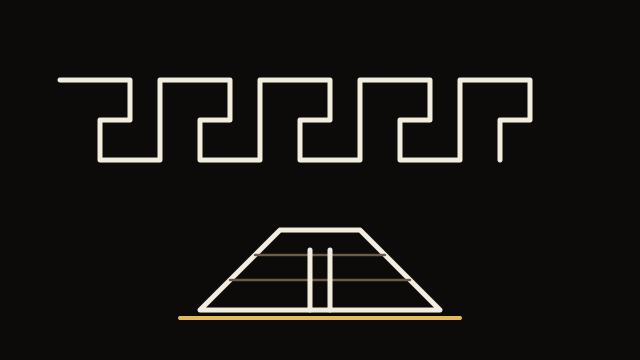
What you see. A stepped design moves in right angles, like a staircase seen from the side. In a step fret it becomes a continuous meander or border; in architecture it becomes a platform with receding tiers. The same right-angle rhythm can be flat ornament or a building profile.
Where and when. A man's tunic from the Central Coast of Peru, dated about 1000 to 1476 CE, carries a principal step-fret design repeated in contrasting colours. At Teotihuacan, the Sun, Moon and Feathered Serpent pyramids were built as stepped platforms with stairways facing the Street of the Dead, in the first centuries CE. The textile guide places the Peruvian example among its traditions.
What scholars read in it. Textile historians describe the step fret as a repeating border that organises a garment's design. Architectural historians describe the stepped platform as a stage for processions and ritual, with access controlled by stairs and raised platforms. Those are readings of use and setting, not a dictionary definition of the shape.
How sure that reading is. The forms, dates and settings are well documented. A single meaning for steps is not. A stepped band on a tunic and a stepped pyramid belong to different media and different cultures; the resemblance is visual, and it does not prove a shared doctrine.
Tocapu
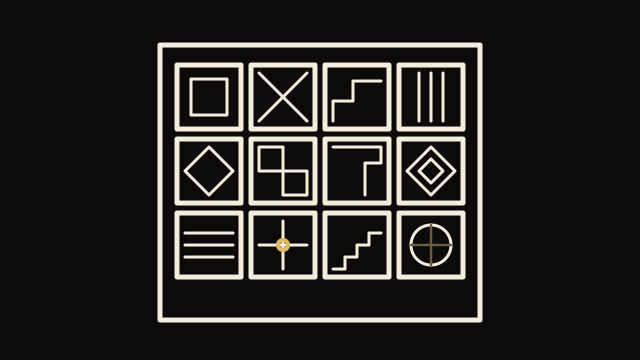
What you see. Tocapu are small square or rectangular motifs set in a grid, often on an Inca tunic. Each square holds a different arrangement of steps, bars, diamonds, crosses or checks. The grid can run as a border or cover most of the garment.
Where and when. Tocapu belong to Inca textile design of the fifteenth and early sixteenth centuries. The Metropolitan Museum's account of Andean textiles describes tocapu as coded geometric designs along borders or as an all-over grid on Inca tunics. The Inca guide explains why cloth carried so much of Inca art.
What scholars read in it. The squares are not free decoration. Scholars connect them with rank, identity and the organisation of the empire; specific designs may relate to peoples, places or social roles. The designs have not been read as a continuous text, and no single key translates a square into a word.
How sure that reading is. Scholars differ about individual designs, and the general point is firmer than any translation: tocapu marked status and difference. Proposals that tocapu formed an alphabet, a calendar or a map remain unproven. Describe the square, its garment and its date first.
The Staff God
What you see. A frontal, symmetrical figure holding a staff upright on each side. The body can be human, with a fanged mouth, clawed hands and feet, hair or a belt ending in serpent heads. The name Staff God is a modern description of the pose, not a recovered ancient title.
Where and when. The image belongs to Chavín art of highland Peru, about 900 to 200 BCE. A painted Chavín textile in the Metropolitan Museum, made in the fourth or third century BCE and said to have been found on the south coast, shows a fanged figure with raptor claws, serpent hair and a serpent belt that the catalogue relates to the Staff God. The Wari and Tiwanaku guide follows related staff-bearing figures into the Middle Horizon.
What scholars read in it. Museum accounts call the Staff God one of the main deities worshipped at Chavín de Huántar. The staffs, fangs, claws and snakes mark a being of combined human and animal power. Portable textiles and other objects are thought to have carried the imagery far from the temple, which helps explain why related figures appear in later Andean art.
How sure that reading is. The Chavín setting and the figure's features are documented. The identification as one god, and the link to every later staff-bearing figure, are hedged. A shared pose can record a shared tradition without proving that each image names the same being.
What a motif cannot tell you
A motif cannot date an object, name its maker or prove that it is ancient. Modern copies reuse crossed bands, cleft heads, step frets and tocapu grids because those forms are familiar and attractive. A correct motif on a wrong object is still a wrong object.
Use a motif as one comparison among several. The object's material, shape, construction, surface and recorded history matter at least as much. The identification key sets out the questions to ask before naming a piece, and the authenticity guide explains what a laboratory test can and cannot show. The Olmec guide and the Inca guide treat their objects in full. If you are considering selling, tell us what you have for a written offer.
Further reading
- Miller, Mary Ellen, and Karl Taube. The Gods and Symbols of Ancient Mexico and the Maya: An Illustrated Dictionary of Mesoamerican Religion. Thames and Hudson, 1993.
- Burger, Richard L. Chavin and the Origins of Andean Civilization. Thames and Hudson, 1992.
- Miller, Mary Ellen. The Art of Mesoamerica: From Olmec to Aztec. Thames and Hudson, 1986.
- Townsend, Richard F. The Aztecs. Thames and Hudson, 1992.
- Coe, Michael D. The Maya. Thames and Hudson, 1966.
- Coe, Michael D., and Mark Van Stone. Reading the Maya Glyphs. Thames and Hudson, 2001.
- Moseley, Michael E. The Incas and Their Ancestors: The Archaeology of Peru. Thames and Hudson, 1992.
Cite this guide: Precolumbian.com, “Pre-Columbian Symbols and Motifs: What They Show”, 2026, https://precolumbian.com/guides/pre-columbian-symbols-and-motifs.html
Common questions
What do Aztec symbols mean?
There is no single dictionary that translates Aztec symbols. A motif's meaning depends on the object, its date, its setting and the other images around it. Colonial written sources help with some names and associations, but they do not decode every carving. Read the visible features first, then the scholarly proposal.
What does the Olmec X symbol mean?
The crossed-bands motif is often compared to a quincunx, a four-part layout around a centre. That comparison may point to the four directions, but the link is drawn from later Mesoamerican ideas. The date and carved form are secure; the meaning is not.
What does a jaguar mean in pre-Columbian art?
A jaguar can signal a predator, a source of power or a being that combines human and animal traits. It does not carry one fixed meaning across Mexico and the Andes. Identify the species and the object first, then ask what the local tradition does with feline features.
What does a feathered serpent mean?
A feathered serpent combines a snake's body with bird covering. It appears at Teotihuacan and in later Mesoamerican art, where it is associated with named deities in some contexts. The same image can belong to different traditions, so the date and place come before any name.
What is tocapu?
Tocapu are small geometric motifs set in grids on Inca textiles, especially tunics. Scholars connect them with rank, identity and social roles, but the designs have not been read as a continuous text. They are not a simple alphabet.
What is the cleft head?
A cleft head has a deep V-shaped notch at the top. Olmec scholars have read it as a maize sprout, an open fontanelle, a jaguar skull feature or a toad's head. The notch is observable; the meaning is debated, and not every cleft head is a maize god.
Can I identify a piece from its motif alone?
No. A motif can support a comparison, but it cannot establish age, culture or authenticity by itself. Material, shape, construction, surface and recorded history carry the argument. Modern copies reuse the same motifs.
Keep reading
Olmec art: jade, colossal heads and the meaning of its symbols
Distinguish Gulf Coast culture, the wider Olmec style and uncertain readings of familiar symbols.
Aztec figures and meanings: gods, animals and pottery
Read deity attributes and animal imagery without turning every figure into the same god or symbol.
Chavin pottery and art: forms, fangs and the Early Horizon
Separate the highland centre, the wider Chavín style and coastal Cupisnique pottery.
Inca art and artifacts: pottery, textiles, metal and stone
What makes a piece Inca: standard pottery forms, textiles, miniature figures and misleading old labels.
Pre-Columbian textiles: Peruvian cloth, weaving and identity
Read the fibre, weave and original garment before assigning a culture or trusting an ancient date.
Have something to sell?
Send us photographs and whatever you know. You hear back within two working days.
Or write straight to info@precolumbian.com