Guide: Peru, Ecuador and the Andes
Wari pottery and Tiwanaku art: two Middle Horizon traditions
Wari pottery is the ceramic art of a society centred in Peru's Ayacucho highlands, known for colourful slip painting, face-neck vessels and striking combinations of figures and abstract design. During the Middle Horizon, broadly about 600 to 1000 CE, Wari interacted with the independent Tiwanaku society of the Lake Titicaca region. Their art shares religious imagery, but Wari and Tiwanaku are neither two names for one culture nor early names for the Inca.
- HuariThe Wari capital, near Ayacucho
- TiwanakuThe highland city south of Lake Titicaca, Bolivia
- Region
- Wari: Ayacucho and a wider Peruvian sphere; Tiwanaku: Lake Titicaca region and wider connections
- Dates
- Middle Horizon comparison broadly about 600 to 1000 CE; broader cultural histories extend outside this span
- Made of
- Slip-painted clay; associated arts include cotton, camelid fibre, stone and wood
- Known for
- Wari face-neck jars and tapestry tunics; Tiwanaku beakers, animal burners and stone monuments
- How to recognise
- Compare separate regional traditions while accounting for shared imagery and ancient adaptations
Where and when were Wari and Tiwanaku?
Wari, also spelled Huari, names both the capital near modern Ayacucho and the wider society associated with it. Wari influence spread across much of what is now Peru. Tiwanaku names a major ceremonial centre near the southern shore of Lake Titicaca in present-day Bolivia and the society associated with it. Its wider cultural reach extended beyond the city and across present-day national borders.
About 600 to 1000 CE is a useful frame for comparing their Middle Horizon arts. It is not a claim that Tiwanaku began only when Wari flourished: broader histories give Tiwanaku earlier beginnings and extend it into the eleventh century. Some outlines also extend Wari later. Chronologies for cities, political expansion and particular art styles answer different questions. The pre-Columbian timeline helps keep these horizons distinct from the later Inca empire.
What is distinctive about Wari culture pottery?
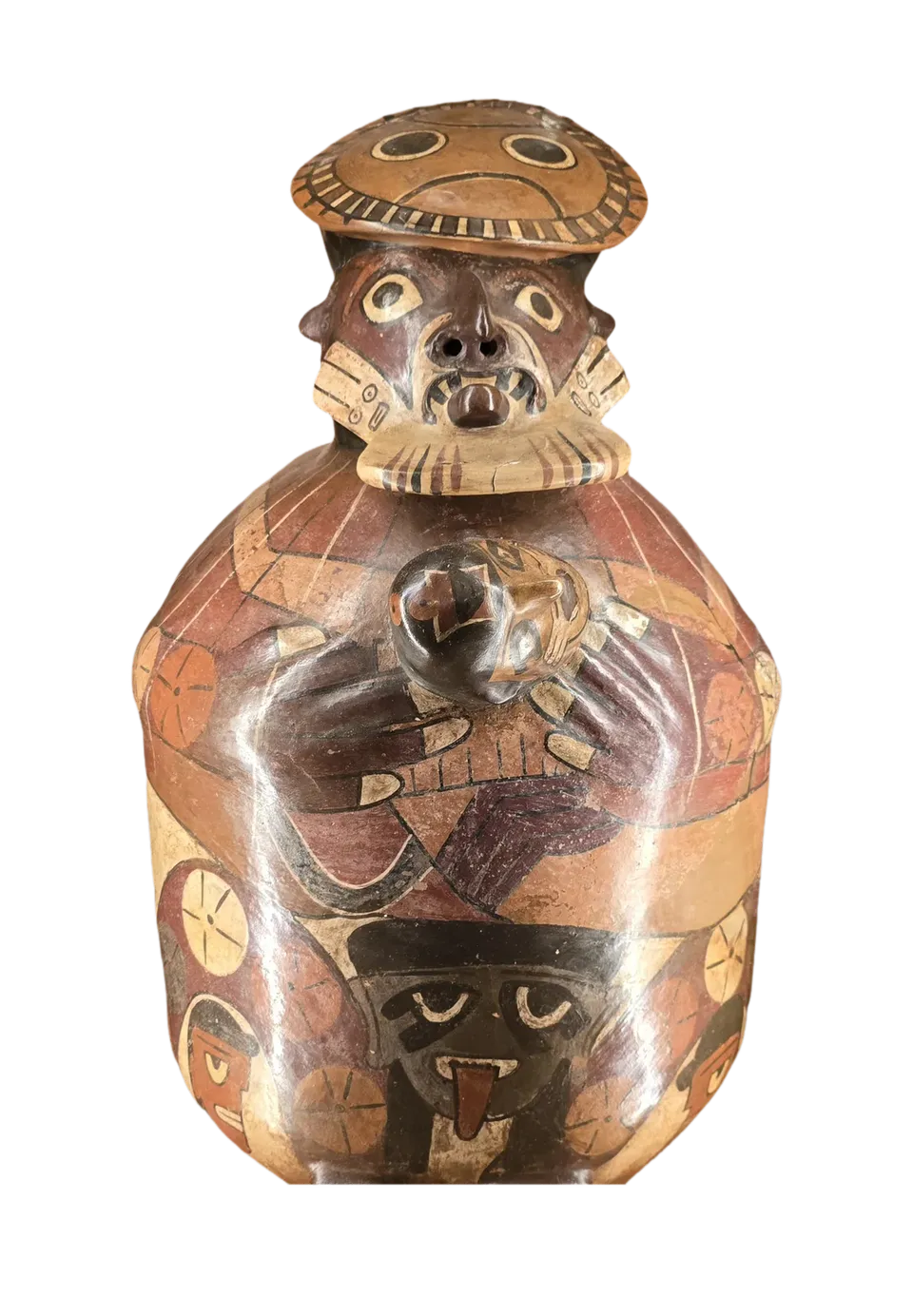
Wari ceramics combine strong colour, outlined imagery and modelled forms. Slip is a clay-rich liquid used to decorate the vessel before firing; polychrome describes the use of several colours. Artists made bowls, bottles, cups and jars, with animals, people and supernatural beings appearing as painted designs or as parts of the vessel itself. There is no single Wari pot shape.
South-coast Nasca traditions contributed to the colourful ceramic language of Wari art. Images associated with Tiwanaku were also adapted by Wari makers. A vessel can therefore combine a coastal painting tradition with highland religious imagery. That relationship is more informative than calling every multicoloured Peruvian bottle Nasca. The Nazca pottery guide describes the earlier south-coast tradition without making the two labels interchangeable.
Face-neck describes a vessel with a face on its neck. On many examples the chamber below becomes the body of a figure in a tunic; others place a supernatural face above an otherwise simpler container. Human and deity readings depend on costume and attributes. A face on a jar does not automatically make it a portrait of an identifiable person, nor does it prove that the jar came from the capital.
Why are the large urns from Conchopata important?
Conchopata in the Ayacucho area was a major centre of Wari ceramic production. Excavations revealed oversized painted urns and anthropomorphic jars, often recovered as broken offerings. Production debris shows that these vessels were made there. Their subjects include figures related to the imagery of Tiwanaku monuments as well as distinct Ayacucho figures.
Some vessels were deliberately broken in ceremonial events. Interpretation depends on the particular deposit: archaeologists distinguish offerings, events associated with sealing spaces and other contexts rather than assigning every fragment the same function. These finds anchor comparisons in archaeological evidence. A small unrecorded jar with similar painting cannot automatically be called a Conchopata offering or assigned the history of those excavated urns.
What are Wari tapestry tunics and figurines?
Wari tapestry tunics turn repeated images into tightly organised fields of colour. Weavers used camelid fibres and cotton, and some fine garments use camelid fibre throughout. Stylised beings can be compressed or transformed until they look almost geometric. Their abstraction is a deliberate design choice, not a sign that the maker could not draw a figure.
Tunics and four-cornered hats are associated with status and ceremonial dress. Scholars interpret their designs within Wari social and religious life, but not every pattern can be translated into a particular rank or named wearer. The textiles guide separates tapestry weaving from embroidery, a distinction that matters even when the finished images look similar.
Wari artifacts also include small carved figures, such as turquoise examples, and sculptural wooden containers. A search for Wari figurines therefore reaches beyond clay. The material, dimensions and actual form should be established before a little human figure receives a ceramic or ritual classification simply because it resembles something in a photograph.
What is Tiwanaku pottery known for?
Tiwanaku ceramics include flaring drinking beakers commonly called keros, as well as bowls and animal-related vessels interpreted as incense burners. Kero, keru and quero are alternative spellings used for Andean beakers. Keros were made in clay and in wood, some even in gold or silver, and wooden keros continued long after Tiwanaku under the Inca and into colonial times, so the name describes a vessel category rather than independently proving a Tiwanaku date.
Painted felines, birds and composite beings occur with bold outlines and fields of colour. On many Tiwanaku feline images an eye is divided into black and white halves, a stylization also described on the Staff God in Wari art. Certain open vessels have a projecting feline head and an opposite tail. Soot inside documented examples supports their interpretation as burners; the same use should not be assigned to every animal-shaped container solely from its silhouette.
Who built Tiwanaku? The people of the Tiwanaku society created its city and monuments centuries before the Inca empire. Its stonework belongs within a documented Andean tradition, alongside ceramics, textiles and other arts. Attributing the city to the Inca because both are Andean erases the considerable interval and the distinct society that produced it.
What does the shared Staff God imagery mean?
A frontal supernatural figure holding upright objects, often called the Staff God or staff-bearing deity, is central to comparisons between Wari and Tiwanaku imagery. Rayed head ornaments, profile attendants and combinations of human and animal features form part of this visual language. Tiwanaku's Gateway of the Sun provides an important monumental comparison.
The term Staff God is descriptive. It does not establish one unchanged deity name across every century or community. Identification with the later creator Wiraqocha is proposed by some researchers rather than securely demonstrated for all these images. Earlier Chavín imagery offers another comparison, but resemblance does not make a Middle Horizon cup a Chavín object.
- Wari centre: the Ayacucho region of Peru; compare painted ceramics, face-neck vessels and tapestry tunics.
- Tiwanaku centre: the Lake Titicaca region, especially the ceremonial city in present-day Bolivia.
- Shared imagery: staff-bearing beings and attendants link the artistic worlds without merging their identities.
- Distinct evidence: form, material, design and archaeological context are stronger together than one familiar motif.
What does Wari-style mean on a label?
It may describe resemblance to a Wari design rather than a securely established workshop or place of manufacture. Ancient regional works can combine Wari imagery with local techniques. A later copy can also repeat a Wari design. Ask whether the description identifies an ancient regional tradition, proposes a cultural attribution or merely notes a visual comparison; the wording alone cannot resolve those alternatives.
Photographs provide a beginning for that assessment. Include the complete form, base, neck, decoration, dimensions and any earlier records, with repairs or surface changes visible. Assessing authenticity explains the limits of isolated clues. We buy single pieces and whole collections; we do not sell. Ask about your piece for a first opinion. We reply within two working days, with an offer in writing where we can make one, with no fee and no obligation.
Further reading
- Isbell, William H., and Gordon F. McEwan, eds. Huari Administrative Structure: Prehistoric Monumental Architecture and State Government. Dumbarton Oaks Research Library and Collection, 1991.
- Kolata, Alan L. The Tiwanaku: Portrait of an Andean Civilization. Blackwell, 1993.
- Young-Sánchez, Margaret, ed. Tiwanaku: Ancestors of the Inca. Denver Art Museum and University of Nebraska Press, 2004.
Cite this guide: Precolumbian.com, “Wari pottery and Tiwanaku art: two Middle Horizon traditions”, 2026, https://precolumbian.com/guides/wari-and-tiwanaku-art.html
Common questions
Are Wari and Tiwanaku the same culture?
No. They were distinct contemporary societies with different centres: Wari in Peru's Ayacucho highlands and Tiwanaku in the Lake Titicaca region. Their arts share imagery and reflect interaction, but a shared staff-bearing deity image does not establish one combined state.
What is a Wari face-neck jar?
It is a vessel with a face on the neck, often above a chamber that represents a figure in a tunic. Examples can depict people or supernatural beings. The face's features and accompanying attributes matter more than the generic presence of a face when interpreting the subject.
What is Tiwanaku?
Tiwanaku is both an ancient ceremonial city near Lake Titicaca in present-day Bolivia and the name used for its associated society. Its artists made monumental stonework, painted pottery and textiles. The city and its major artistic traditions preceded the Inca empire.
Is every kero a Tiwanaku cup?
No. Kero and its alternative spellings are used for flaring beakers made in several Andean traditions and periods, including Tiwanaku, Wari and Inca. Tiwanaku keros were made in fired clay and also in carved wood, and wooden keros continued under the Inca and into colonial times. Material, profile, decoration and documented comparisons are needed to place an individual example.
Keep reading
Nazca pottery history: colours, forms and painted beings
How Nazca potters made their colours, what the images show, and what a mouse label really means.
Chavin pottery and art: forms, fangs and the Early Horizon
Separate the highland centre, the wider Chavín style and coastal Cupisnique pottery.
Pre-Columbian textiles: Peruvian cloth, weaving and identity
Read the fibre, weave and original garment before assigning a culture or trusting an ancient date.
Inca art and artifacts: pottery, textiles, metal and stone
What makes a piece Inca: standard pottery forms, textiles, miniature figures and misleading old labels.
Have something to sell?
Send us photographs and whatever you know. You hear back within two working days.
Or write straight to info@precolumbian.com