Guide: Peru, Ecuador and the Andes
Pre-Columbian Whistling Vessels, Ocarinas and Flutes
Pre-Columbian whistling vessels are ceramic instruments that make sound when air or water moves through a small whistle built into the pot. The best known are the double-chambered water whistles of Peru and Ecuador, but whistles, vessel flutes and flutes were also made in Mesoamerica and Colombia. This guide separates the main kinds, explains the mechanism in plain terms, and shows what an instrument's shape can and cannot tell you.
At a glance
- Region
- Mesoamerica, the Andes and the lands between, especially Peru and Ecuador
- Dates
- Double-chambered vessels from about 750-400 BCE in Mesoamerica; Andean examples through the 15th century
- Made of
- Fired clay with slip or paint; rare gold examples survive
- Forms
- Single whistles, vessel flutes, double-chambered water whistles, quenas and panpipes
- Sound
- A whistle tone, often quiet; water whistles add flowing and breath-like noises
- How to recognise
- A hollow chamber with a duct and edge, or two chambers joined by a tube; not every hole is a mouthpiece
Whistles, ocarinas, flutes and whistling vessels compared
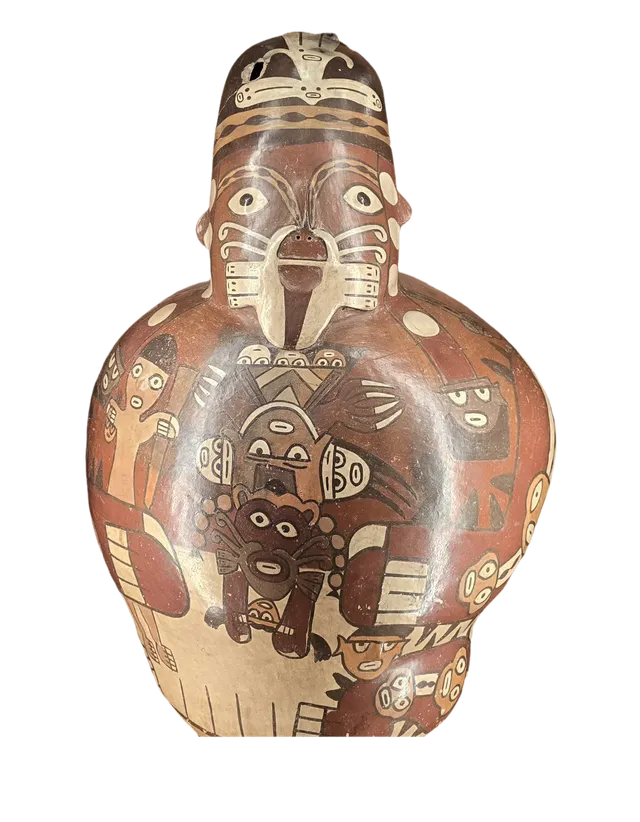
A whistle is the simplest of these instruments: air is forced past a sharp edge and the column of air in a cavity sounds. In a whistling vessel the whistle is built into the pot, so the vessel itself is the instrument. A single-chambered whistle has one cavity. A double-chambered whistling vessel has two chambers joined by a tube, with the whistle in the closed chamber. The player tips the vessel, and the movement of air or liquid does the rest.
An ocarina is a vessel flute: an enclosed cavity with finger holes and a mouthpiece, played by blowing. The word is Italian and dates from the nineteenth century, so it is a modern name for a very old form. Museums use it for small globular flutes from Colombia, Mesoamerica and elsewhere. A flute is a tube, end-blown or side-blown. Andean flutes include the quena, a vertical end-notched flute, and panpipes, which are sets of stopped tubes of different lengths. Panpipes and quenas are not whistling vessels, even when they are found beside them.
- Whistling vessel. A pot with a built-in whistle; it may be blown directly or sounded by tilting water through a second chamber.
- Ocarina. A modern name for a vessel flute with finger holes; the ancient instrument is the cavity and the holes, not the name.
- Flute. A tube with an open end or a notch; quenas and panpipes belong here, not with the vessel whistles.
- Rattle. Loose pellets or a separate chamber that shakes; a vessel can carry a rattle and a whistle at the same time.
How a water whistling vessel makes sound
The classic Peruvian water whistle has two chambers connected by a narrow tube. One chamber has a wide opening; the other is closed and carries the whistle. When the vessel is tilted, liquid runs from the open chamber into the closed one. That pushes air out through the whistle duct, and the whistle sounds. When the vessel is tilted back, the liquid returns and air is drawn in again, producing a softer breath-like noise. The cycle can repeat with each tilt, and the flow of liquid adds its own sounds.
Not every whistling vessel needs water. Many South American examples have a spout that can be blown directly, with or without liquid. Mesoamerican double-chambered vessels more often have a wide cup-shaped opening that is hard to seal with the mouth, which is why researchers describe most of them as liquid-driven. The instrument is quiet, and its tone and rhythm depend on the size of the chambers, the tube, the whistle and the amount and thickness of the liquid. A vessel that no longer sounds may simply have a blocked duct, a repaired edge or a lost mouthpiece.
Peruvian and Ecuadorian whistling vessels
The Peruvian coast has a long record of these instruments. Cupisnique potters made ceramic whistles in the second millennium BCE, and the double-chambered bottle appears in several later traditions. Vicús, Moche and Chimú vessels are among the best known, with larger resonators and lower tones than the small high-pitched examples from central Mexico. Moche artists also made figure whistles in clay and, in at least one surviving example, in gold. Paracas potters used double-spout-and-bridge bottles, and on some of them one spout acts as a whistle.
In Ecuador, whistle bottles were developed and refined during the Chorrera culture, roughly 900 to 100 BCE, and became more complex in the Bahía period. A study of a Chorrera-Bahía double bottle with a bird form found that the instrument sounded both when blown and when moved with water inside. Its makers combined animal shapes with sounds that were described as imitating nature. That does not prove every animal-shaped bottle imitated that animal, but it shows that the form and the sound were designed together. The Chavín and Moche pottery guides describe those cultures.
Mesoamerican and Colombian examples, without equating them
Mesoamerica has its own tradition of whistling vessels, separate from the Peruvian water whistle. Teotihuacan made double-chambered whistling vessels in the Classic period, roughly 100 to 650 CE. Their chambers are small and their tones high, and at least some were liquid-driven. Maya artists made whistles and vessel flutes in the form of people, animals and deities, often with one or two finger holes. A crocodile whistle and rattle, a whistle showing the Maize God emerging from a flower, and a simple whistling vessel are all known from Maya contexts of the first millennium CE.
In Colombia, Tairona potters made small ocarinas in the centuries before the Spanish conquest, and Quimbaya and other traditions produced ceramic figures. These are vessel flutes, not copies of the Peruvian water whistle, and their forms and decoration belong to their own regions. The Quimbaya and Colombian art guide places them, and the Maya pottery guide covers Maya ceramics. A shared word such as whistle or ocarina does not make the instruments one tradition.
What a shape, hole or rattle can and cannot show
A hole in a vessel may be a mouthpiece, a finger hole, a suspension hole or a vent left from firing. A small opening at the shoulder is not proof of a whistle, and a whistle cannot always be seen from the outside. The same caution applies to animal shapes. A vessel shaped like a bird may have been made to sound like a bird, but studies of whistling vessels often find that the sound does not match the creature shown. The shape is evidence of what the maker chose to represent, not a recording of the sound.
A rattle is a separate sound source: loose pellets or a small chamber that shakes. A vessel can have a rattle, a whistle or both, and the presence of one does not prove the other. Modern copies exist, from simple souvenir whistles to careful reproductions of published vessels. Look at the whole object: the clay, the joins, the surface, the paint, the wear and any repairs. A working whistle is not a certificate of age, and a silent one is not proof of a fake. Is my pottery real explains why no single feature settles the question.
If you hold a whistling vessel, photographs of the whole pot, both openings, the base, the joins and any repairs are more useful than a recording alone. We buy single pieces and whole collections; we do not sell. Tell us about your piece for a first opinion, and how we value explains the factors we compare. We reply within two working days, with an offer in writing where we can make one, and there is no fee and no obligation.
Further reading
- Both, Adje. “Teotihuacan Whistling Vessels.” Journal of Music Archaeology 2, 2024.
- Olsen, Dale A. Music of El Dorado: The Ethnomusicology of Ancient South American Cultures. University Press of Florida, 2002.
- Bernier, Hélène. “Moche Decorated Ceramics.” Heilbrunn Timeline of Art History. The Metropolitan Museum of Art, 2009.
- Pillsbury, Joanne, ed. Moche Art and Archaeology in Ancient Peru. National Gallery of Art, 2001.
Cite this guide: Precolumbian.com, “Pre-Columbian Whistling Vessels, Ocarinas and Flutes”, 2026, https://precolumbian.com/guides/pre-columbian-whistling-vessels.html
Common questions
What is a pre-Columbian whistling vessel?
A ceramic pot with a whistle built into it, made in the ancient Americas. The whistle sounds when air is blown through it or when tilting the vessel moves water between two chambers and pushes air through the duct. The double-chambered water whistle is the best-known form.
How do Peruvian water whistling vessels work?
Two chambers are joined by a tube, and one chamber carries a whistle. Tilting the vessel sends water into the closed chamber, which pushes air through the whistle. Tilting it back draws air in and makes a softer breath-like sound. The cycle repeats with each tilt.
What is the difference between an ocarina and a whistling vessel?
An ocarina is a vessel flute with finger holes, played by blowing into a mouthpiece. The word is modern and Italian. A whistling vessel is a pot with a built-in whistle, often sounded by moving water or air through a second chamber. Some small ancient flutes are called ocarinas today, but the two terms are not interchangeable.
Did the Maya and other Mesoamerican cultures make whistling vessels?
Yes. Teotihuacan made double-chambered whistling vessels in the Classic period, and Maya artists made whistles and vessel flutes in many forms. They are not the same as Peruvian water whistles: the chambers, the way they are played and the imagery belong to different traditions.
What is a pre-Columbian death whistle?
The name usually refers to Aztec skull-shaped whistles from the Postclassic period. Experiments show that they can produce hiss-like and scream-like sounds that listeners find startling. Whether they were used in sacrifice, warfare or another ritual is debated, and the popular name is modern.
Can you tell an ancient whistle from a modern copy?
Not from the sound alone. A working whistle proves that air can pass through it, not that the pot is old. Look at the clay, joins, surface, paint, wear and repairs, and compare the form with published examples. A specialist examination is different from a visual checklist.
Keep reading
Moche Pottery: Forms, Fineline Painting and Uses
The shapes, painted scenes, making and phases of Peru's north-coast Moche pottery.
Chavin pottery and art: forms, fangs and the Early Horizon
Separate the highland centre, the wider Chavín style and coastal Cupisnique pottery.
Mayan pottery history: painted vessels, figures and glyphs
Read the shapes, painted scenes and glyphs, and distinguish a style from proof of age.
Quimbaya artifacts and Colombian art: gold and pottery
Separate Quimbaya gold and later pottery, and place neighbouring Colombian traditions on the map.
Pre-Columbian art glossary: reading an object description
Plain definitions of the forms, techniques, periods and qualifications found in object descriptions.
Have something to sell?
Send us photographs and whatever you know. You hear back within two working days.
Or write straight to info@precolumbian.com