Guide: Reference
What is pre-Columbian art? Its meaning, regions, materials and history
What is pre-Columbian art? It is the art that Indigenous peoples of the Americas made before Columbus reached the Americas in 1492, from carved stone and painted pottery to gold, shell and woven cloth. The name covers thousands of years and many separate peoples, in Mexico and Central America, in the Andes and in the lands between. Below: what the term means, why some scholars avoid it, the regions, the materials, how the art is dated and how collectors and museums came to treat it as art.
At a glance
- Means
- Art made by Indigenous peoples of the Americas before Columbus arrived in 1492
- Other names
- Pre-Hispanic, pre-Cortesian and ancient Americas; some scholars write precolumbian as one word
- Main areas
- Mesoamerica, the Andes and the Intermediate Area between them, with the Caribbean islands
- Era ends
- The Aztec capital in 1521 and the Inca empire by 1533 in Britannica's account; many traditions continued
- Materials
- Clay, stone, jade, shell, gold, silver, copper, cloth, feathers, wood and bone
- Best known
- Olmec colossal heads, Maya painted vessels, Moche portrait vessels, Andean gold and woven cloth
- Early collector
- Robert Woods Bliss, who began in 1912 and published a catalogue of his collection in 1957
What is pre-Columbian art?
Pre-Columbian art is the art of the Indigenous peoples of the Americas before Columbus arrived in 1492 and before the Spanish conquests that followed. It includes monumental stone sculpture, painted and modelled pottery, carved jade and shell, gold, silver and copper work, cloth and featherwork, and buildings and painted books. It is the work of many peoples with their own styles, not one art.
Gordon Willey's account of the pre-Columbian civilizations in Britannica ranks the urban cultures of Mesoamerica and the Andes with the early civilizations of Egypt, Mesopotamia and China. Like them, he writes, they had kingdoms and empires, great monuments and cities, and refinements in the arts, metallurgy and writing.
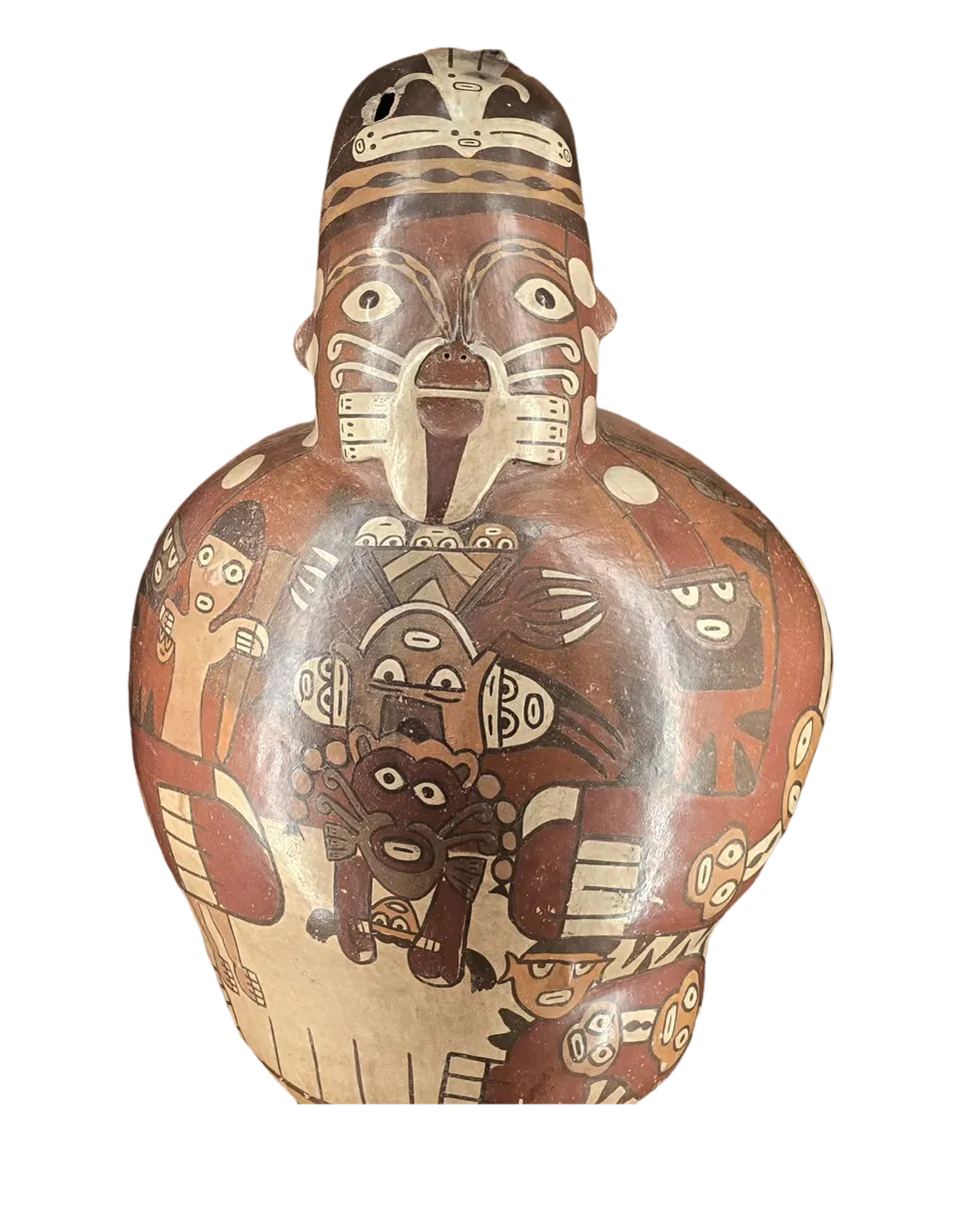
A piece in a museum or collection today is usually a vessel, a figure, an ornament or a textile that was made for a use. In the Andes, Palo Alto College's open art-history textbook notes, decorated pots held food and drink for the living or went into graves with the dead, and gold, silver and copper ornaments adorned rulers and other elites. The famous artifacts guide names fifteen of the best-known works.
What does pre-Columbian mean, and why do some scholars avoid the word?
Pre-Columbian means before Columbus: it refers to the period in the Americas before his arrival in 1492. The word names no people, place or style. Maya Jiménez, in Smarthistory's essay on the term, points out that it invokes a European explorer rather than any of the many cultures that flourished in the Americas, and that because Indigenous peoples flourished before and after Europeans arrived, the term is often seen as flawed.
Other terms are in use: pre-Hispanic, pre-Cortesian and ancient Americas. Many scholars write the word as one, precolumbian, to give Columbus less weight in it. None of these names means that Indigenous peoples or their arts ended in 1492; many traditions continued, and the glossary explains the other terms that come with the field.
What was the pre-Columbian era?
There is no single pre-Columbian period. The era begins with the first peoples of the Americas, whose arrival is still debated, and it ends at different dates in different places. In Britannica's account the Aztec capital fell to Hernán Cortés in 1521 and the Spaniards took over the Inca empire by 1533. The timeline gives the traditions in the order they began, and scholars draw its outlines differently.
Willey sees a pattern repeat in both main areas. In Mesoamerica the Olmec style of the Gulf coast spread widely from the time of the first large monuments, between about 1200 and 900 BCE. Separate regional kingdoms followed, among them the Maya, the Zapotec and Teotihuacan, until about 700 to 900 CE. The Toltecs of Tula held sway from about 900 to 1200, and the Aztec became the dominant force in central Mexico after 1428.
In the Andes he sees the Chavín style spread across the northern part of the area until about 500 BCE, regional kingdoms such as the Moche and the Nazca until about 600 CE, and the Tiwanaku and Wari horizon from about 600 to 1000. Regional states followed from 1000 to 1438, and the Inca from 1438.
The two areas rose and fell at similar times, Willey writes, yet there is little sign that political or religious ideas passed between them. Each followed its own course.
What are the regions of pre-Columbian art?
Scholars group the art into three large areas, Mesoamerica, the Andes and the Intermediate Area between them. Dumbarton Oaks names exactly these three for its collection of objects made over three thousand years. The map of the cultures places the traditions below.
- Mesoamerica. The part of Mexico and Central America that was urbanized before the Spanish arrived. The anthropologist Paul Kirchhoff coined the name in 1943, and Britannica's boundary takes in about half of Mexico, all of Guatemala and Belize, and parts of Honduras and El Salvador. Guides: Olmec, Maya, Teotihuacan, Zapotec, Toltec, Aztec, the tomb figures of West Mexico and the Colima dogs.
- The Andes. The mountains of western South America with the desert coast to their west and the forest to their east, a distinct cultural area from about the fourth millennium BCE to the Spanish conquest. Guides: Valdivia, Chavín, Paracas, Nazca with the Nazca Lines, Moche, Wari and Tiwanaku, Chimú and the Inca.
- The Intermediate Area. The lands between the two, in lower Central America and Colombia. Guides: Quimbaya and Colombian art and the pottery of Costa Rica and Panama.
- The Caribbean. The islands, where the Taíno lived when Columbus arrived. Guide: Taíno art.
What is pre-Columbian art made of?
Clay, stone, shell, metal, cloth, feathers, wood and bone, in different mixes in different places. Smarthistory describes Mesoamerican art as known for large stone sculpture and sharp obsidian tools and weapons, with featherwork and stonework in basalt, turquoise and jade. In the Andes, artists worked ceramic, stone, wood, bone, gourds, feathers and cloth, and gold, silver and copper adorned rulers and other elites.
What counted as precious differed from place to place. The Metropolitan Museum's account of its Golden Kingdoms exhibition says jade, rather than gold, was most esteemed by the Olmec and the Maya, while the Inca and the Aztec prized feathers and tapestry. It says goldworking was first practised in the Andes about 2000 BCE and over several thousand years moved north into Central America and Mexico, and that metals were made mainly into regalia and ritual objects and only secondarily into weapons and tools. Smarthistory adds that Mesoamericans did not develop metalworking until at least about 900 CE.
Each material has its own guide: jade, textiles, gold and tumbaga and Spondylus shell.
How is pre-Columbian art dated and told apart?
Most dates come from digging. Archaeologists tie what they find to layers in the ground and to samples that can be dated. Pottery styles help: when a vessel shape or surface treatment spreads quickly across many peoples it becomes what archaeologists call a horizon, a marker that links different cultures to the same time. Britannica lists examples for Mesoamerica's Early Formative period: zones of red pigment set off by incised lines, rocker stamping, a neckless globular jar called a tecomate, and Olmec excised pottery.
Olmec art shows why dating matters. Britannica says its artistry led some archaeologists to doubt how old it was, until radiocarbon dates from La Venta showed that Olmec civilization began at least a thousand years before the Maya. The Nazca Lines guide shows what a dating argument looks like when radiocarbon, pottery and luminescence results meet.
A single object in a collection is harder to place. A familiar motif does not prove age, and ancient styles have been copied. What counts is the object's own evidence and its recorded history: see how to tell whether pre-Columbian pottery is real and what provenance means.
How did collectors and museums come to treat it as art?
Dumbarton Oaks records that Robert Woods Bliss saw a jadeite Olmec figure in Paris in 1912, bought it in 1914 and went on collecting until his death in 1962, acquiring works from some thirty ancient American cultures. It says he was one of the first collectors to stress their artistic significance, equating them with Greek and Roman antiquities and European paintings at a time when such objects were generally placed in museums of natural history. He published a catalogue of his collection in 1957, arguably the first of its kind, and the gallery he planned opened in 1963.
Esther Pasztory's *Pre-Columbian Art* (1998) describes the very different traditions of Mesoamerica and the Andes. Its publisher says it also shows the effects of colonialism on the art and the power the art has had on Western art, in art theory and in the making of artworks.
Museums now look at the art on its own terms. The Metropolitan Museum and the Getty showed Golden Kingdoms in 2017 and 2018 to present, in the Met's words, a new understanding of ancient American art based on indigenous ideas of value. What the market and appraisers make of a piece today is in how much pre-Columbian pottery is worth and in appraisal.
Where can you see pre-Columbian art?
In museums on both sides of the Atlantic. The museum guide lists twenty with maps, and the guide to famous artifacts says where fifteen well-known works are kept. Dumbarton Oaks in Washington shows selected objects from the Bliss collection, which holds over seven hundred objects: stone sculpture, ceramics, architectural panels, small metal objects and textiles.
If you hold a piece and want to know what it is, what we buy says what we look at, and sending photographs takes a few minutes.
Further reading
- Pasztory, Esther. Pre-Columbian Art. Cambridge University Press, 1998.
- Potts, Timothy, Joanne Pillsbury, and Kim N. Richter, eds. Golden Kingdoms: Luxury Arts in the Ancient Americas. J. Paul Getty Museum and Getty Research Institute, 2017.
- Kubler, George. The Art and Architecture of Ancient America: The Mexican, Maya and Andean Peoples. Penguin Books, 1962.
- Coe, Michael D. Mexico: From the Olmecs to the Aztecs. Thames and Hudson, 1994.
- Bruhns, Karen Olsen. Ancient South America. Cambridge University Press, 1994.
Cite this guide: Precolumbian.com, “What is pre-Columbian art? Its meaning, regions, materials and history”, 2026, https://precolumbian.com/guides/what-is-pre-columbian-art.html
Common questions
What is pre-Columbian art?
Art made by the Indigenous peoples of the Americas before Columbus arrived in 1492 and before the Spanish conquests. It covers many peoples and thousands of years in Mexico and Central America, the Andes and the lands between, in stone, clay, jade, shell, metal, cloth and feathers.
What does pre-Columbian mean?
Before Columbus: the period in the Americas before his arrival in 1492. The word names a European explorer rather than any of the cultures, so scholars often see it as flawed and use pre-Hispanic, pre-Cortesian or ancient Americas instead.
What is the pre-Columbian era?
The time before Columbus, which has no single start or end. Settled village life began at different times in different places, and the era ended as Spanish forces took the last Indigenous states: in Britannica's account the Aztec capital in 1521 and the Inca empire by 1533.
Which cultures made pre-Columbian art?
Many. In Mesoamerica the Olmec, Maya, Teotihuacan, Zapotec, Toltec and Aztec; in the Andes Valdivia, Chavín, Paracas, Nazca, Moche, Wari, Tiwanaku, Chimú and the Inca; between them the peoples of Colombia, Costa Rica and Panama; and the Taíno of the Caribbean.
Did pre-Columbian art end when Columbus arrived?
No. 1492 is a marker for the arrival of Europeans, not an end. Indigenous peoples flourished before and after it, and many traditions continued, which is one reason scholars question the term. It describes work made before contact, not the end of Indigenous art.
Why are so many surviving pieces pottery and stone?
They last. Joanne Pillsbury of the Metropolitan Museum has said ideas about the art were long based on ceramic and stone, durable materials, while countless works of gold and silver were melted down, delicate manuscripts were burned and time has taken a heavy toll on feathers and textiles.
Where can I see pre-Columbian art?
In museums such as the National Museum of Anthropology in Mexico City, the Larco Museum in Lima and Dumbarton Oaks in Washington. The museum guide lists twenty with maps, and the famous artifacts guide says where fifteen well-known works are kept.
Keep reading
Pre-Columbian art timeline: cultures, dates and regions
An approximate chronology that keeps overlapping cultures and different regional period names distinct.
Pre-Columbian art glossary: reading an object description
Plain definitions of the forms, techniques, periods and qualifications found in object descriptions.
Map of pre-Columbian civilizations: where the cultures lived
Three maps of the Americas: where the Olmec, Maya, Aztec, Nazca, Moche, Inca and others lived, and when.
Pre-Columbian art museum guide: where to see the great collections
Museums in Mexico, Peru, Colombia, Costa Rica, the United States and Europe, what each holds, and three maps.
What is provenance in art? How to trace a piece's history
What an object's documented history can tell you, and how to follow the evidence.
Have something to sell?
Send us photographs and whatever you know. You hear back within two working days.
Or write straight to info@precolumbian.com